

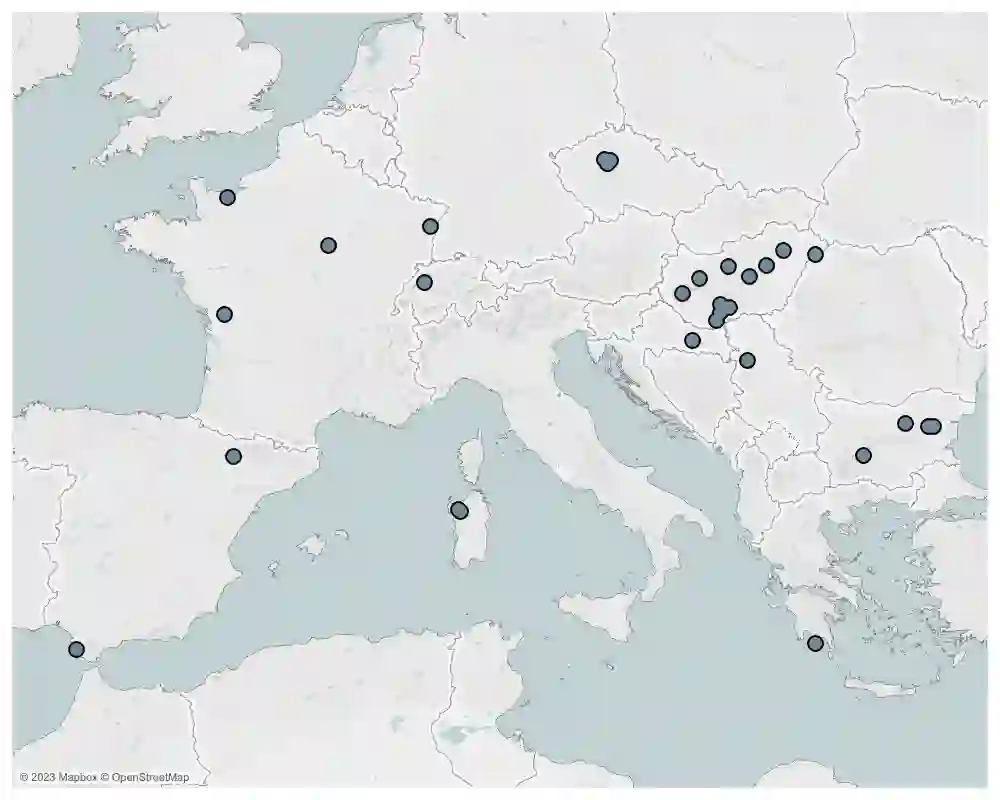
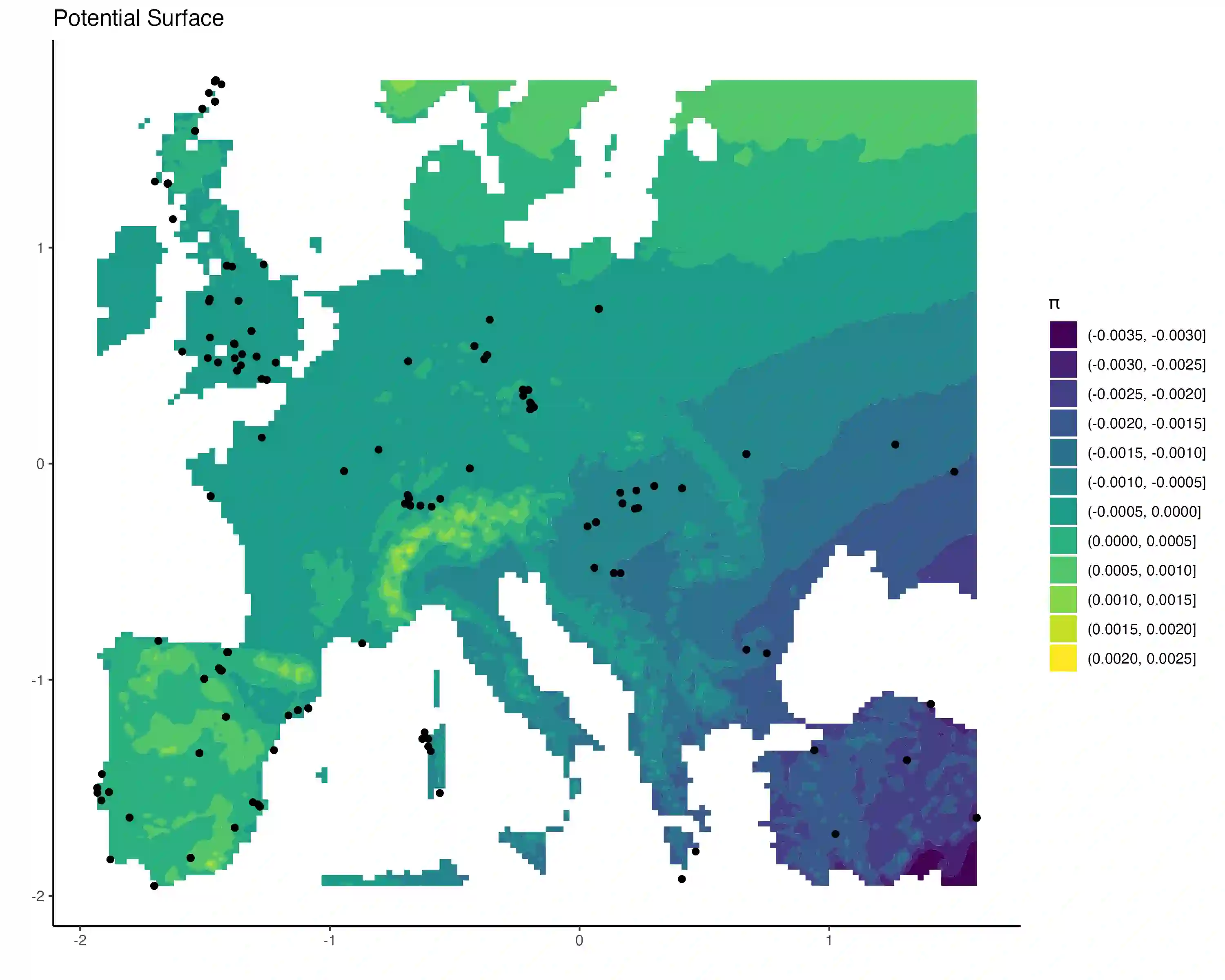
Mechanistic statistical models are commonly used to study the flow of biological processes. For example, in landscape genetics, the aim is to infer mechanisms that govern gene flow in populations. Existing statistical approaches in landscape genetics do not account for temporal dependence in the data and may be computationally prohibitive. We infer mechanisms with a Bayesian hierarchical dyadic model that scales well with large data sets and that accounts for spatial and temporal dependence. We construct a fully-connected network comprising spatio-temporal data for the dyadic model and use normalized composite likelihoods to account for the dependence structure in space and time. Our motivation for developing a dyadic model was to account for physical mechanisms commonly found in physical-statistical models. However, a numerical solver is not required in our approach because we model first-order changes directly. We apply our methods to ancient human DNA data to infer the mechanisms that affected human movement in Bronze Age Europe.
翻译:机制统计模型通常用于研究生物过程的流动。例如,在景观遗传学中,目的是推断控制种群中基因流动的机制。现有的景观遗传学统计方法未考虑数据中的时间依赖性,且可能计算成本高昂。我们通过一个贝叶斯分层二元模型来推断机制,该模型能良好地适应大型数据集,并考虑了空间和时间依赖性。我们构建了一个包含时空数据的全连接网络用于二元模型,并使用归一化复合似然来考虑空间和时间中的依赖结构。我们开发二元模型的动机是为了考虑物理统计模型中常见的物理机制。然而,我们的方法不需要数值求解器,因为我们直接对一阶变化进行建模。我们将该方法应用于古代人类DNA数据,以推断影响青铜时代欧洲人类迁徙的机制。




相关内容





 微信扫码咨询专知VIP会员