

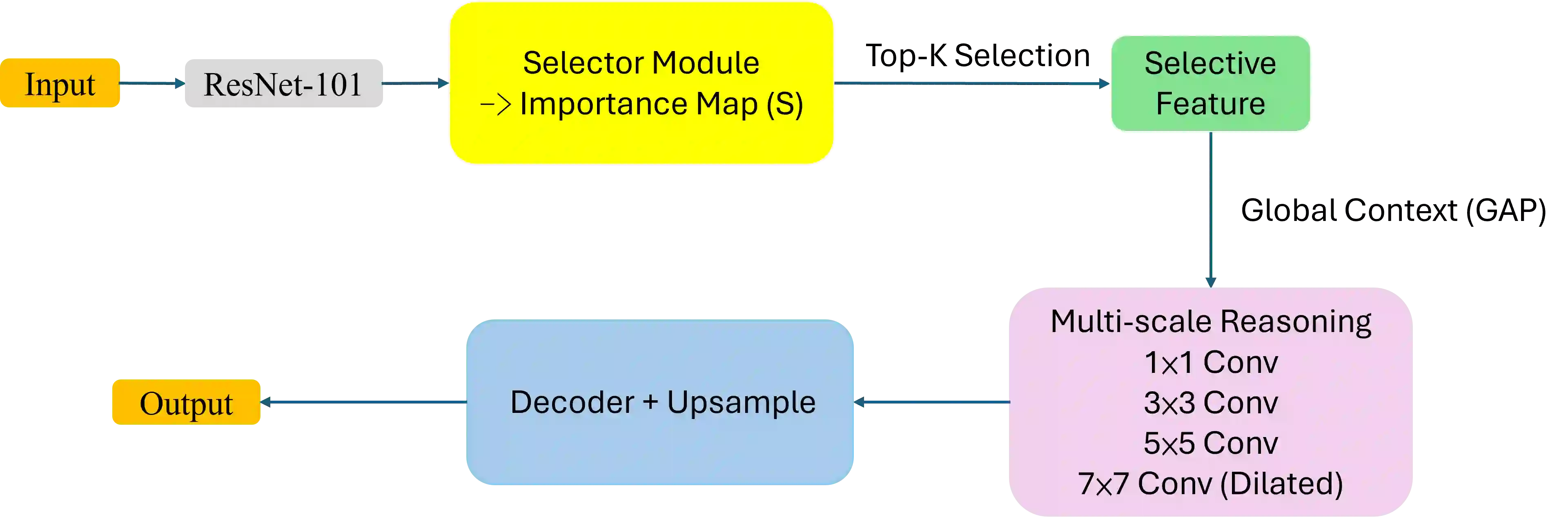
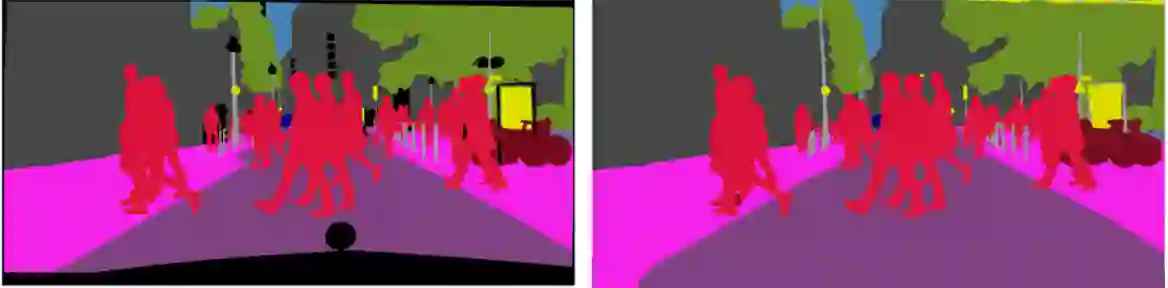
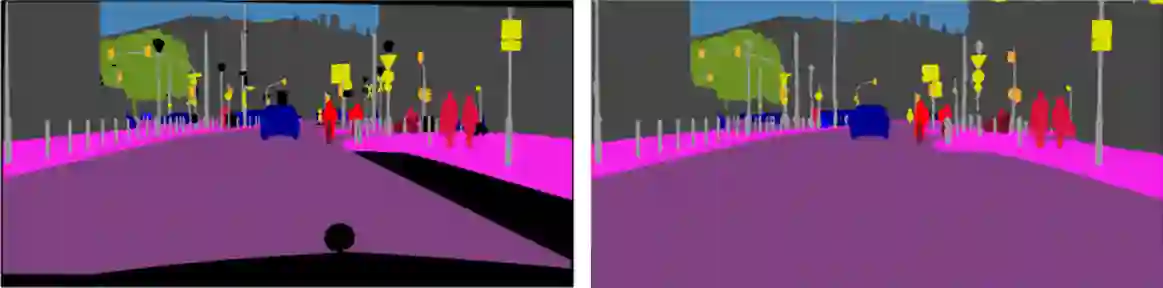
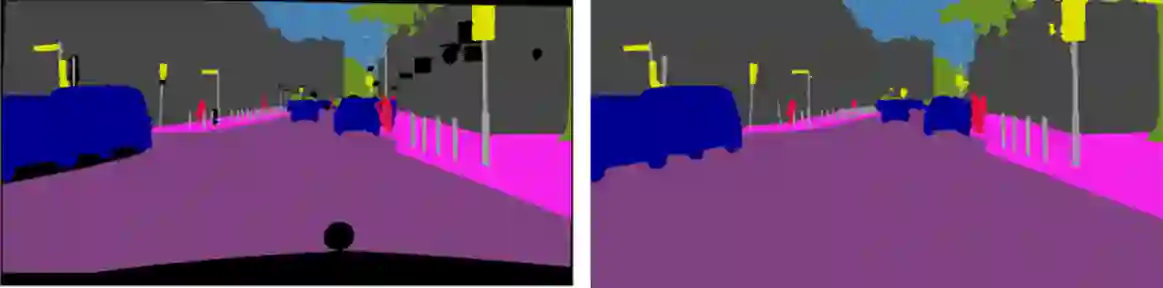
We present FoR-Net, a lightweight architecture for semantic segmentation that focuses on identifying and enhancing hard regions. Instead of relying on heavy global modeling, FoR-Net adopts an efficient strategy that selectively emphasizes informative regions through a learned importance map and a Top-K activation mechanism. Specifically, a selector module predicts region-wise importance, enabling the model to focus on challenging areas such as thin structures and object boundaries. Multi-scale reasoning is achieved using convolutional branches with different receptive fields, allowing diverse spatial context aggregation. We evaluate FoR-Net on the Cityscapes benchmark under limited computational resources. Despite its lightweight design and standard training configuration, FoR-Net achieves competitive performance and demonstrates improved consistency in challenging regions. These results suggest that region-focused reasoning provides a simple yet effective inductive bias for efficient semantic segmentation.
翻译:我们提出FoR-Net,一种轻量级语义分割架构,通过识别并增强困难区域来提升性能。不同于依赖繁重的全局建模,FoR-Net采用高效策略,通过学习的显著图与Top-K激活机制选择性强调信息区域。具体而言,选择器模块预测区域重要性,使模型聚焦于薄结构、物体边界等挑战性区域。通过具有不同感受野的卷积分支实现多尺度推理,可聚合多样化的空间上下文信息。我们在有限计算资源条件下于Cityscapes基准上评估FoR-Net。尽管采用轻量级设计与标准训练配置,FoR-Net仍取得具有竞争力的性能,并在困难区域展现出更优的一致性。这些结果表明,区域聚焦推理为高效语义分割提供了简单而有效的归纳偏置。





相关内容
 微信扫码咨询专知VIP会员