

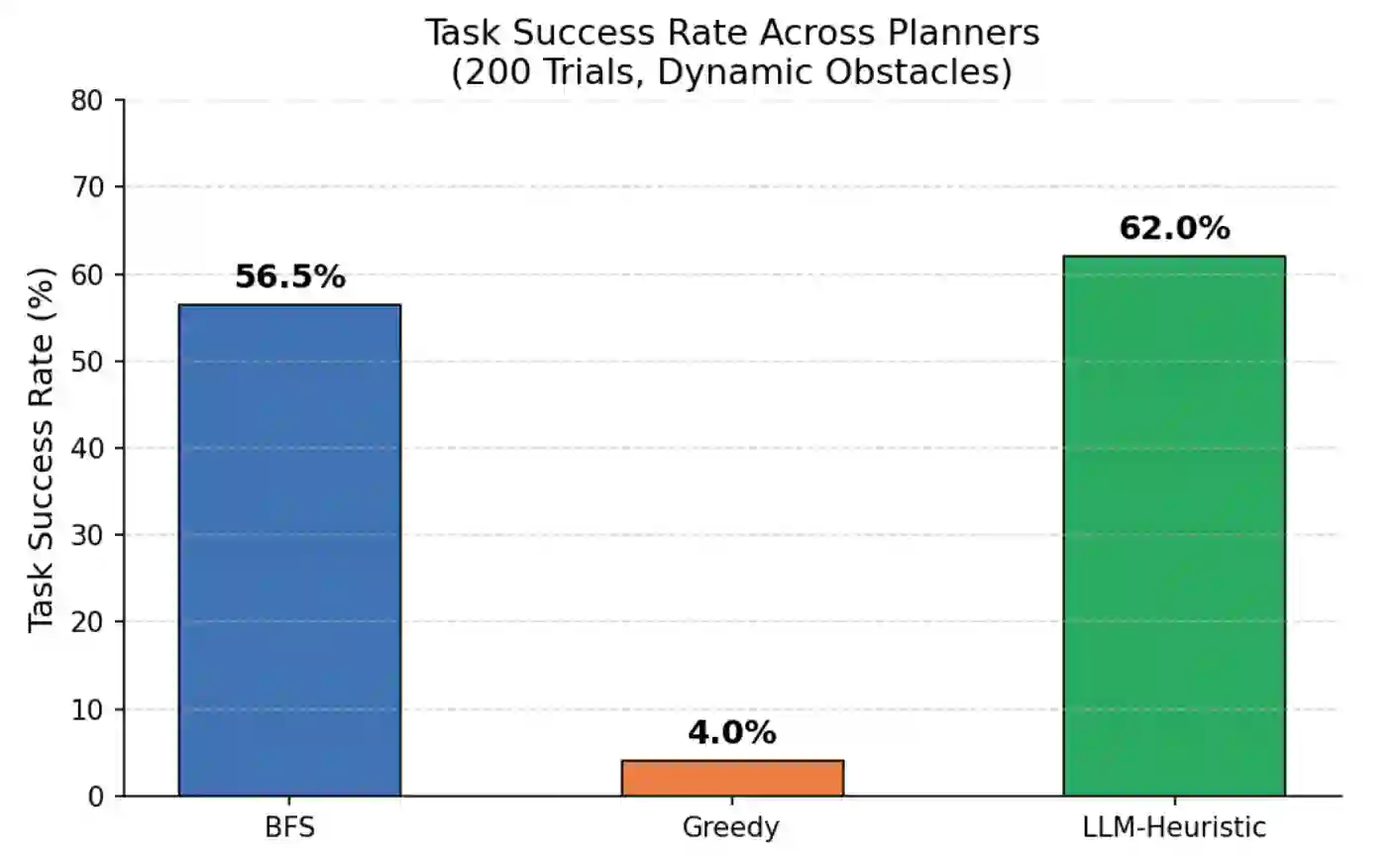
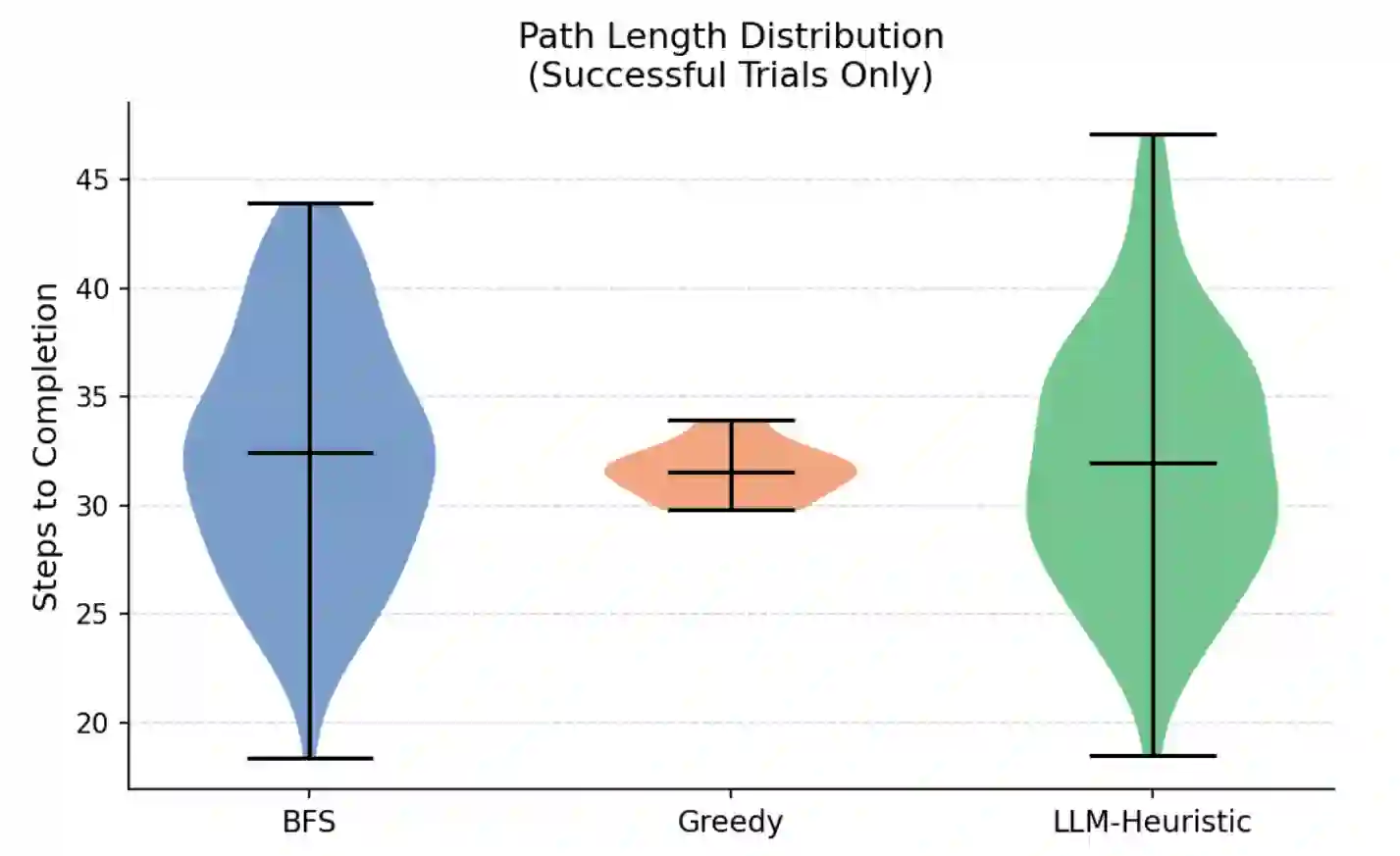
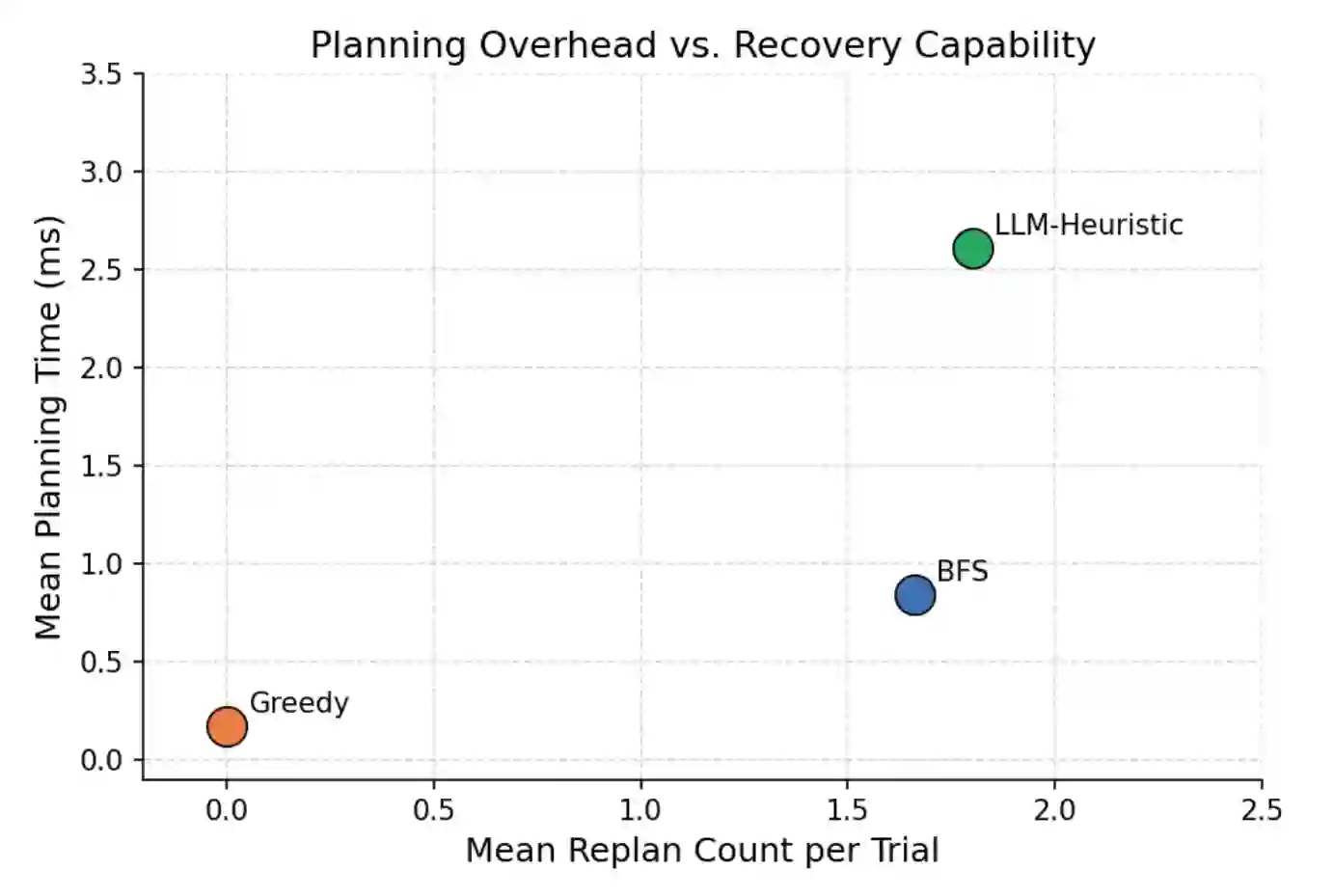
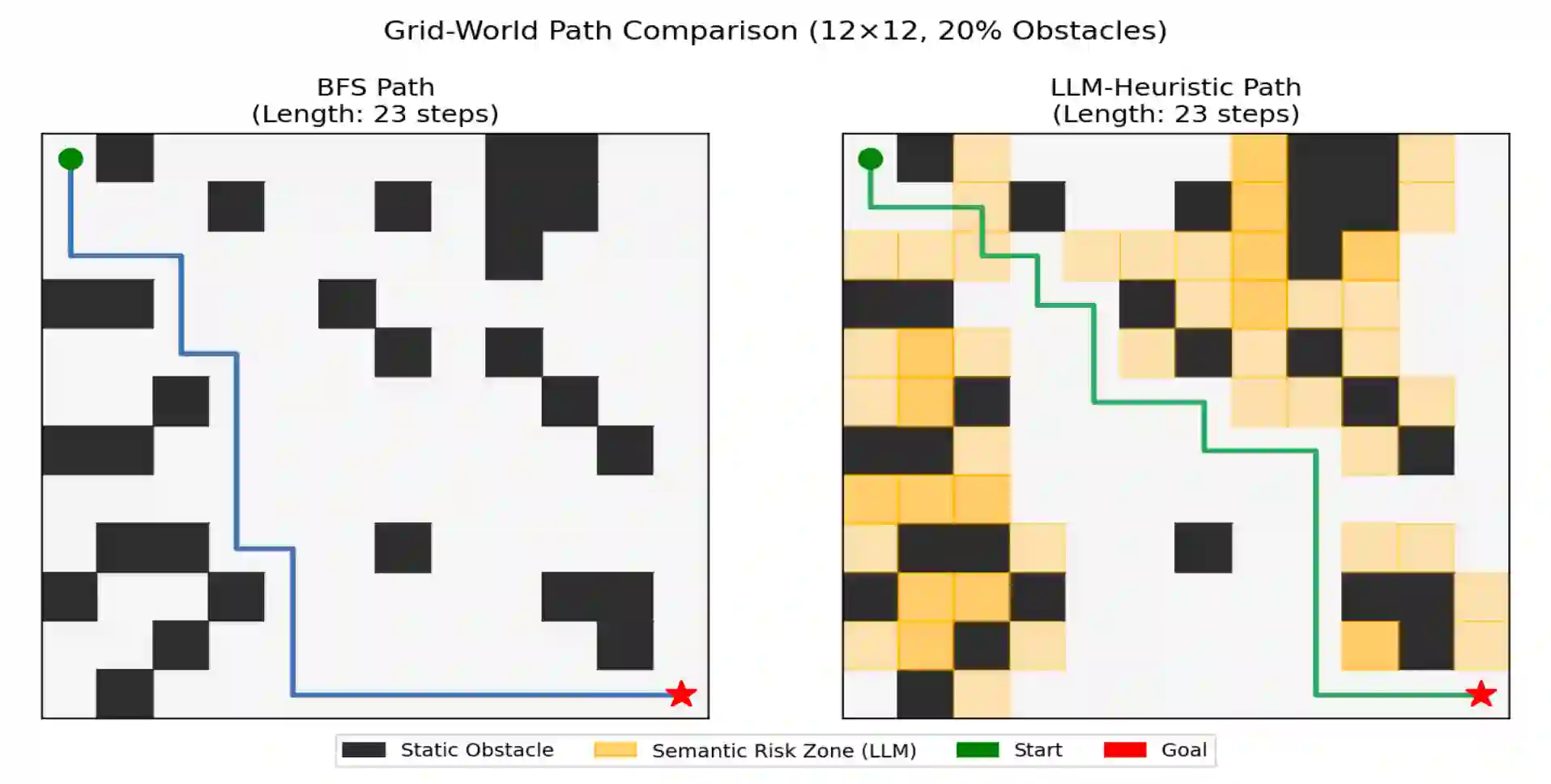
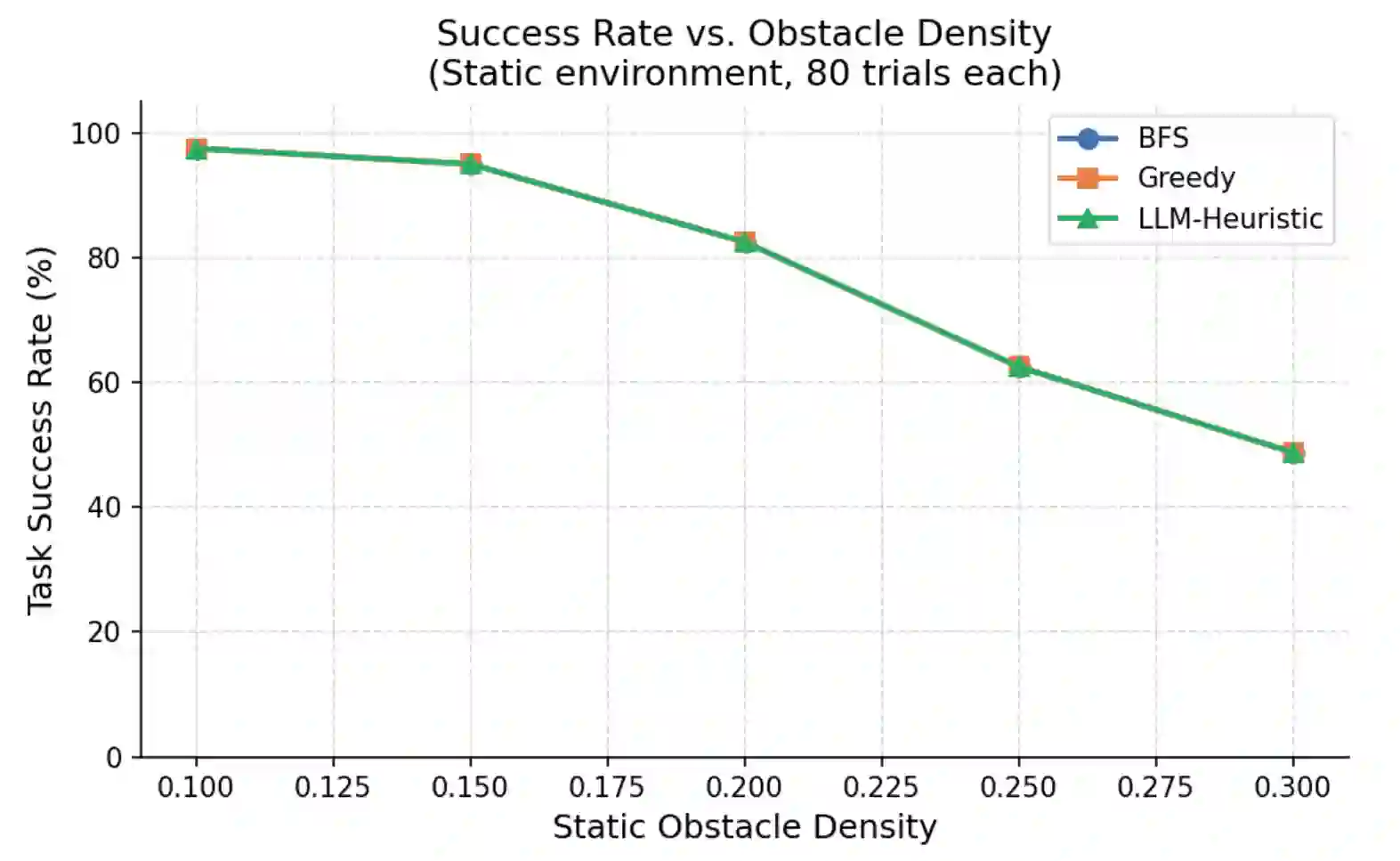
The integration of Large Language Model (LLM) reasoning principles into classical robot path planning represents a rapidly emerging research direction. In this paper, we propose a Semantic Risk-Aware Heuristic (SRAH) planner that encodes LLM-inspired cost functions penalising geometrically cluttered or high-risk zones into an A$^*$ search framework, augmented with closed-loop replanning upon dynamic obstacle detection. We evaluate SRAH against two established baselines Breadth-First Search (BFS) with replanning and a Greedy heuristic without replanning across 200 randomised trials in a $15{\times}15$ grid-world with 20\% static obstacle density and stochastic dynamic obstacles. SRAH achieves a task success rate of 62.0\%, outperforming BFS (56.5\%) by 9.7\% relative improvement and Greedy (4.0\%) by a large margin. We further analyse the trade-off between planning overhead, path efficiency, and failure-recovery count, and demonstrate via an obstacle-density ablation that semantic cost shaping consistently improves navigation across environments of varying difficulty. Our results suggest that even lightweight, LLM-inspired heuristics provide measurable safety and robustness gains for autonomous robot navigation.
翻译:将大语言模型的推理原理融入经典机器人路径规划是一个快速发展的新兴研究方向。本文提出了一种语义风险感知启发式规划器,它将受大语言模型启发的代价函数——惩罚几何拥挤或高风险区域——编码到A$^*$搜索框架中,并辅以动态障碍物检测时的闭环重规划。我们在一个$15{\times}15$网格世界(包含20%静态障碍物密度和随机动态障碍物)中,通过200次随机试验,将SRAH与两种基线方法——带重规划的广度优先搜索和无重规划的贪心启发式方法——进行了对比。SRAH的任务成功率达到62.0%,相比BFS(56.5%)取得了9.7%的相对提升,并以极大优势超过贪心方法(4.0%)。我们进一步分析了规划开销、路径效率与故障恢复次数之间的权衡,并通过障碍物密度消融实验证明,语义代价塑造能够在不同难度的环境中持续改善导航性能。我们的结果表明,即使是轻量级的受大语言模型启发的启发式方法,也能为自主机器人导航带来可测量的安全性和鲁棒性增益。




相关内容
 微信扫码咨询专知VIP会员