

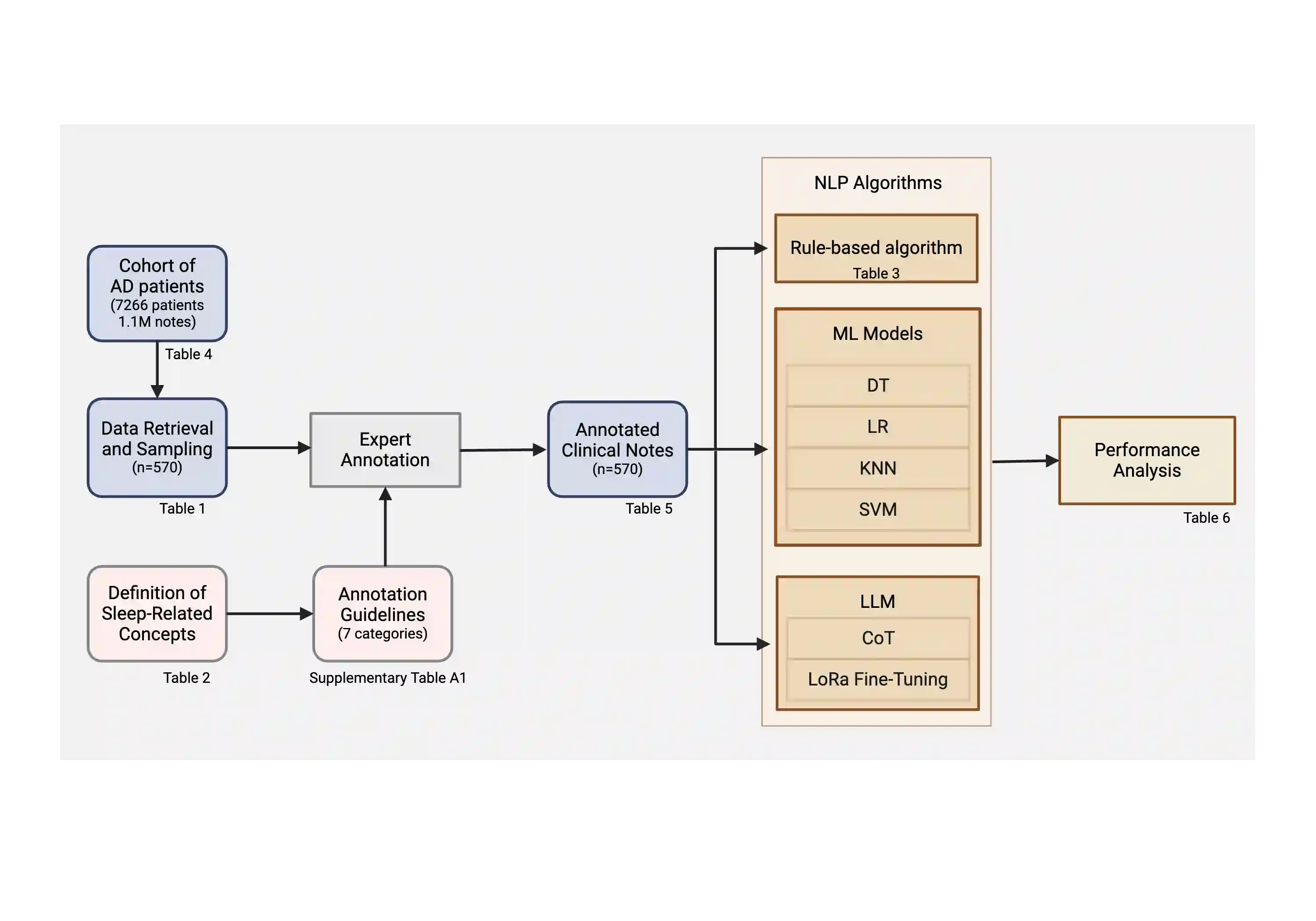
Alzheimer's Disease (AD) is the most common form of dementia in the United States. Sleep is one of the lifestyle-related factors that has been shown critical for optimal cognitive function in old age. However, there is a lack of research studying the association between sleep and AD incidence. A major bottleneck for conducting such research is that the traditional way to acquire sleep information is time-consuming, inefficient, non-scalable, and limited to patients' subjective experience. A gold standard dataset is created from manual annotation of 570 randomly sampled clinical note documents from the adSLEEP, a corpus of 192,000 de-identified clinical notes of 7,266 AD patients retrieved from the University of Pittsburgh Medical Center (UPMC). We developed a rule-based Natural Language Processing (NLP) algorithm, machine learning models, and Large Language Model(LLM)-based NLP algorithms to automate the extraction of sleep-related concepts, including snoring, napping, sleep problem, bad sleep quality, daytime sleepiness, night wakings, and sleep duration, from the gold standard dataset. Rule-based NLP algorithm achieved the best performance of F1 across all sleep-related concepts. In terms of Positive Predictive Value (PPV), rule-based NLP algorithm achieved 1.00 for daytime sleepiness and sleep duration, machine learning models: 0.95 and for napping, 0.86 for bad sleep quality and 0.90 for snoring; and LLAMA2 with finetuning achieved PPV of 0.93 for Night Wakings, 0.89 for sleep problem, and 1.00 for sleep duration. The results show that the rule-based NLP algorithm consistently achieved the best performance for all sleep concepts. This study focused on the clinical notes of patients with AD, but could be extended to general sleep information extraction for other diseases.
翻译:阿尔茨海默病(AD)是美国最常见的痴呆症类型。睡眠已被证明是维持老年认知功能的关键生活方式相关因素之一。然而,目前缺乏关于睡眠与AD发病率之间关联的研究。开展此类研究的主要瓶颈在于,传统的睡眠信息获取方式耗时、低效、难以扩展,且仅局限于患者的主观体验。本研究基于adSLEEP语料库(包含从匹兹堡大学医学中心(UPMC)检索的7,266名AD患者的192,000份去标识化临床记录),通过人工标注570份随机抽样的临床记录文档,创建了一个金标准数据集。我们开发了基于规则的自然语言处理(NLP)算法、机器学习模型以及基于大型语言模型(LLM)的NLP算法,以自动从金标准数据集中提取睡眠相关概念,包括打鼾、小睡、睡眠问题、睡眠质量差、日间嗜睡、夜间觉醒和睡眠时长。在所有睡眠相关概念中,基于规则的NLP算法在F1值上表现最佳。在阳性预测值(PPV)方面,基于规则的NLP算法在日间嗜睡和睡眠时长上达到1.00;机器学习模型在小睡上达到0.95,在睡眠质量差上达到0.86,在打鼾上达到0.90;经过微调的LLAMA2模型在夜间觉醒上达到0.93,在睡眠问题上达到0.89,在睡眠时长上达到1.00。结果表明,基于规则的NLP算法在所有睡眠概念上均持续取得最佳性能。本研究聚焦于AD患者的临床记录,但可推广至其他疾病的通用睡眠信息提取。




相关内容





 微信扫码咨询专知VIP会员