

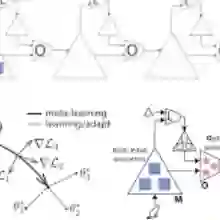
The advances in deep learning have enabled machine learning methods to outperform human beings in various areas, but it remains a great challenge for a well-trained model to quickly adapt to a new task. One promising solution to realize this goal is through meta-learning, also known as learning to learn, which has achieved promising results in few-shot learning. However, current approaches are still enormously different from human beings' learning process, especially in the ability to extract structural and transferable knowledge. This drawback makes current meta-learning frameworks non-interpretable and hard to extend to more complex tasks. We tackle this problem by introducing concept discovery to the few-shot learning problem, where we achieve more effective adaptation by meta-learning the structure among the data features, leading to a composite representation of the data. Our proposed method Concept-Based Model-Agnostic Meta-Learning (COMAML) has been shown to achieve consistent improvements in the structured data for both synthesized datasets and real-world datasets.
翻译:深度学习的进步使得机器学习方法在多个领域超越了人类表现,但训练良好的模型能否快速适应新任务仍是一大挑战。实现该目标的一种有效途径是元学习(即学会学习),该方法已在少样本学习中取得显著成果。然而,现有方法仍与人类学习过程存在巨大差异,尤其是在提取结构化与可迁移知识的能力方面。这一缺陷使当前元学习框架缺乏可解释性,且难以拓展至更复杂的任务。针对该问题,我们将概念发现引入少样本学习场景:通过元学习数据特征间的结构关系,实现数据复合表征的构建,从而达成更高效的适应。我们提出的基于概念与模型无关的元学习方法(COMAML)在合成数据集与真实数据集的结构化数据上均展现出持续的改进效果。




相关内容


 微信扫码咨询专知VIP会员