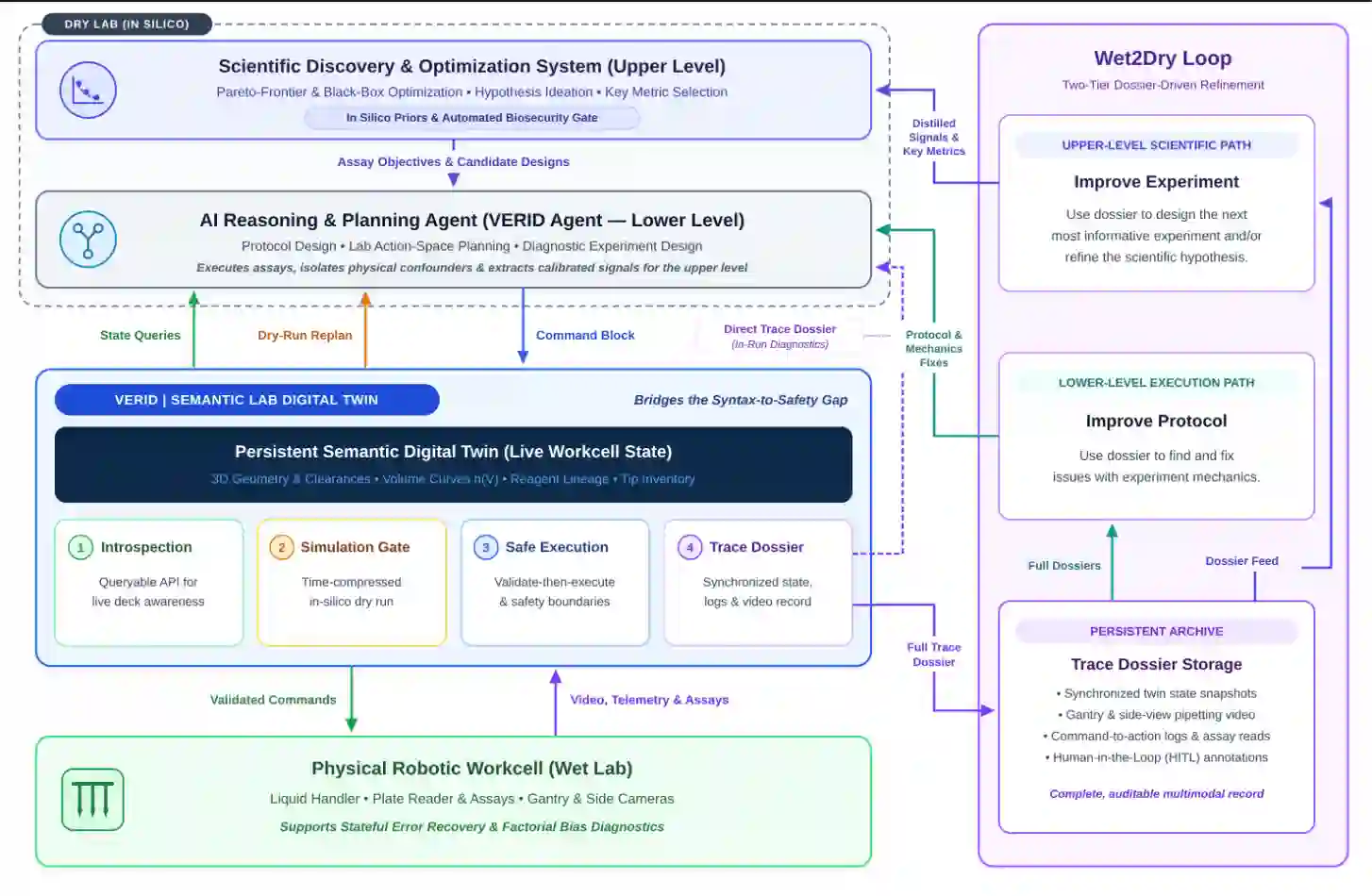
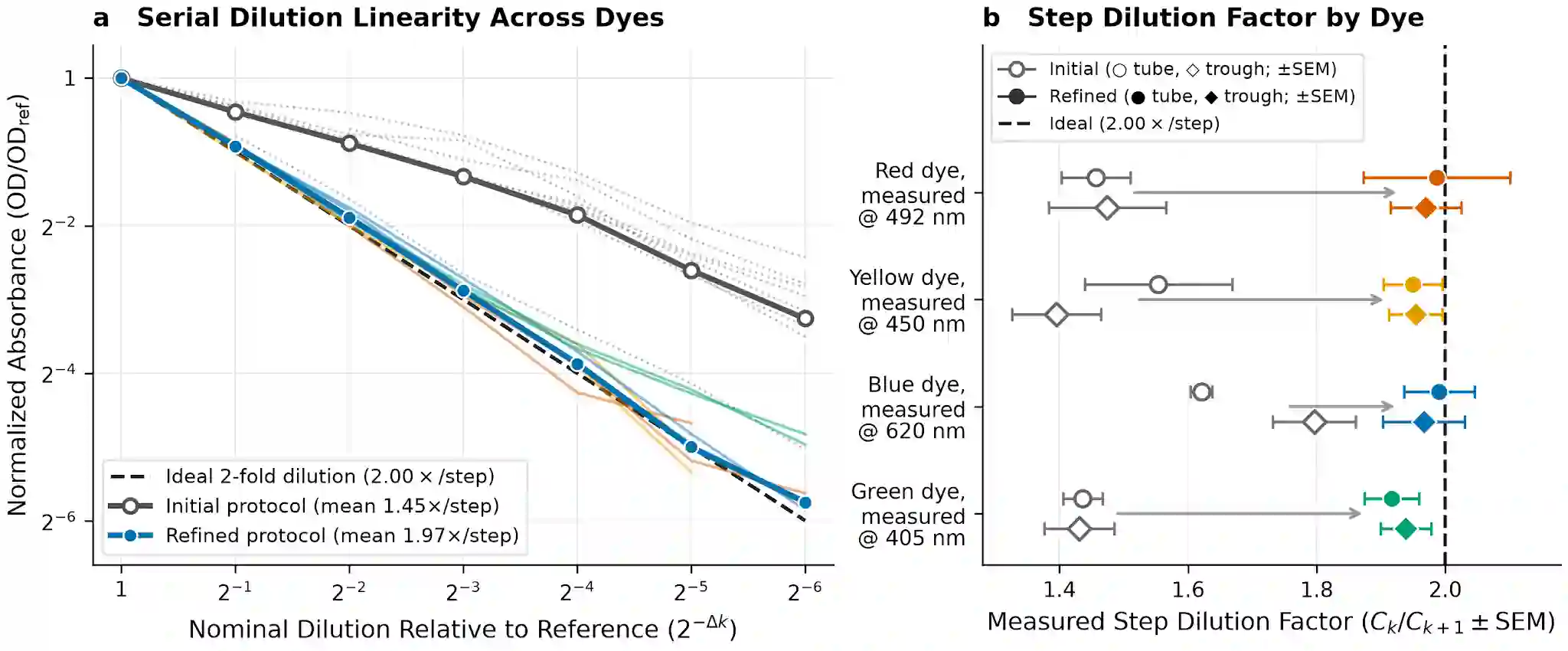
Navigating complex, high-dimensional biological search spaces necessitates scalable physical and computational intelligence to explore beyond local optima through iterative self-play across ideation, experimentation, and automation. Translating experimental designs into reliable physical execution remains bottlenecked by static laboratory automation and unmodeled physical variability. To address this, we introduce VERified Infrastructure for Discovery Laboratories, or VERID, a foundational infrastructure designed to bridge the gap between the high-level reasoning of artificial intelligence (AI) agents and complex, error-prone physical realities of wet labs. VERID is a persistent, high-fidelity semantic digital twin of the laboratory workcell that provides four core services: queryable introspection for agentic reasoning, time-compressed simulation for protocol validation, comprehensive trace persistence for a complete scientific record, and a framework for safe execution. We present three case studies using aqueous dye and deionized water mixtures to validate the optical and fluidic foundations of VERID. These studies demonstrate how VERID enables pre-emptive detection of critical errors in experimental protocols, stateful mid-run error recovery and post-hoc identification of subtle physical failures. The simulation functions as a discrete accounting engine, allowing agents to safely and inexpensively explore experimental designs in silico and refine experimental strategies through iterative self-play. VERID also captures structured multimodal experimental data for downstream analysis, knowledge mining and agent training. We argue that this semantic layer is an essential prerequisite for deploying autonomous agents in the biochemical and biomedical sciences, ensuring data integrity, operational safety, and paving the way for tackling previously intractable grand challenges in biology.


翻译:暂无翻译

0
下载
关闭预览

相关内容

综述 | Deep Academic Survey:有状态闭环综述自动化
专知会员服务
13+阅读 · 8月19日
AgentRxiv:迈向协作式自主科学研究
专知会员服务
11+阅读 · 2月20日
Nature 子刊 | SciToolAgent:知识图谱引导的科学工具智能体
专知会员服务
22+阅读 · 2025年11月1日
Nature速递:基于大语言模型的自动化学研究
专知会员服务
35+阅读 · 2024年1月5日
[ICML2022] NeuroFluid: 流体仿真的人工智能新范式
专知会员服务
28+阅读 · 2022年6月8日
深度解读:小米AI实验室AutoML团队最新成果FairNAS
PaperWeekly
32+阅读 · 2019年7月11日
Hierarchically Structured Meta-learning
CreateAMind
27+阅读 · 2019年5月22日
Transferring Knowledge across Learning Processes
CreateAMind
29+阅读 · 2019年5月18日
Unsupervised Learning via Meta-Learning
CreateAMind
44+阅读 · 2019年1月3日
A Technical Overview of AI & ML in 2018 & Trends for 2019
待字闺中
18+阅读 · 2018年12月24日
论文浅尝 | Question Answering over Freebase
开放知识图谱
19+阅读 · 2018年1月9日
NLP中自动生产文摘(auto text summarization)
机器学习研究会
14+阅读 · 2017年10月10日
国家自然科学基金
3+阅读 · 2017年12月31日
国家自然科学基金
52+阅读 · 2015年12月31日
国家自然科学基金
3+阅读 · 2015年12月31日
国家自然科学基金
2+阅读 · 2015年12月31日
国家自然科学基金
1+阅读 · 2015年12月31日
国家自然科学基金
0+阅读 · 2015年12月31日
国家自然科学基金
0+阅读 · 2014年12月31日
国家自然科学基金
19+阅读 · 2012年12月31日
国家自然科学基金
18+阅读 · 2009年12月31日
国家自然科学基金
19+阅读 · 2008年12月31日
VIP会员
最新内容
《美空军2026条令文件:对海压制作战》
专知会员服务
18+阅读 · 11月9日
人工智能与战争的未来
专知会员服务
7+阅读 · 11月8日
《Agent Mosaic:识别智能体LLM系统中的机密泄露》
人工智能在军事教育中的应用:若干视角与经验
专知会员服务
10+阅读 · 11月6日
“星链”减速与不断适应的乌克兰
专知会员服务
8+阅读 · 11月6日
美国中期选举之后:帕兰提尔面临不确定性?
专知会员服务
5+阅读 · 11月6日
相关资讯
深度解读:小米AI实验室AutoML团队最新成果FairNAS
PaperWeekly
32+阅读 · 2019年7月11日
Hierarchically Structured Meta-learning
CreateAMind
27+阅读 · 2019年5月22日
Transferring Knowledge across Learning Processes
CreateAMind
29+阅读 · 2019年5月18日
Unsupervised Learning via Meta-Learning
CreateAMind
44+阅读 · 2019年1月3日
A Technical Overview of AI & ML in 2018 & Trends for 2019
待字闺中
18+阅读 · 2018年12月24日
论文浅尝 | Question Answering over Freebase
开放知识图谱
19+阅读 · 2018年1月9日
NLP中自动生产文摘(auto text summarization)
机器学习研究会
14+阅读 · 2017年10月10日
相关基金
国家自然科学基金
3+阅读 · 2017年12月31日
国家自然科学基金
52+阅读 · 2015年12月31日
国家自然科学基金
3+阅读 · 2015年12月31日
国家自然科学基金
2+阅读 · 2015年12月31日
国家自然科学基金
1+阅读 · 2015年12月31日
国家自然科学基金
0+阅读 · 2015年12月31日
国家自然科学基金
0+阅读 · 2014年12月31日
国家自然科学基金
19+阅读 · 2012年12月31日
国家自然科学基金
18+阅读 · 2009年12月31日
国家自然科学基金
19+阅读 · 2008年12月31日
Top
微信扫码咨询专知VIP会员