

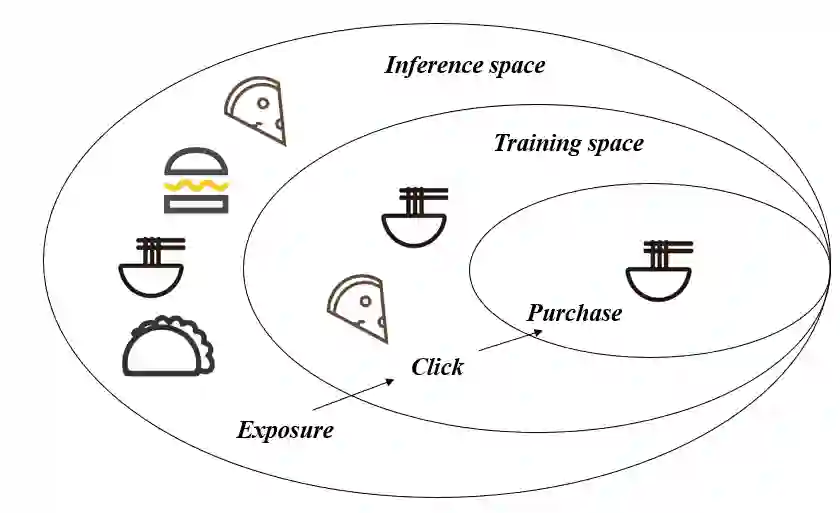
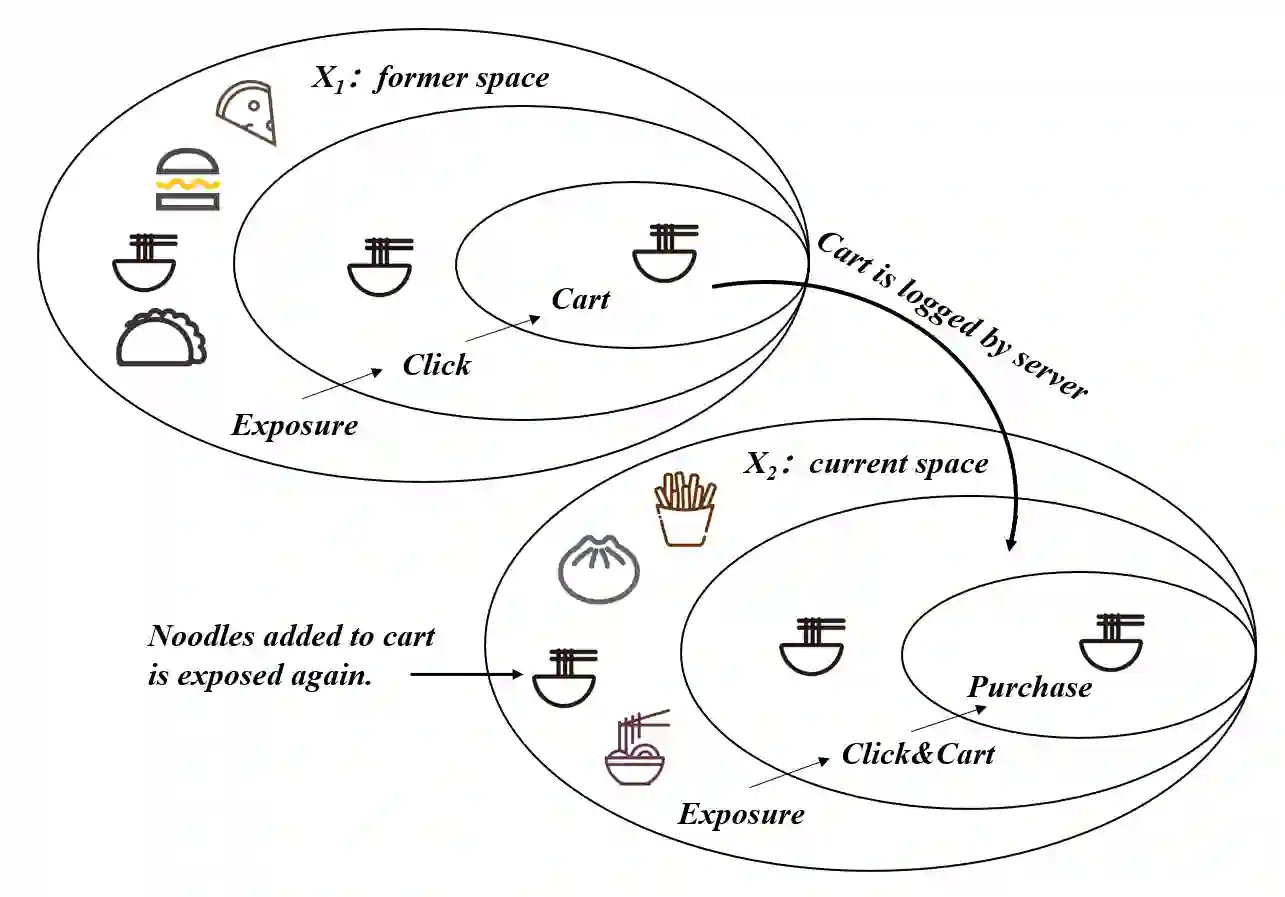
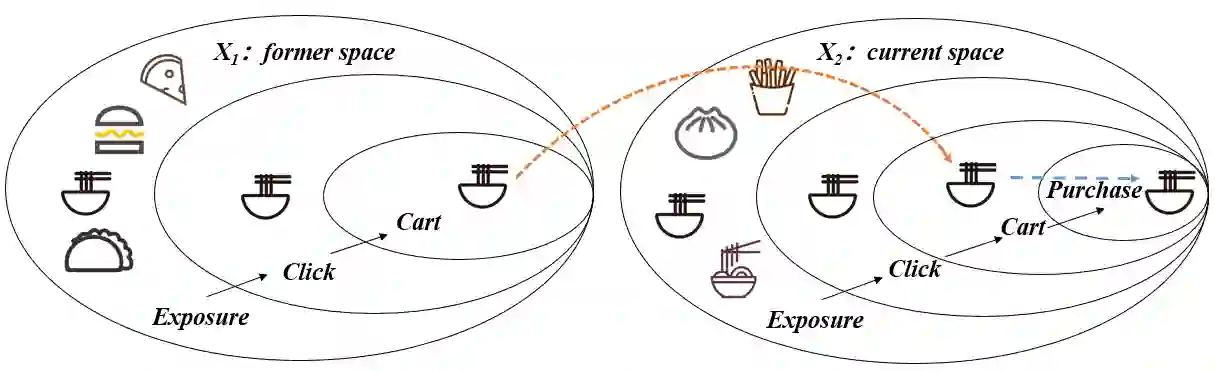
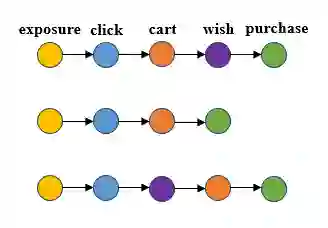
Large-scale online recommender system spreads all over the Internet being in charge of two basic tasks: Click-Through Rate (CTR) and Post-Click Conversion Rate (CVR) estimations. However, traditional CVR estimators suffer from well-known Sample Selection Bias and Data Sparsity issues. Entire space models were proposed to address the two issues via tracing the decision-making path of "exposure_click_purchase". Further, some researchers observed that there are purchase-related behaviors between click and purchase, which can better draw the user's decision-making intention and improve the recommendation performance. Thus, the decision-making path has been extended to "exposure_click_in-shop action_purchase" and can be modeled with conditional probability approach. Nevertheless, we observe that the chain rule of conditional probability does not always hold. We report Probability Space Confusion (PSC) issue and give a derivation of difference between ground-truth and estimation mathematically. We propose a novel Entire Space Multi-Task Model for Post-Click Conversion Rate via Parameter Constraint (ESMC) and two alternatives: Entire Space Multi-Task Model with Siamese Network (ESMS) and Entire Space Multi-Task Model in Global Domain (ESMG) to address the PSC issue. Specifically, we handle "exposure_click_in-shop action" and "in-shop action_purchase" separately in the light of characteristics of in-shop action. The first path is still treated with conditional probability while the second one is treated with parameter constraint strategy. Experiments on both offline and online environments in a large-scale recommendation system illustrate the superiority of our proposed methods over state-of-the-art models. The real-world datasets will be released.
翻译:大型在线推荐系统遍布互联网,负责两大基础任务:点击率(CTR)和后点击转化率(CVR)预估。然而,传统CVR预估器存在众所周知的样本选择偏差和数据稀疏性问题。全空间模型通过追踪"曝光→点击→购买"决策路径,旨在解决这两个问题。进一步地,部分研究者发现点击与购买之间存在与购买相关的行为,这些行为能更好地刻画用户决策意图并提升推荐性能。因此,决策路径被扩展为"曝光→点击→店内行为→购买",并可采用条件概率方法建模。然而,我们观察到条件概率的链式法则并非始终成立。本文提出概率空间混淆(PSC)问题,并从数学上推导了真实值与估计值之间的差异。为此,我们提出一种新的基于参数约束的全空间多任务后点击转化率模型(ESMC),以及两种替代方案:基于孪生网络的全空间多任务模型(ESMS)和全局域全空间多任务模型(ESMG),以解决PSC问题。具体而言,我们根据店内行为的特性,分别处理"曝光→点击→店内行为"和"店内行为→购买"两个路径:前者仍采用条件概率方法,后者则采用参数约束策略。在大型推荐系统的离线与在线环境下的实验结果表明,所提方法优于当前最优模型。相关真实数据集将公开发布。




相关内容




 微信扫码咨询专知VIP会员