

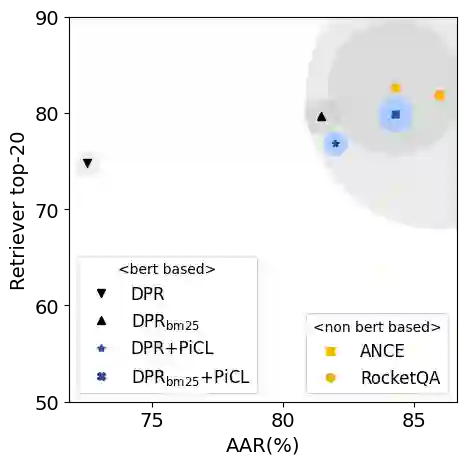
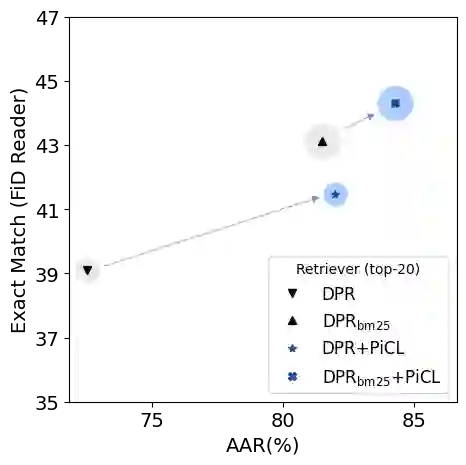
The retriever-reader framework is popular for open-domain question answering (ODQA), where a retriever samples for the reader a set of relevant candidate passages from a large corpus. A key assumption behind this method is that high relevance scores from the retriever likely indicate high answerability from the reader, which implies a high probability that the retrieved passages contain answers to a given question. In this work, we empirically dispel this belief and observe that recent dense retrieval models based on DPR often rank unanswerable counterfactual passages higher than their answerable original passages. To address such answer-unawareness in dense retrievers, we seek to use counterfactual samples as additional training resources to better synchronize the relevance measurement of DPR with the answerability of question-passage pairs. Specifically, we present counterfactually-Pivoting Contrastive Learning (PiCL), a novel representation learning approach for passage retrieval that leverages counterfactual samples as pivots between positive and negative samples in their learned embedding space. We incorporate PiCL into the retriever training to show the effectiveness of PiCL on ODQA benchmarks and the robustness of the learned models.
翻译:检索器-阅读器框架在开放域问答(ODQA)中广为流行,其中检索器从大型语料库中为阅读器采样一组相关的候选段落。该方法背后的关键假设是:检索器给出的高相关性分数很可能预示着阅读器对问题的可回答性较高,这意味着检索到的段落包含给定问题答案的概率较高。本文通过实证研究发现,该假设并不成立,我们观察到基于DPR的最新稠密检索模型往往将不可回答的反事实段落排在比其可回答的原始段落更高的位置。为解决稠密检索器存在的这种对回答不敏感的问题,我们尝试将反事实样本作为额外的训练资源,以更好地使DPR的相关性度量与问答对的可回答性同步。具体而言,我们提出了反事实支点对比学习(PiCL),这是一种新颖的段落检索表征学习方法,利用反事实样本作为正负样本之间在所学嵌入空间中的支点。我们将PiCL融入检索器训练中,在ODQA基准测试上展示了PiCL的有效性以及所学模型的鲁棒性。







相关内容


 微信扫码咨询专知VIP会员