

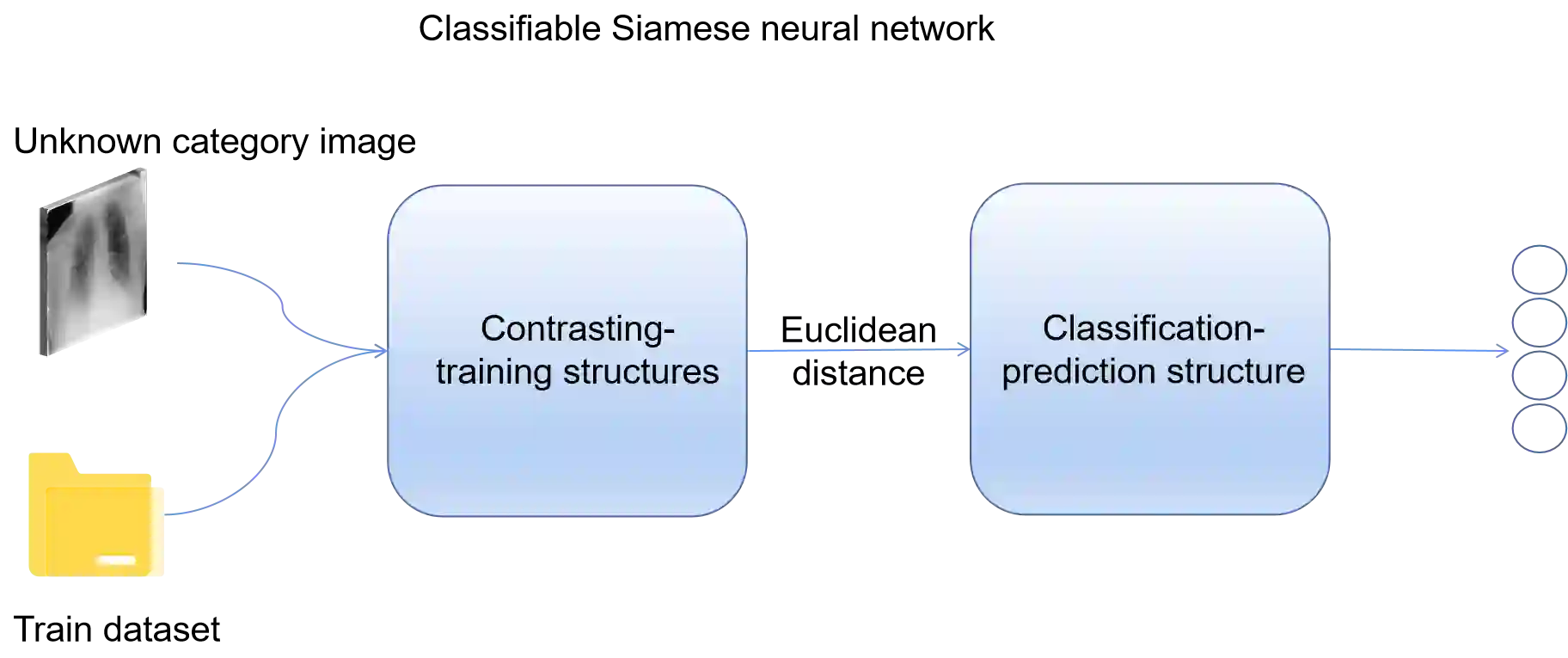
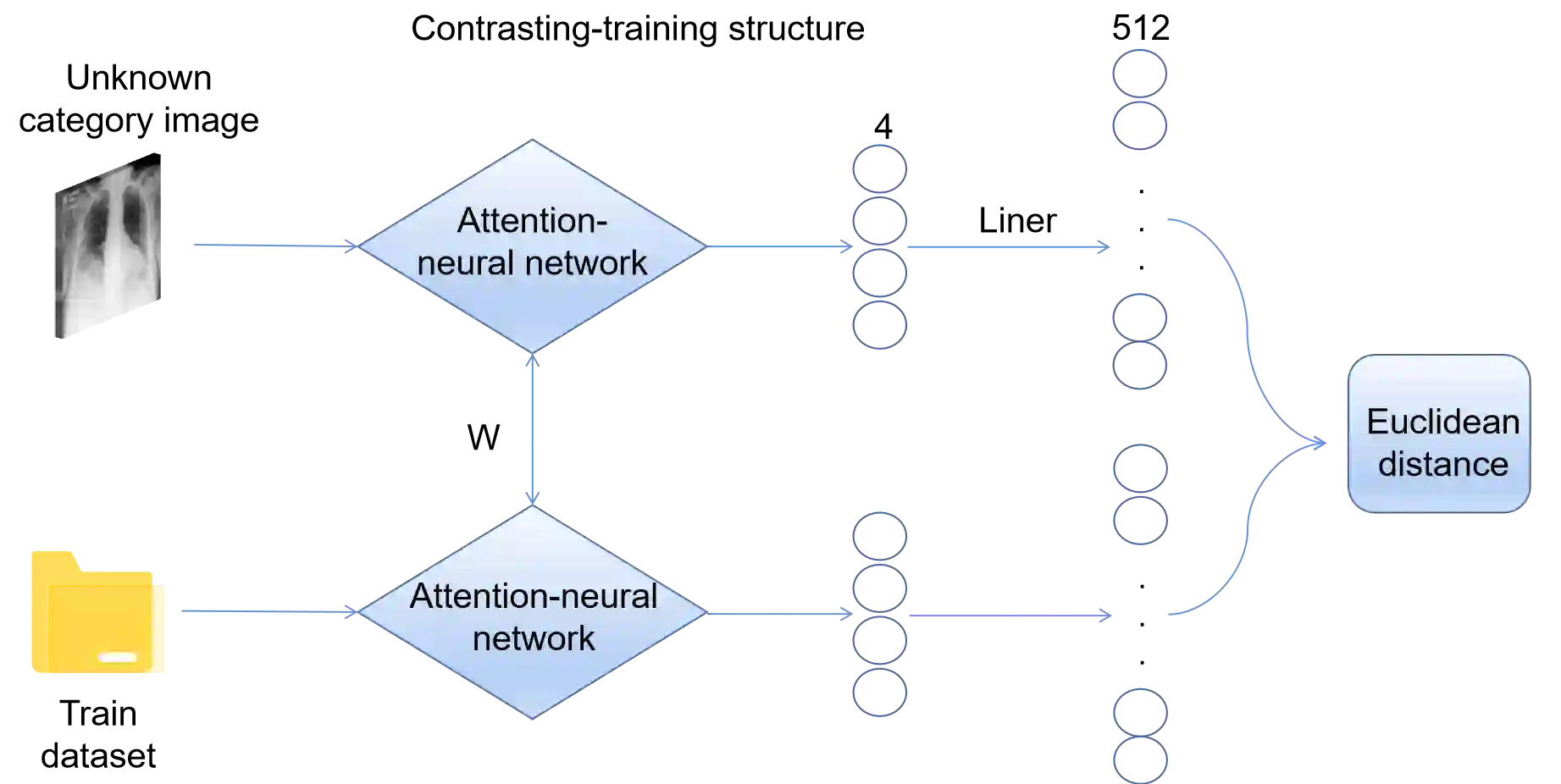
Medical image recognition often faces the problem of insufficient data in practical applications. Image recognition and processing under few-shot conditions will produce overfitting, low recognition accuracy, low reliability and insufficient robustness. It is often the case that the difference of characteristics is subtle, and the recognition is affected by perspectives, background, occlusion and other factors, which increases the difficulty of recognition. Furthermore, in fine-grained images, the few-shot problem leads to insufficient useful feature information in the images. Considering the characteristics of few-shot and fine-grained image recognition, this study has established a recognition model based on attention and Siamese neural network. Aiming at the problem of few-shot samples, a Siamese neural network suitable for classification model is proposed. The Attention-Based neural network is used as the main network to improve the classification effect. Covid- 19 lung samples have been selected for testing the model. The results show that the less the number of image samples are, the more obvious the advantage shows than the ordinary neural network.
翻译:医学图像识别在实际应用中常面临数据不足的问题。少样本条件下的图像识别与处理会产生过拟合、识别精度低、可靠性差及鲁棒性不足等现象。特征差异细微、识别受视角、背景、遮挡等因素影响的情况时有发生,这进一步增加了识别难度。此外,在细粒度图像中,少样本问题导致图像中可用的有效特征信息不足。考虑到少样本与细粒度图像识别的特点,本研究构建了基于注意力和孪生神经网络的识别模型。针对少样本问题,提出了一种适用于分类模型的孪生神经网络。采用基于注意力的神经网络作为主网络以提升分类效果。选用新冠肺炎肺部样本对模型进行测试,结果表明:图像样本数量越少,该模型相较于普通神经网络的性能优势越明显。







相关内容



 微信扫码咨询专知VIP会员