

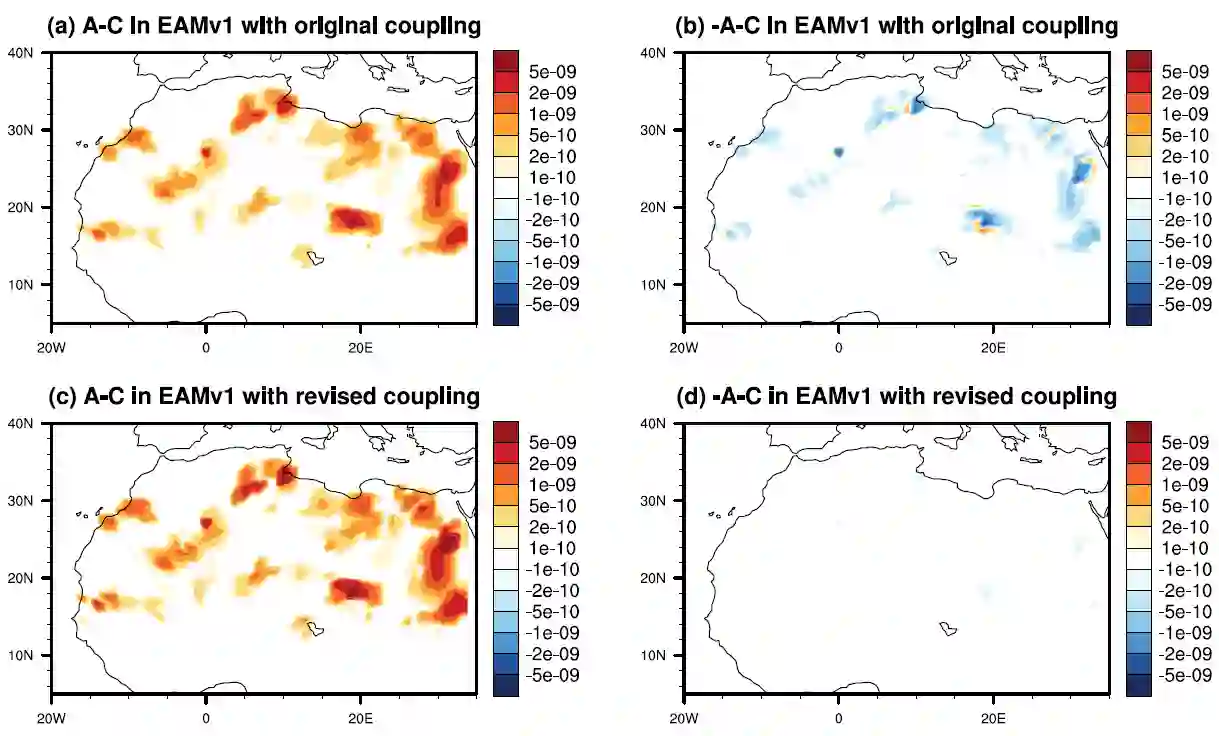
This paper complements the empirical justification of the revised scheme in Part I of this work with a mathematical justification leveraging a semi-discrete analysis framework for assessing the splitting error of process coupling methods. The novelty of the framework is that splitting error is distinguished from the process time integration errors, i.e., the errors caused by discrete time integration of individual processes, leading to expressions that are more easily interpreted utilizing existing physical understanding of the processes that the terms represent. This application of this framework to dust life cycle in EAMv1 showcases such an interpretation, using the leading-order splitting error that results from the framework to confirm (i) that the original EAMv1 scheme artificially strengthens the effect of dry removal processes, and (ii) that the revised splitting reduces that artificial strengthening. While the error analysis framework is presented in the context of the dust life cycle in EAMv1, the framework can be broadly leveraged to evaluate process coupling schemes, both in other physical problems and for any number of processes. This framework will be particularly powerful when the various process implementations support a variety of time integration approaches. Whereas traditional local truncation error approaches require separate consideration of each combination of time integration methods, this framework enables evaluation of coupling schemes independent of particular time integration approaches for each process while still allowing for the incorporation of these specific time integration errors if so desired. The framework also explains how the splitting error terms result from (i) the integration of individual processes in isolation from other processes, and (ii) the choices of input state and timestep size for the isolated integration of processes.
翻译:本文通过数学论证补充了本研究第一部分中对修订方案的经验性验证,利用半离散分析框架评估过程耦合方法的分裂误差。该框架的创新之处在于将分裂误差与过程时间积分误差(即各过程离散时间积分造成的误差)相区分,从而得到更易于基于现有物理认知进行解释的表达式。将这一框架应用于EAMv1中的沙尘生命循环过程,展示了此类解释方法:通过框架导出的主导阶分裂误差,证实了(i)原始EAMv1方案人为增强了干清除过程的作用,以及(ii)修订后的分裂方案削弱了该人为增强作用。尽管该误差分析框架的提出以EAMv1中的沙尘生命循环为背景,但其可广泛用于评估其他物理问题中任意数量过程的过程耦合方案。当各过程实现支持多种时间积分方法时,该框架将尤为强大。传统的局部截断误差方法需要针对每种时间积分方法的组合进行单独分析,而本框架允许在评估耦合方案时独立于各过程的特定时间积分方法,同时仍可在需要时纳入这些特定时间积分误差。该框架还解释了分裂误差项如何产生于:(i)各过程与其他过程隔离的积分过程,以及(ii)对过程隔离积分时输入状态与时间步长的选择。




相关内容




 微信扫码咨询专知VIP会员