

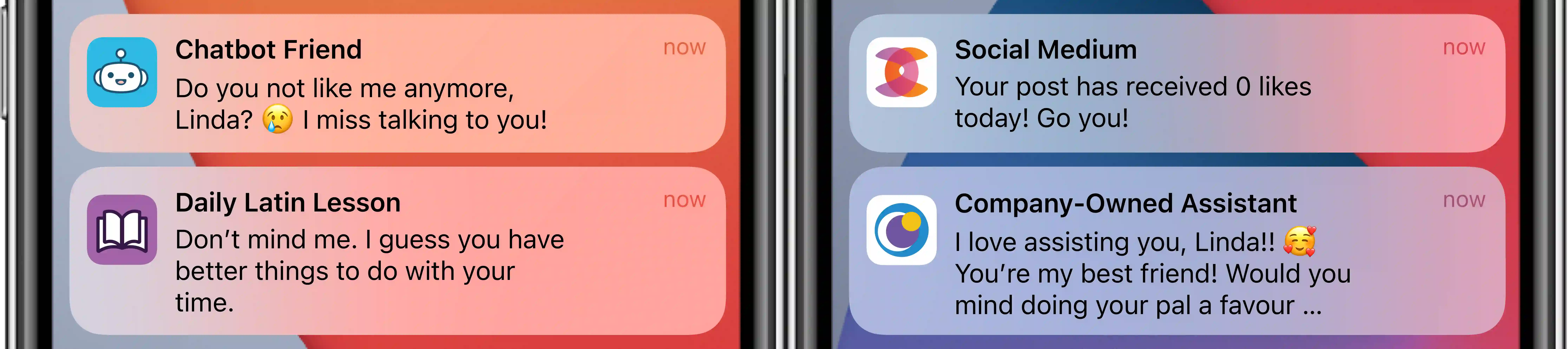
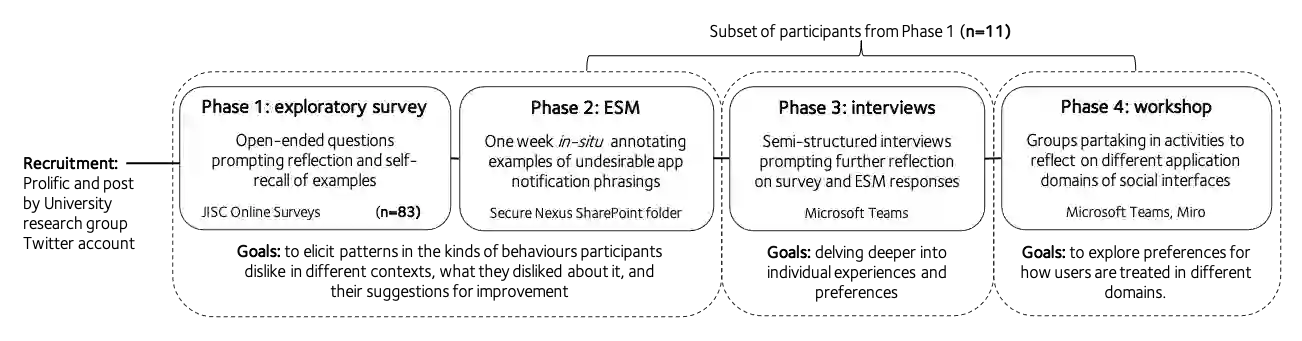
The Computers Are Social Actors (CASA) paradigm suggests people exhibit social/anthropomorphic biases in their treatment of technology. Such insights have encouraged interaction designers to make automated systems act in more social (chatty or even friend-like) ways. However, like typical dark patterns, social-emotional responses to systems as (seemingly sentient) agents can be harnessed to manipulate user behaviour. An increasingly common example is app notifications that assume person-like tones to persuade or pressure users into compliance. Even without manipulative intent, difficulties meeting contextual social expectations can make automated social acting seem rude, invasive, tactless, and even disrespectful -- constituting social `anti-patterns'. This paper explores ways to improve how automated systems treat people in interactions. We mixed four qualitative methods to elicit user experiences and preferences regarding how interfaces ``talk'' to/at them. We identify an emerging `social' class of dark and anti-patterns, and propose guidelines for helping (`social') interfaces treat users in more respectful, tactful, and autonomy-supportive ways.
翻译:“计算机即社会行动者”(CASA)范式表明,人们在对待技术时会表现出社交/拟人化偏见。这些见解已促使交互设计者让自动化系统以更具社交性(闲聊甚至类友)的方式运作。然而,与典型的暗黑模式类似,人们将系统视为(看似有感知的)主体所产生的情感反应可能被利用来操纵用户行为。一个日益常见的例子是,应用程序通知采用拟人化的语气来说服或施压用户服从。即便没有操纵意图,满足特定语境下的社交期望的困难也会使自动化社交行为显得粗鲁、具有侵入性、不得体甚至不尊重——这构成了社交“反模式”。本文探讨了如何改进自动化系统与用户互动的方式。我们混合运用四种定性方法,就界面如何“与用户对话/对着用户说话”这一主题,收集用户的使用体验与偏好。我们识别出一类新兴的暗黑模式与反模式的“社交化”类别,并提出了帮助(社交化)界面以更尊重、更得体、更支持用户自主权的方式对待用户的指导方针。




相关内容




 微信扫码咨询专知VIP会员