

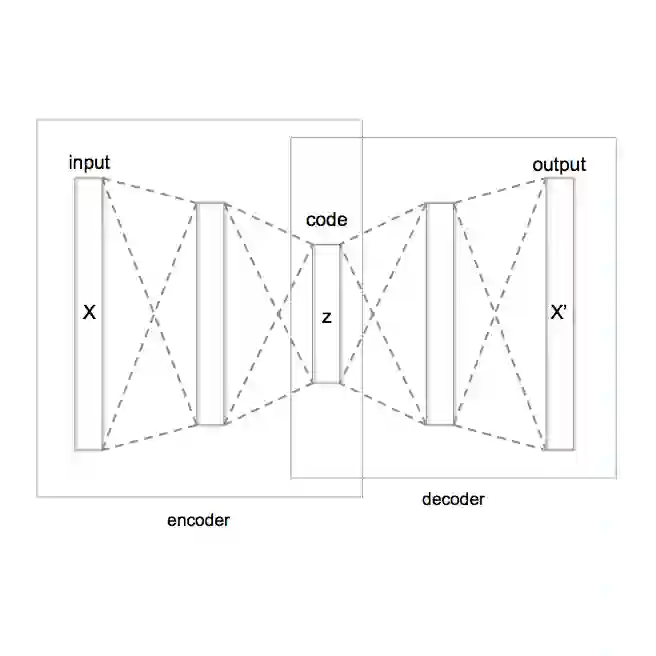
Data-driven flow-field reconstruction typically relies on autoencoder architectures that compress high-dimensional states into low-dimensional latent representations. However, classical approaches such as variational autoencoders (VAEs) often struggle to preserve the higher-order statistical structure of fluid flows when subjected to strong compression. We propose DiffCoder, a coupled framework that integrates a probabilistic diffusion model with a conventional convolutional ResNet encoder and trains both components end-to-end. The encoder compresses the flow field into a latent representation, while the diffusion model learns a generative prior over reconstructions conditioned on the compressed state. This design allows DiffCoder to recover distributional and spectral properties that are not strictly required for minimizing pointwise reconstruction loss but are critical for faithfully representing statistical properties of the flow field. We evaluate DiffCoder and VAE baselines across multiple model sizes and compression ratios on a challenging dataset of Kolmogorov flow fields. Under aggressive compression, DiffCoder significantly improves the spectral accuracy while VAEs exhibit substantial degradation. Although both methods show comparable relative L2 reconstruction error, DiffCoder better preserves the underlying distributional structure of the flow. At moderate compression levels, sufficiently large VAEs remain competitive, suggesting that diffusion-based priors provide the greatest benefit when information bottlenecks are severe. These results demonstrate that the generative decoding by diffusion offers a promising path toward compact, statistically consistent representations of complex flow fields.
翻译:数据驱动的流场重建通常依赖于自编码器架构,该架构将高维状态压缩为低维潜在表示。然而,当进行强压缩时,变分自编码器等经典方法往往难以保持流体流动的高阶统计结构。我们提出了DiffCoder,这是一个将概率扩散模型与传统卷积ResNet编码器集成的耦合框架,并对两个组件进行端到端训练。编码器将流场压缩为潜在表示,而扩散模型则学习以压缩状态为条件的重建生成先验。这种设计使得DiffCoder能够恢复分布和谱特性,这些特性对于最小化逐点重建损失并非严格必需,但对于忠实表示流场的统计特性至关重要。我们在具有挑战性的Kolmogorov流场数据集上,评估了DiffCoder和VAE基线在多种模型大小和压缩比下的性能。在激进压缩下,DiffCoder显著提高了谱精度,而VAE则表现出显著退化。尽管两种方法显示出相当的相对L2重建误差,但DiffCoder更好地保留了流场的底层分布结构。在中等压缩水平下,足够大的VAE仍具有竞争力,这表明基于扩散的先验在信息瓶颈严重时提供最大的优势。这些结果表明,通过扩散进行生成解码为复杂流场的紧凑、统计一致的表示提供了一条有前景的路径。




相关内容


 微信扫码咨询专知VIP会员