

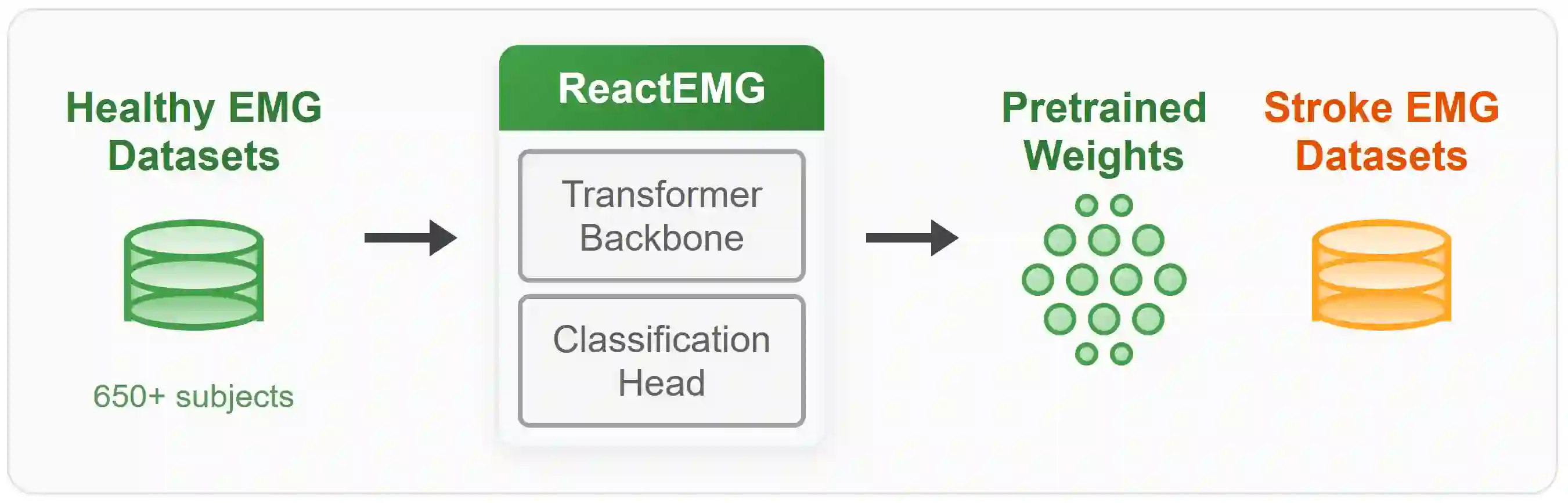
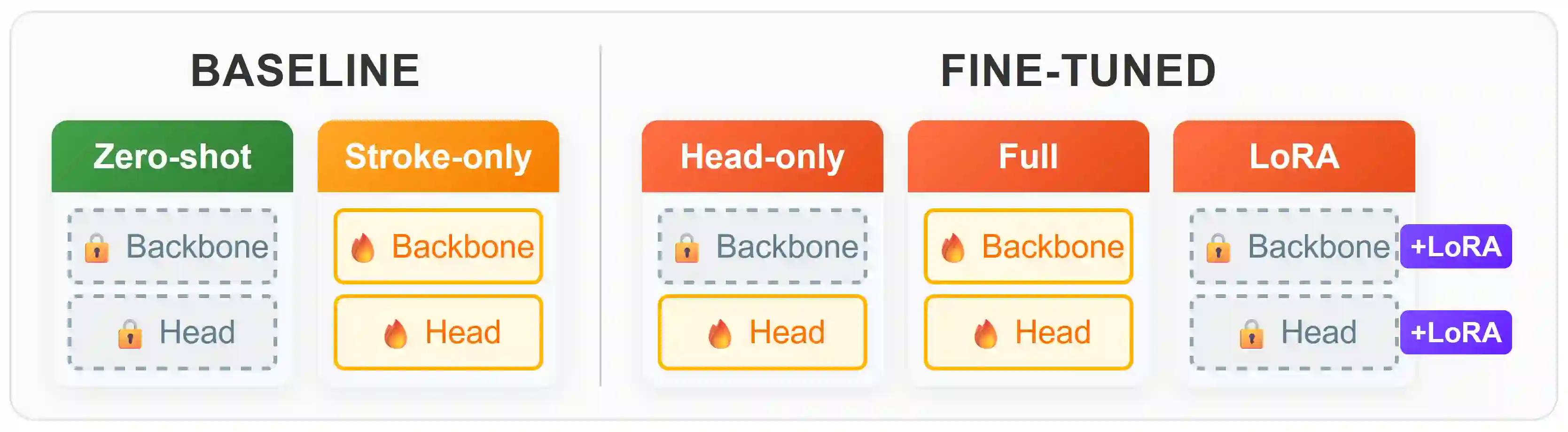
Surface electromyography (sEMG) is a promising control signal for assist-as-needed hand rehabilitation after stroke, but detecting intent from paretic muscles often requires lengthy, subject-specific calibration and remains brittle to variability. We propose a healthy-to-stroke adaptation pipeline that initializes an intent detector from a model pretrained on large-scale able-bodied sEMG, then fine-tunes it for each stroke participant using only a small amount of subject-specific data. Using a newly collected dataset from three individuals with chronic stroke, we compare adaptation strategies (head-only tuning, parameter-efficient LoRA adapters, and full end-to-end fine-tuning) and evaluate on held-out test sets that include realistic distribution shifts such as within-session drift, posture changes, and armband repositioning. Across conditions, healthy-pretrained adaptation consistently improves stroke intent detection relative to both zero-shot transfer and stroke-only training under the same data budget; the best adaptation methods improve average transition accuracy from 0.42 to 0.61 and raw accuracy from 0.69 to 0.78. These results suggest that transferring a reusable healthy-domain EMG representation can reduce calibration burden while improving robustness for real-time post-stroke intent detection.
翻译:表面肌电图(sEMG)是中风后按需辅助手部康复的一种有前景的控制信号,但从麻痹肌肉中检测意图通常需要冗长且针对特定受试者的校准,并且对变异性仍然敏感。我们提出了一种从健康到中风的适应流程:首先利用在大规模健康人群sEMG数据上预训练的模型初始化意图检测器,然后仅使用少量特定受试者数据为每位中风参与者进行微调。基于新收集的三名慢性中风患者的数据集,我们比较了不同的适应策略(仅微调头部层、参数高效的LoRA适配器以及完整的端到端微调),并在包含现实分布偏移(如会话内漂移、姿势变化和臂带重新定位)的保留测试集上进行了评估。在各种条件下,相对于相同数据预算下的零样本迁移和仅使用中风数据的训练,基于健康数据预训练的适应方法持续提升了中风意图检测的性能;最佳适应方法将平均转换准确率从0.42提升至0.61,原始准确率从0.69提升至0.78。这些结果表明,迁移可复用的健康领域肌电图表征能够减少校准负担,同时提升实时中风后意图检测的鲁棒性。





相关内容

一是主要脏器无疾病,身体形态发育良好,体形均匀,人体各系统具有良好的生理功能,有较强的身体活动能力和劳动能力,这是对健康最基本的要求;
二是对疾病的抵抗能力较强,能够适应环境变化,各种生理刺激以及致病因素对身体的作用。传统的健康观是“无病即健康”,现代人的健康观是整体健康,世界卫生组织提出“健康不仅是躯体没有疾病,还要具备心理健康、社会适应良好和有道德”。因此,现代人的健康内容包括:躯体健康、心理健康、心灵健康、社会健康、智力健康、道德健康、环境健康等。健康是人的基本权利。健康是人生的第一财富。


 微信扫码咨询专知VIP会员