

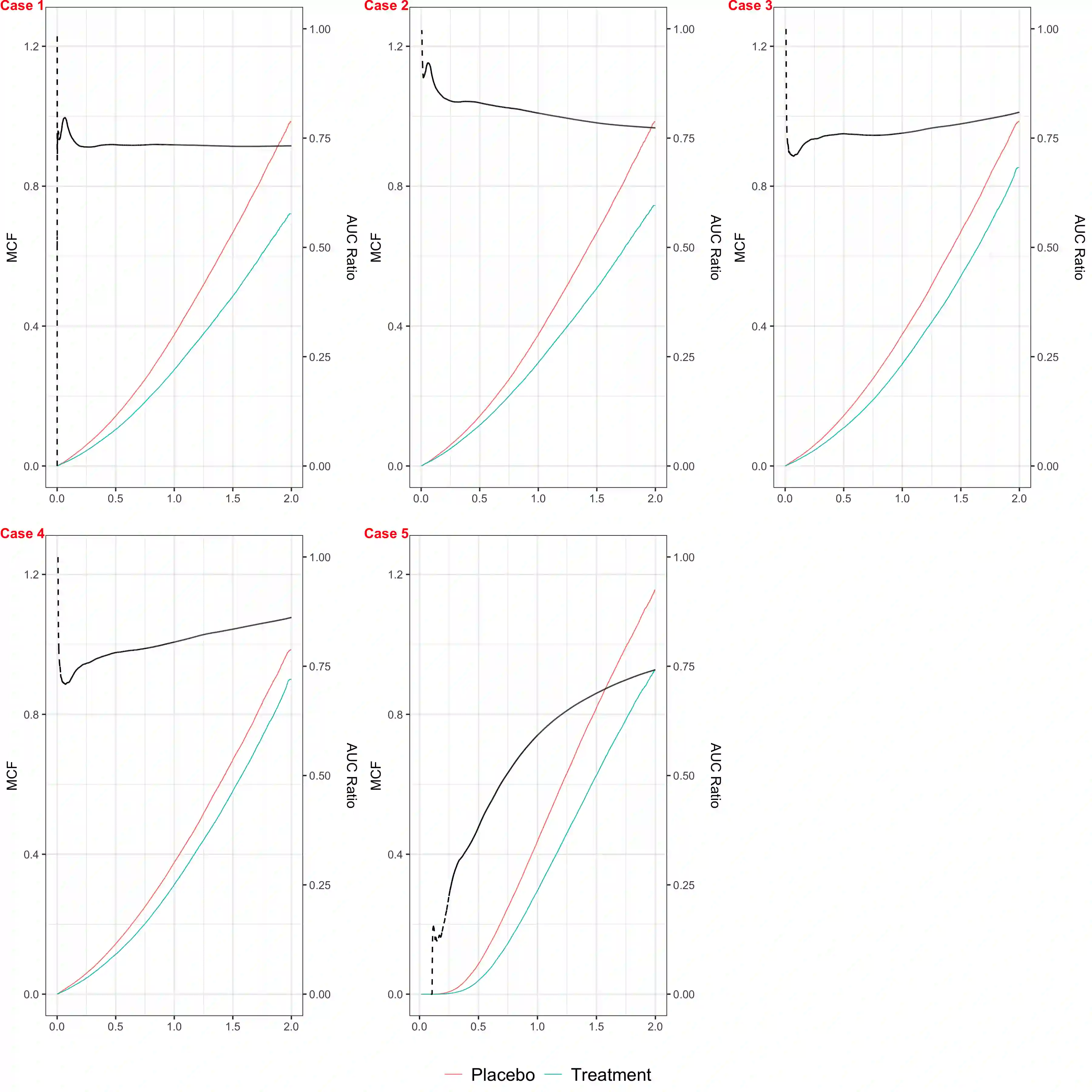
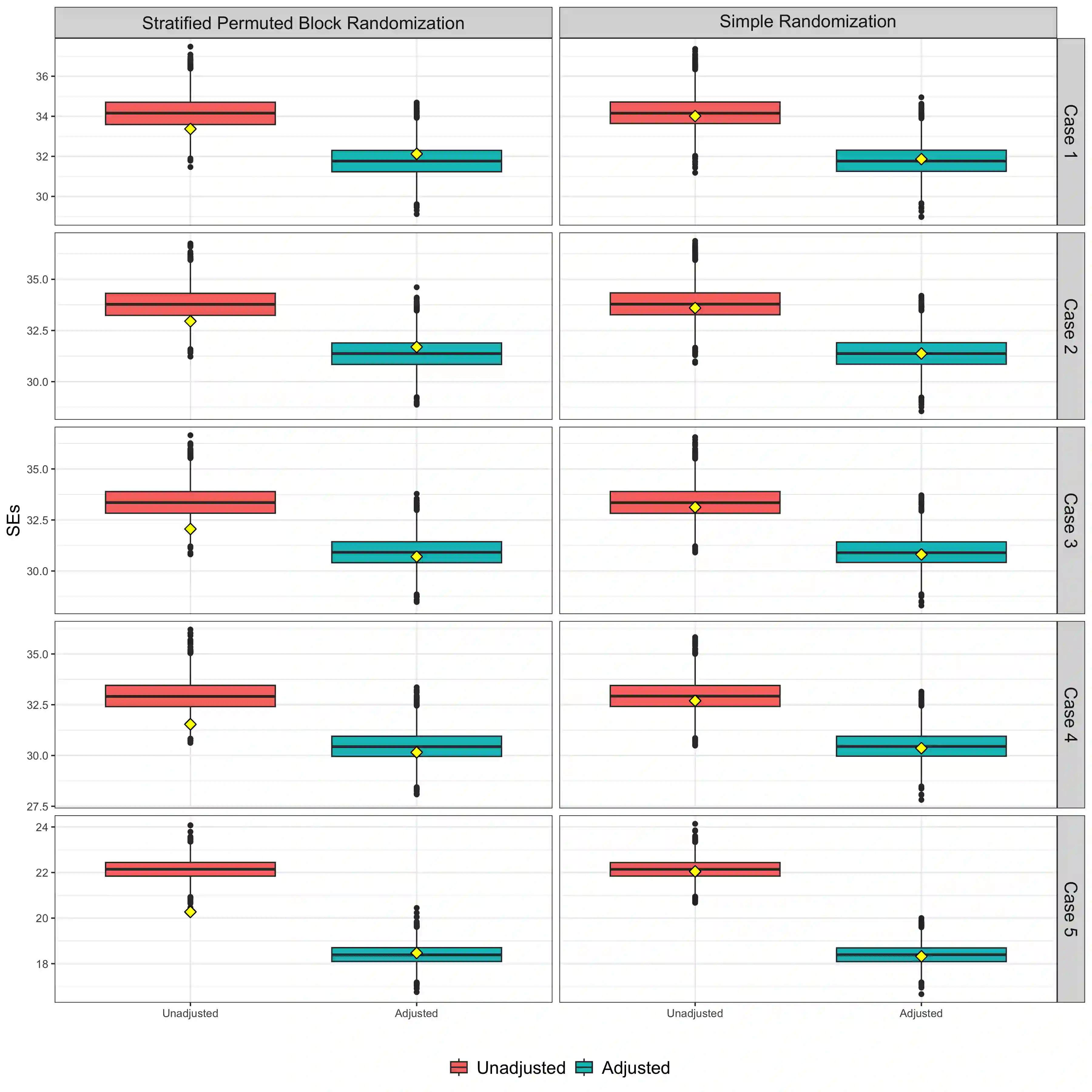
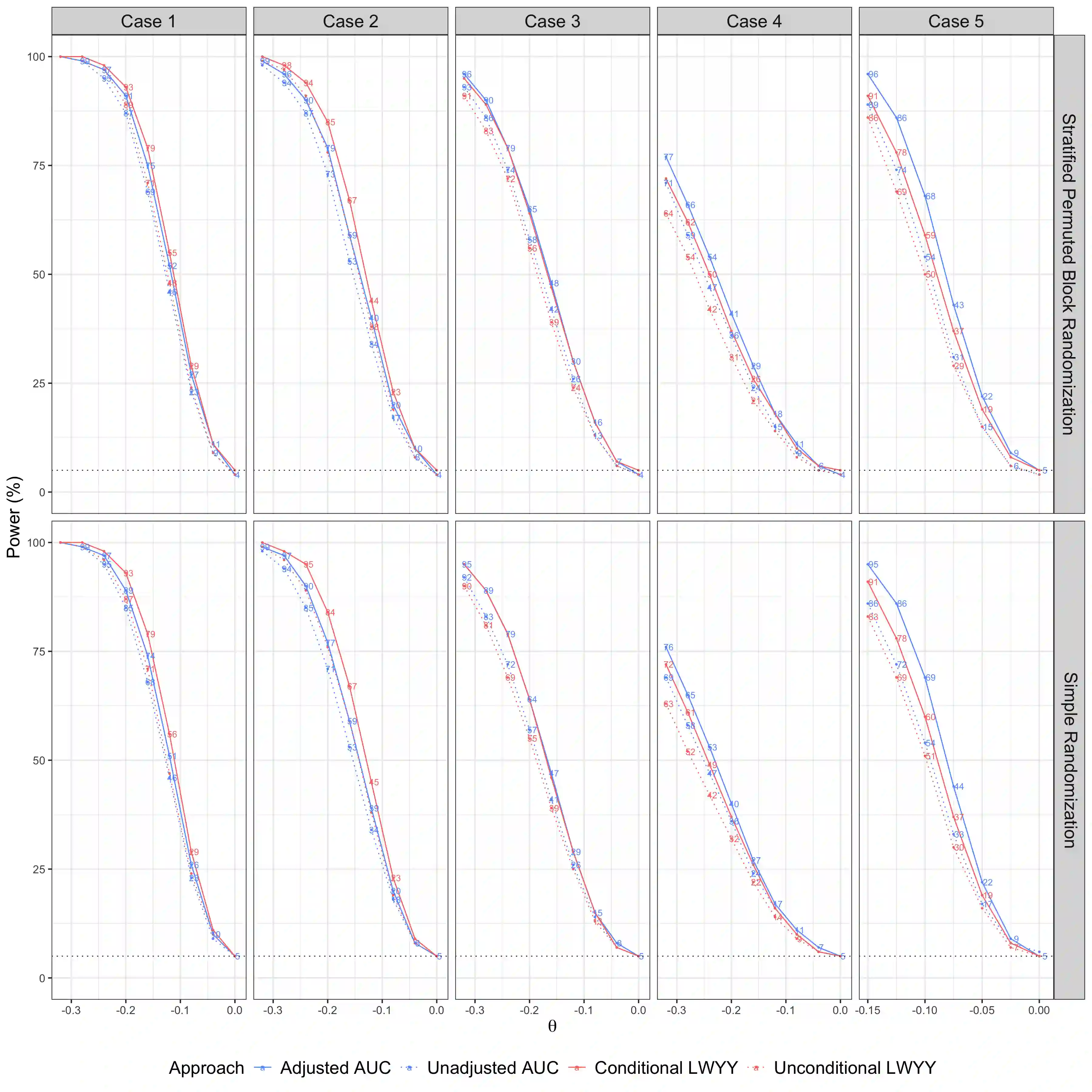
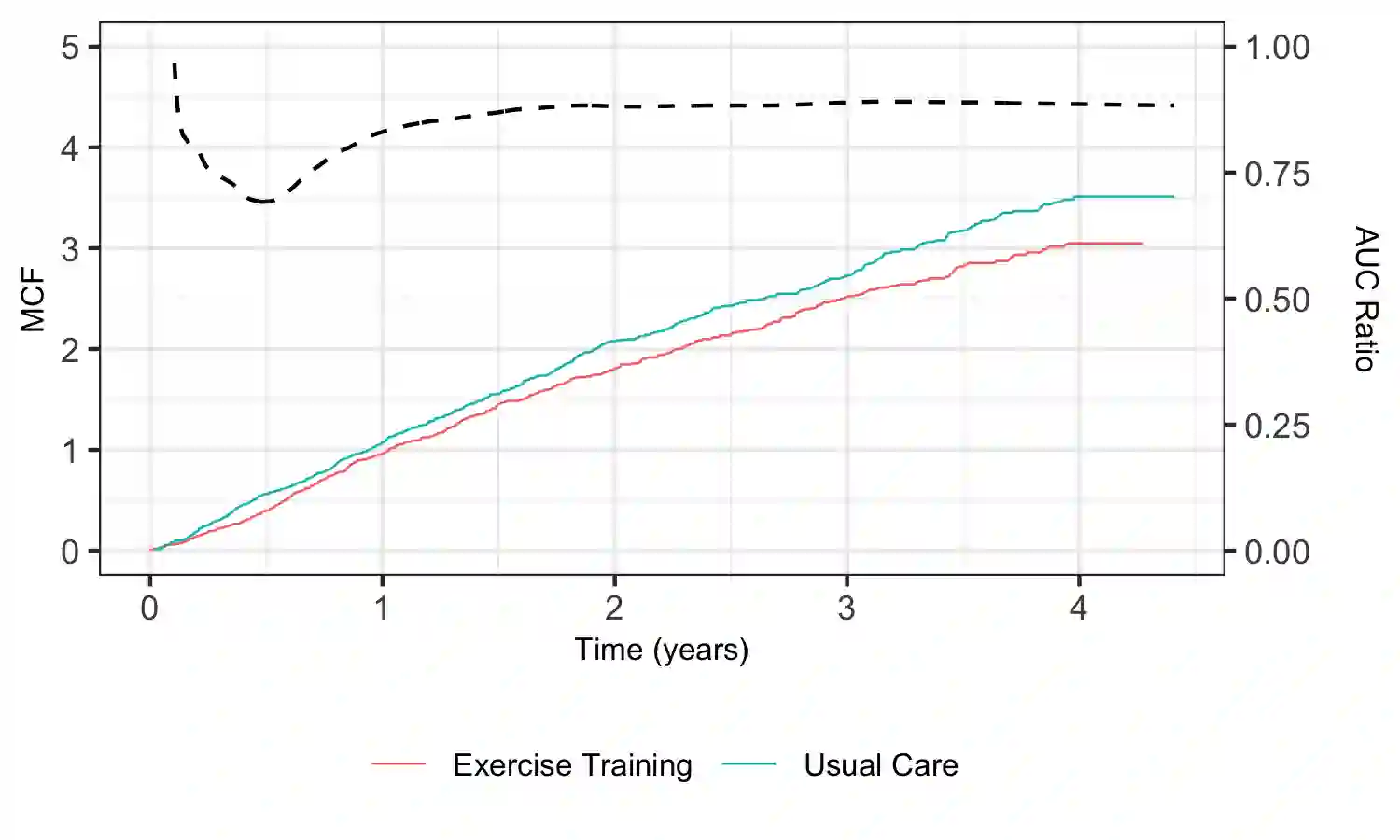
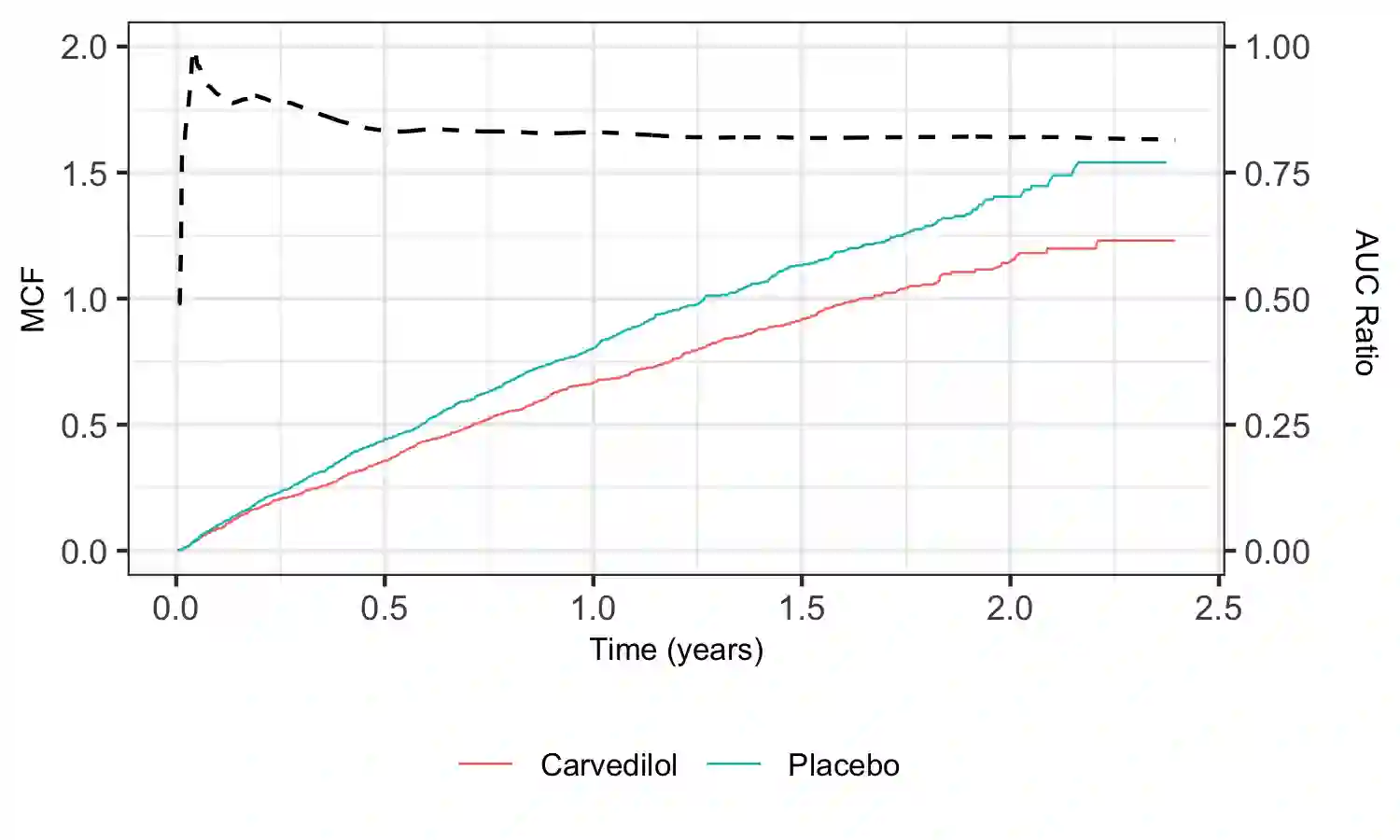
The area under the curve (AUC) of the mean cumulative function (MCF) has recently been introduced as a novel estimand for evaluating treatment effects in recurrent event settings, capturing a totality of evidence in relation to disease progression. While the Lin-Wei-Yang-Ying (LWYY) model is commonly used for analyzing recurrent events, it relies on the proportional rate assumption between treatment arms, which is often violated in practice. In contrast, the AUC under MCFs does not depend on such proportionality assumptions and offers a clinically interpretable measure of treatment effect. To improve the precision of the AUC estimation while preserving its unconditional interpretability, we propose a nonparametric covariate adjustment approach. This approach guarantees efficiency gain compared to unadjusted analysis, as demonstrated by theoretical asymptotic distributions, and is universally applicable to various randomization schemes, including both simple and covariate-adaptive designs. Extensive simulations across different scenarios further support its advantage in increasing statistical power. Our findings highlight the importance of covariate adjustment for the analysis of AUC in recurrent event settings, offering practical guidance for its application in randomized clinical trials.
翻译:平均累积函数(MCF)的曲线下面积(AUC)最近被提出作为评估复发事件场景中治疗效果的新型估计量,其能够捕捉与疾病进展相关的整体证据。尽管林-魏-杨-英(LWYY)模型常用于分析复发事件,但其依赖于治疗组间的比例风险假设,而这一假设在实践中常被违背。相比之下,MCF下的AUC不依赖于此类比例性假设,并提供了临床可解释的治疗效果度量。为在保持其无条件可解释性的同时提升AUC估计的精度,我们提出了一种非参数协变量调整方法。理论渐近分布证明,相较于未调整的分析,该方法能保证效率提升,且普遍适用于包括简单随机化和协变量自适应设计在内的各种随机化方案。多种场景下的广泛仿真进一步支持了其在提升统计功效方面的优势。我们的研究结果凸显了协变量调整在复发事件AUC分析中的重要性,为其在随机临床试验中的应用提供了实践指导。




相关内容



 微信扫码咨询专知VIP会员