

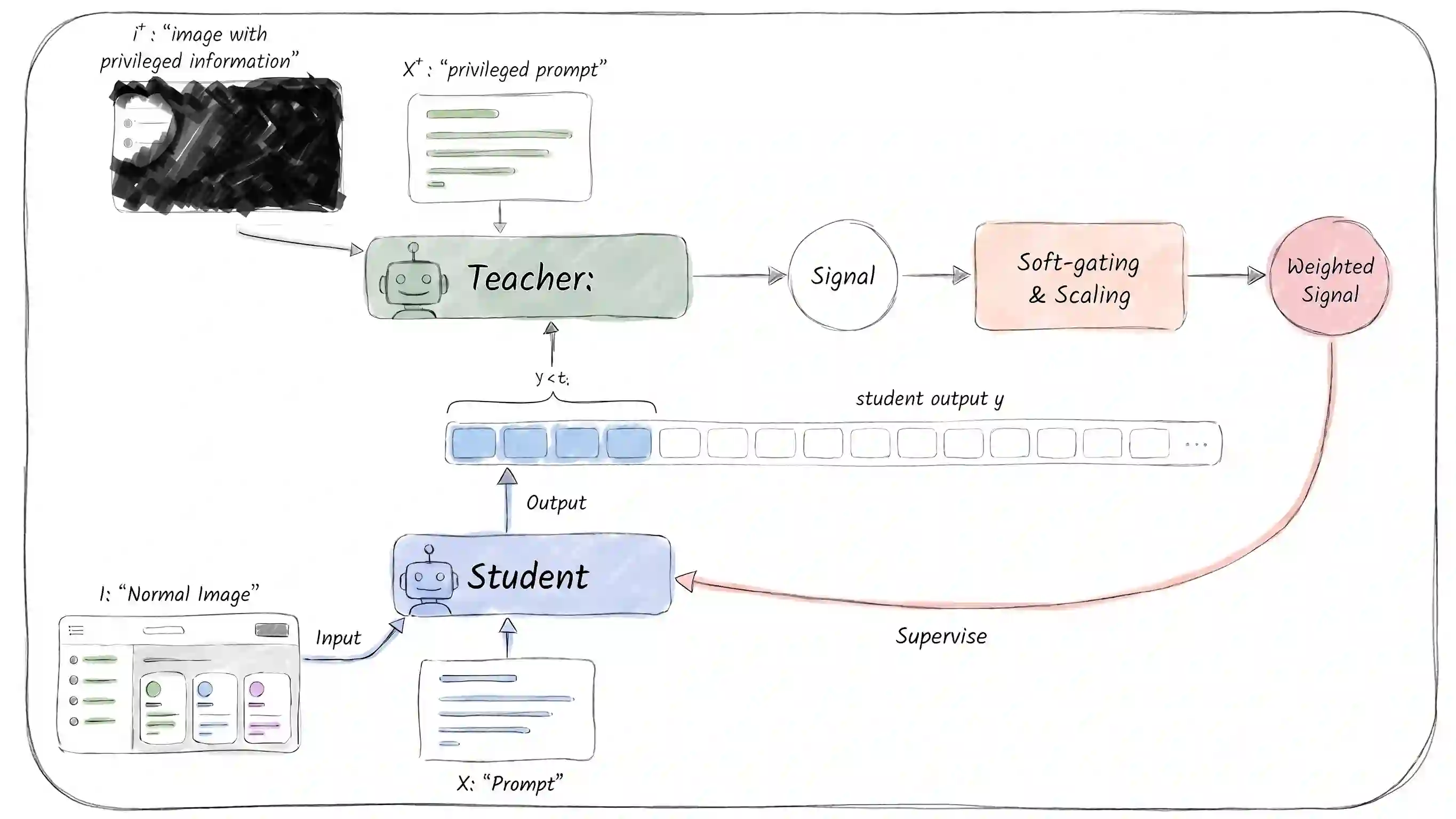
Graphical user interface (GUI) grounding requires vision-language models (VLMs) to identify small target elements in high-resolution screenshots and predict precise screen coordinates. On-policy self-distillation (OPSD) is a promising post-training approach for this coordinate-sensitive task, since it provides dense token-level teacher signals beyond hard coordinate labels. However, naive OPSD is not well suited to GUI grounding: OPSD evaluates the teacher on student-generated prefixes, the quality of coordinate-token teacher signals can degrade when the prefix has already deviated from the target coordinate, leading to unreliable teacher signal. To mitigate this, We propose quality-aware self-distillation for VLM-based GUI grounding, which improves coordinate-token teacher-signal quality through soft correctness-aware gating and teacher-probability scaling. The soft correctness-aware gate checks whether the teacher's current coordinate-token prediction can still be completed into the ground-truth box under the student-generated prefix. If not, the corresponding teacher signal is down-weighted. Teacher-probability scaling then uses the teacher's confidence as a lightweight factor to further calibrate the strength of the gated supervision. A key empirical finding is that neither component alone improves overall performance, whereas combining them consistently improves performance. This suggests that the two mechanisms play complementary roles: correctness-aware gating suppresses unreliable coordinate-token supervision, while teacher-probability scaling calibrates the strength of the remaining signals. Experiments across six GUI grounding benchmarks show that our method consistently improves the base model and outperforms strong baselines.
翻译:图形用户界面(GUI)定位要求视觉语言模型(VLM)在高分辨率截图中识别微小的目标元素,并预测精确的屏幕坐标。在线策略自蒸馏(OPSD)是这种坐标敏感任务的一种有前景的后训练方法,因为它提供超越硬坐标标签的密集令牌级教师信号。然而,朴素OPSD并不适于GUI定位:OPSD在基于学生生成的前缀上评估教师,当该前缀已经偏离目标坐标时,坐标令牌教师信号的质量会下降,从而产生不可靠的教师信号。为此,我们提出了面向基于VLM的GUI定位的质量感知自蒸馏方法,该方法通过软正确性感知门控和教师概率缩放来提升坐标令牌教师信号的质量。软正确性感知门控检查:在给定学生生成的前缀下,教师当前的坐标令牌预测是否仍能补全为真实边界框;若不能,则对应教师信号的权重被降低。教师概率缩放则利用教师置信度作为轻量级因子,进一步校准门控监督的强度。关键实验发现是:单独使用任一组件均无法提升整体性能,而两者结合能持续改进性能。这表明两个机制发挥互补作用:正确性感知门控抑制不可靠的坐标令牌监督,而教师概率缩放校准剩余信号的强度。在六个GUI定位基准上的实验表明,我们的方法持续提升了基础模型性能,并优于强基线方法。




相关内容



 微信扫码咨询专知VIP会员