

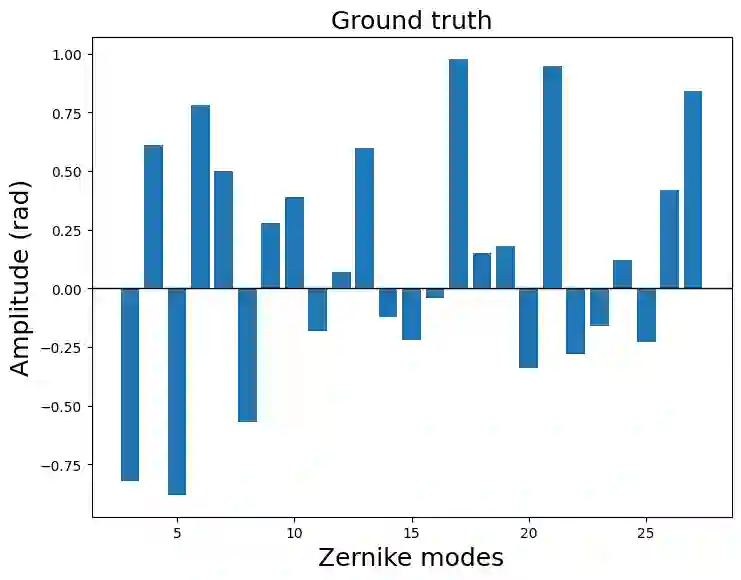
Optical imaging quality can be severely degraded by system and sample induced aberrations. Existing adaptive optics systems typically rely on iterative search algorithm to correct for aberrations and improve images. This study demonstrates the application of convolutional neural networks to characterise the optical aberration by directly predicting the Zernike coefficients from two to three phase-diverse optical images. We evaluated our network on 600,000 simulated Point Spread Function (PSF) datasets randomly generated within the range of -1 to 1 radians using the first 25 Zernike coefficients. The results show that using only three phase-diverse images captured above, below and at the focal plane with an amplitude of 1 achieves a low RMSE of 0.10 radians on the simulated PSF dataset. Furthermore, this approach directly predicts Zernike modes simulated extended 2D samples, while maintaining a comparable RMSE of 0.15 radians. We demonstrate that this approach is effective using only a single prediction step, or can be iterated a small number of times. This simple and straightforward technique provides rapid and accurate method for predicting the aberration correction using three or less phase-diverse images, paving the way for evaluation on real-world dataset.
翻译:光学成像质量常因系统和样品引起的像差而严重退化。现有自适应光学系统通常依赖迭代搜索算法校正像差以改善图像质量。本研究展示了利用卷积神经网络通过两至三幅相位差异光学图像直接预测Zernike系数,从而实现光学像差表征的方法。我们采用前25阶Zernike系数在-1至1弧度范围内随机生成60万组模拟点扩散函数(PSF)数据集,对网络性能进行了评估。结果表明,仅利用焦平面上方、下方及焦面处采集的三幅幅值为1的相位差异图像,即可在模拟PSF数据集上实现0.10弧度的低均方根误差(RMSE)。此外,该方法可直接预测模拟扩展二维样本的Zernike模式,同时保持0.15弧度的可比RMSE值。我们验证了该方法仅需单步预测即可有效工作,亦可进行少量迭代。这种简便直接的技术通过三幅或更少相位差异图像即可快速准确预测像差校正,为在真实数据集上的评估奠定了基础。




相关内容




 微信扫码咨询专知VIP会员