

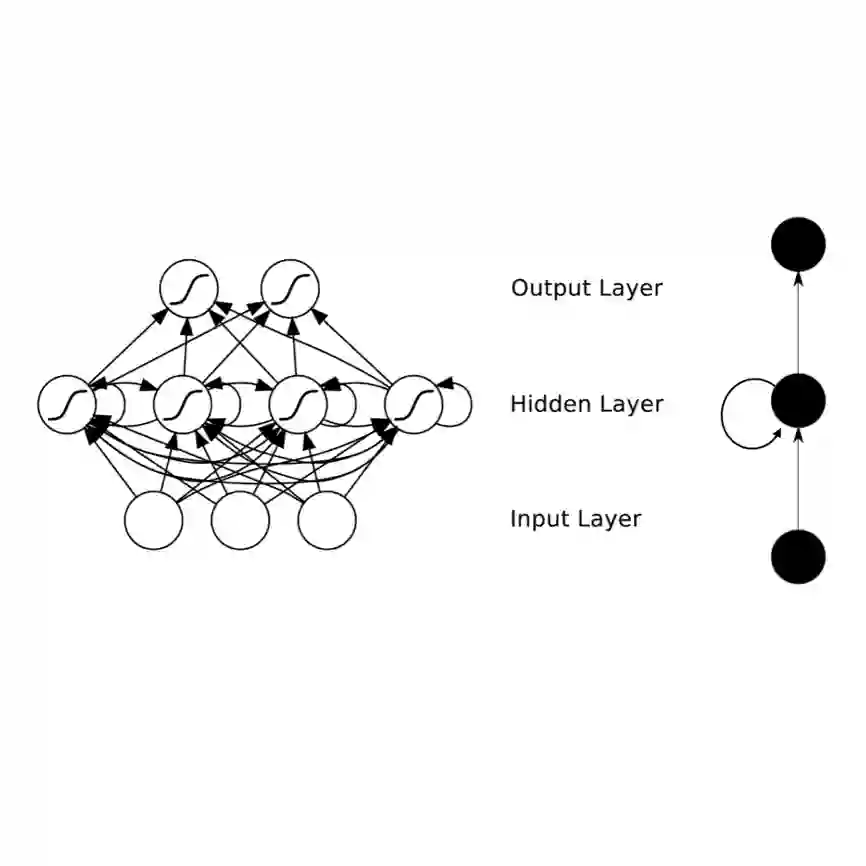
Hands are used for communicating with the surrounding environment and have a complex structure that enables them to perform various tasks with their multiple degrees of freedom. Hand amputation can prevent a person from performing their daily activities. In that event, finding a suitable, fast, and reliable alternative for the missing limb can affect the lives of people who suffer from such conditions. As the most important use of the hands is to grasp objects, the purpose of this study is to accurately predict gripping force from surface electromyography (sEMG) signals during a pinch-type grip. In that regard, gripping force and sEMG signals are derived from 10 healthy subjects. Results show that for this task, recurrent networks outperform nonrecurrent ones, such as a fully connected multilayer perceptron (MLP) network. Gated recurrent unit (GRU) and long short-term memory (LSTM) networks can predict the gripping force with R-squared values of 0.994 and 0.992, respectively, and a prediction rate of over 1300 predictions per second. The predominant advantage of using such frameworks is that the gripping force can be predicted straight from preprocessed sEMG signals without any form of feature extraction, not to mention the ability to predict future force values using larger prediction horizons adequately. The methods presented in this study can be used in the myoelectric control of prosthetic hands or robotic grippers.
翻译:手部用于与周围环境进行交流,其复杂结构通过多自由度使其能够执行各种任务。手部截肢会阻碍患者完成日常活动。在此情况下,为缺失肢体寻找合适、快速且可靠的替代方案,将影响此类患者的生活质量。鉴于手部最重要的功能是抓握物体,本研究旨在通过捏取式抓握过程中的表面肌电信号(sEMG)准确预测握力。为此,我们从10名健康受试者中采集了握力与sEMG信号。结果表明,针对该任务,递归网络优于非递归网络(如全连接多层感知机(MLP)网络)。门控循环单元(GRU)与长短期记忆(LSTM)网络预测握力的R-squared值分别达到0.994和0.992,预测速率超过每秒1300次。采用此类框架的主要优势在于:无需任何形式的特征提取,即可直接从预处理后的sEMG信号预测握力,更不必说能够通过更大的预测范围充分预测未来握力值。本研究所提出的方法可用于假肢手或机器人夹爪的肌电控制。




相关内容




 微信扫码咨询专知VIP会员