

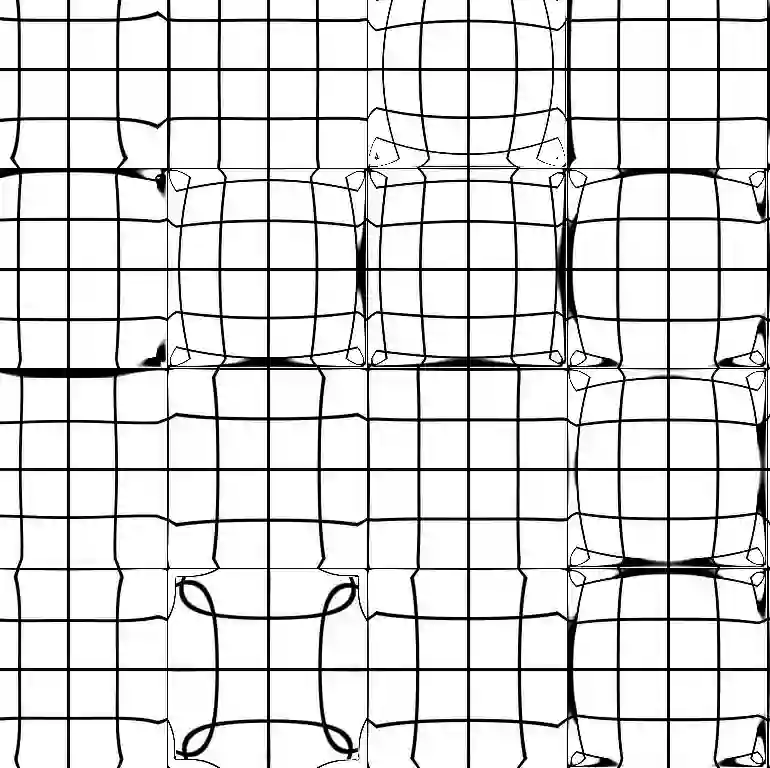
Semantic Image Segmentation facilitates a multitude of real-world applications ranging from autonomous driving over industrial process supervision to vision aids for human beings. These models are usually trained in a supervised fashion using example inputs. Distribution Shifts between these examples and the inputs in operation may cause erroneous segmentations. The robustness of semantic segmentation models against distribution shifts caused by differing camera or lighting setups, lens distortions, adversarial inputs and image corruptions has been topic of recent research. However, robustness against spatially varying radial distortion effects that can be caused by uneven glass structures (e.g. windows) or the chaotic refraction in heated air has not been addressed by the research community yet. We propose a method to synthetically augment existing datasets with spatially varying distortions. Our experiments show, that these distortion effects degrade the performance of state-of-the-art segmentation models. Pretraining and enlarged model capacities proof to be suitable strategies for mitigating performance degradation to some degree, while fine-tuning on distorted images only leads to marginal performance improvements.
翻译:语义图像分割支持众多实际应用,从自动驾驶、工业过程监控到人类视觉辅助。这些模型通常使用示例输入以监督方式进行训练。这些示例与运行中的输入之间的分布偏移可能导致错误分割。语义分割模型对由不同相机或光照设置、镜头畸变、对抗性输入和图像损坏引起的分布偏移的鲁棒性已成为近期研究的热点。然而,研究界尚未解决由不均匀玻璃结构(如窗户)或热空气混沌折射引起的空间变化径向畸变效应的鲁棒性问题。我们提出了一种方法,用于在现有数据集中合成添加空间变化畸变。实验表明,这些畸变效应会降低最先进分割模型的性能。预训练和增大模型容量被证明是缓解性能退化的适当策略,而仅在畸变图像上进行微调仅带来边际性能提升。





相关内容




 微信扫码咨询专知VIP会员