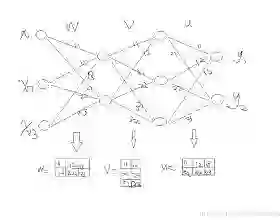
A Noise-modulated Neural Network (NNN) learns and infers only in the presence of noise, treating noise as a computational resource rather than a disturbance. The noise lets it learn efficiently by backpropagation while transmitting spike-like signals, but backpropagation needs a reverse path through transposed weights, the weight transport problem, which undermines biological and neuromorphic plausibility. Forward-only alternatives typically substitute a different objective or fixed random feedback, sacrificing stability and accuracy. We show that backpropagation itself can be reconstructed in the NNN from forward-pass statistics alone: a weight mirror estimates each weight matrix from the covariance between a previous-layer unit's output and the next-layer unit's input, and combining it with local differential estimation inside the units propagates the output error recursively along the computational graph, with no transposed-weight readout and no backward data path. The resulting gradient is empirically near-unbiased, and with local per-weight Adam updates it matches the final accuracy of backpropagation on simple regression tasks. With uniformly distributed noise, the local operations reduce to polynomials and comparators, making the whole system, learning rule included, well suited to digital circuits. Thus, in the NNN, noise is a resource not only for inference but also for reconstructing backpropagation.


翻译:暂无翻译

0
下载
关闭预览

相关内容

反向传播一词严格来说仅指用于计算梯度的算法,而不是指如何使用梯度。但是该术语通常被宽松地指整个学习算法,包括如何使用梯度,例如通过随机梯度下降。反向传播将增量计算概括为增量规则中的增量规则,该规则是反向传播的单层版本,然后通过自动微分进行广义化,其中反向传播是反向累积(或“反向模式”)的特例。 在机器学习中,反向传播(backprop)是一种广泛用于训练前馈神经网络以进行监督学习的算法。对于其他人工神经网络(ANN)都存在反向传播的一般化–一类算法,通常称为“反向传播”。反向传播算法的工作原理是,通过链规则计算损失函数相对于每个权重的梯度,一次计算一层,从最后一层开始向后迭代,以避免链规则中中间项的冗余计算。
【GNN】MPNN:消息传递神经网络
深度学习自然语言处理
17+阅读 · 2020年4月11日
Graph Neural Networks 综述
计算机视觉life
30+阅读 · 2019年8月13日
基础 | GRU神经网络
黑龙江大学自然语言处理实验室
27+阅读 · 2018年3月5日
论文浅尝 | Improved Neural Relation Detection for KBQA
开放知识图谱
13+阅读 · 2018年1月21日
ResNet, AlexNet, VGG, Inception:各种卷积网络架构的理解
全球人工智能
20+阅读 · 2017年12月17日
基于注意力机制的图卷积网络
科技创新与创业
74+阅读 · 2017年11月8日
【深度学习基础】4. Recurrent Neural Networks
微信AI
16+阅读 · 2017年7月19日
国家自然科学基金
6+阅读 · 2017年12月31日
国家自然科学基金
1+阅读 · 2015年12月31日
国家自然科学基金
0+阅读 · 2015年12月31日
国家自然科学基金
0+阅读 · 2015年12月31日
国家自然科学基金
0+阅读 · 2015年12月31日
国家自然科学基金
0+阅读 · 2015年12月31日
VIP会员
最新内容
乌克兰无人机饱和战场中的错误教训
专知会员服务
1+阅读 · 今天15:13
面向最后一战术英里:美军无人机创新尝试
专知会员服务
1+阅读 · 今天14:52
《美空军2026条令文件:对海压制作战》
专知会员服务
25+阅读 · 11月9日
人工智能与战争的未来
专知会员服务
10+阅读 · 11月8日
《Agent Mosaic:识别智能体LLM系统中的机密泄露》
专知会员服务
12+阅读 · 11月8日
人工智能在军事教育中的应用:若干视角与经验
专知会员服务
13+阅读 · 11月6日
“星链”减速与不断适应的乌克兰
专知会员服务
10+阅读 · 11月6日
美国中期选举之后:帕兰提尔面临不确定性?
专知会员服务
7+阅读 · 11月6日
相关VIP内容
相关资讯
【GNN】MPNN:消息传递神经网络
深度学习自然语言处理
17+阅读 · 2020年4月11日
Graph Neural Networks 综述
计算机视觉life
30+阅读 · 2019年8月13日
基础 | GRU神经网络
黑龙江大学自然语言处理实验室
27+阅读 · 2018年3月5日
论文浅尝 | Improved Neural Relation Detection for KBQA
开放知识图谱
13+阅读 · 2018年1月21日
ResNet, AlexNet, VGG, Inception:各种卷积网络架构的理解
全球人工智能
20+阅读 · 2017年12月17日
基于注意力机制的图卷积网络
科技创新与创业
74+阅读 · 2017年11月8日
【深度学习基础】4. Recurrent Neural Networks
微信AI
16+阅读 · 2017年7月19日
相关基金
国家自然科学基金
6+阅读 · 2017年12月31日
国家自然科学基金
1+阅读 · 2015年12月31日
国家自然科学基金
0+阅读 · 2015年12月31日
国家自然科学基金
0+阅读 · 2015年12月31日
国家自然科学基金
0+阅读 · 2015年12月31日
国家自然科学基金
0+阅读 · 2015年12月31日
Top
微信扫码咨询专知VIP会员