

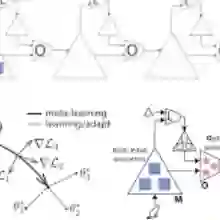
Deep neural networks have become a foundational tool for addressing imaging inverse problems. They are typically trained for a specific task, with a supervised loss to learn a mapping from the observations to the image to recover. However, real-world imaging challenges often lack ground truth data, rendering traditional supervised approaches ineffective. Moreover, for each new imaging task, a new model needs to be trained from scratch, wasting time and resources. To overcome these limitations, we introduce a novel approach based on meta-learning. Our method trains a meta-model on a diverse set of imaging tasks that allows the model to be efficiently fine-tuned for specific tasks with few fine-tuning steps. We show that the proposed method extends to the unsupervised setting, where no ground truth data is available. In its bilevel formulation, the outer level uses a supervised loss, that evaluates how well the fine-tuned model performs, while the inner loss can be either supervised or unsupervised, relying only on the measurement operator. This allows the meta-model to leverage a few ground truth samples for each task while being able to generalize to new imaging tasks. We show that in simple settings, this approach recovers the Bayes optimal estimator, illustrating the soundness of our approach. We also demonstrate our method's effectiveness on various tasks, including image processing and magnetic resonance imaging.
翻译:深度神经网络已成为解决成像逆问题的基础工具。它们通常针对特定任务进行训练,通过监督损失学习从观测数据到目标图像的映射。然而,现实世界的成像挑战往往缺乏真实数据,使得传统监督方法失效。此外,每遇到新的成像任务,都需要从头训练新模型,造成时间和资源的浪费。为克服这些限制,我们提出了一种基于元学习的新方法。该方法在多样化成像任务上训练元模型,使模型能够通过少量微调步骤高效适应特定任务。我们证明所提方法可扩展至无监督场景(即无真实数据可用的情况)。其双层优化结构中,外层采用监督损失评估微调模型性能,内层损失既可为监督式也可为非监督式(仅依赖测量算子)。这使得元模型能为每个任务利用少量真实样本,同时泛化至新成像任务。我们证明在简单设定下,该方法可恢复贝叶斯最优估计器,验证了方法的可靠性。最后,我们在图像处理与磁共振成像等多种任务上展示了该方法的有效性。




相关内容



 微信扫码咨询专知VIP会员