

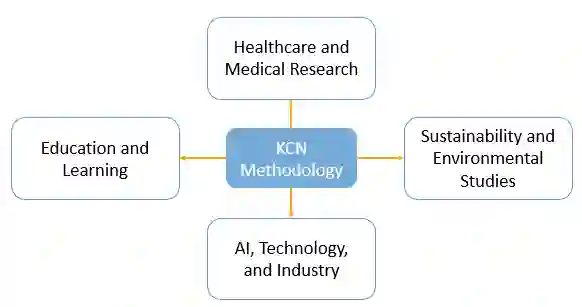
The study of research trends is pivotal for understanding scientific development on specific topics. Traditionally, this involves keyword analysis within scholarly literature, yet comprehensive tools for such analysis are scarce, especially those capable of parsing large datasets with precision. pyKCN, a Python toolkit, addresses this gap by automating keyword cleaning, extraction and trend analysis from extensive academic corpora. It is equipped with modules for text processing, deduplication, extraction, and advanced keyword co-occurrence and analysis, providing a granular view of research trends. This toolkit stands out by enabling researchers to visualize keyword relationships, thereby identifying seminal works and emerging trends. Its application spans diverse domains, enhancing scholars' capacity to understand developments within their fields. The implications of using pyKCN are significant. It offers an empirical basis for predicting research trends, which can inform funding directions, policy-making, and academic curricula. The code source and details can be found on: https://github.com/zhenyuanlu/pyKCN
翻译:研究趋势分析对于理解特定主题的科学进展至关重要。传统上,这一过程依赖于学术文献中的关键词分析,然而能够精确解析大规模数据集的全方位工具仍然稀缺。pyKCN 作为一款Python工具包,通过自动清洗、提取关键词及进行大规模学术语料库的趋势分析,填补了这一空白。该工具集成了文本处理、去重、提取以及高级关键词共现分析等模块,能够提供细粒度的研究趋势视图。其独特优势在于使研究者能够可视化关键词之间的关系,从而识别里程碑式成果与新兴趋势。该工具可广泛应用于多个学科领域,显著提升学者对其领域进展的认知能力。使用pyKCN的意义重大:它为研究趋势预测提供了实证基础,可服务于科研资金分配、政策制定及学术课程设计。代码与详细信息请参见:https://github.com/zhenyuanlu/pyKCN




相关内容




 微信扫码咨询专知VIP会员