

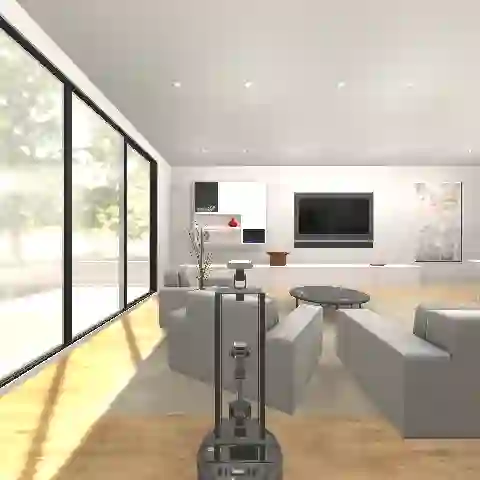
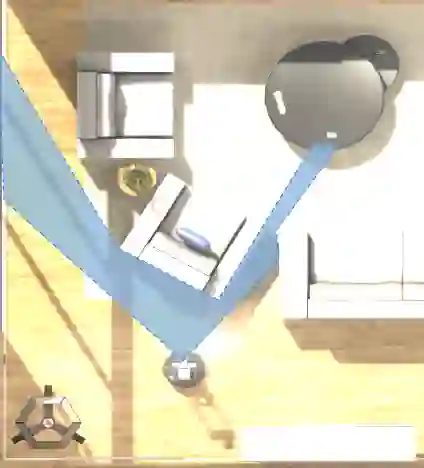
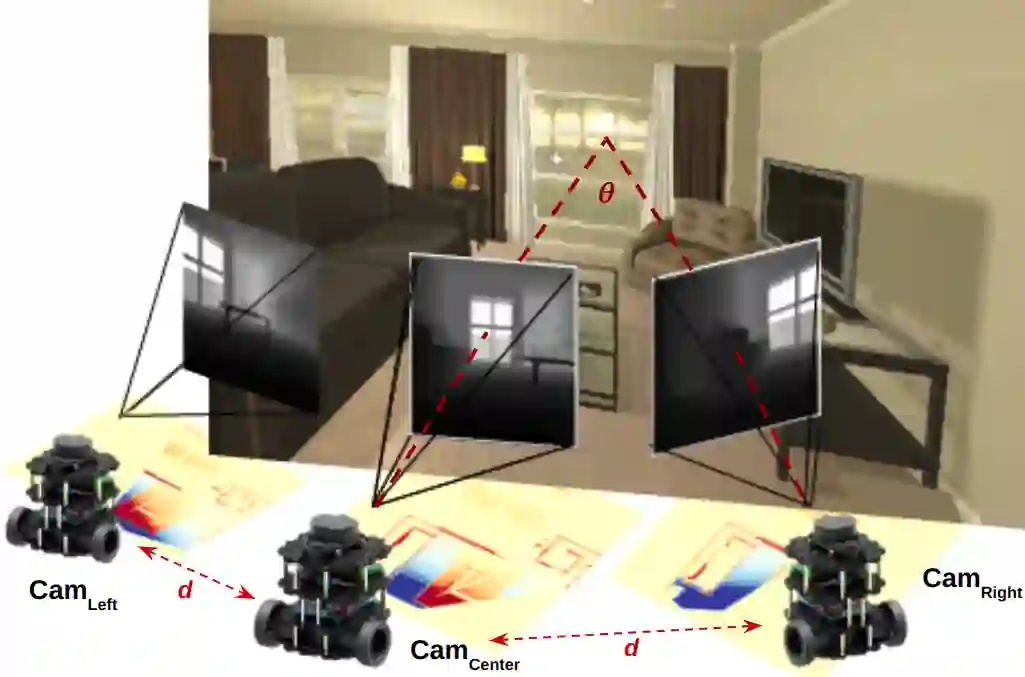
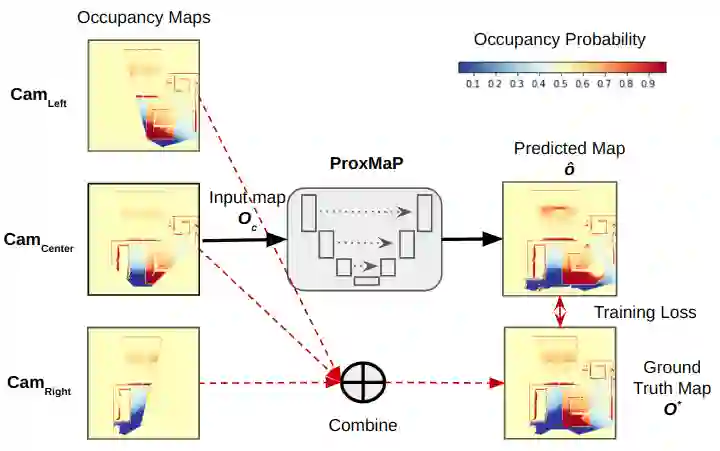
In a typical path planning pipeline for a ground robot, we build a map (e.g., an occupancy grid) of the environment as the robot moves around. While navigating indoors, a ground robot's knowledge about the environment may be limited due to occlusions. Therefore, the map will have many as-yet-unknown regions that may need to be avoided by a conservative planner. Instead, if a robot is able to correctly predict what its surroundings and occluded regions look like, the robot may be more efficient in navigation. In this work, we focus on predicting occupancy within the reachable distance of the robot to enable faster navigation and present a self-supervised proximity occupancy map prediction method, named ProxMaP. We show that ProxMaP generalizes well across realistic and real domains, and improves the robot navigation efficiency in simulation by \textbf{$12.40\%$} against the traditional navigation method. We share our findings on our project webpage (see https://raaslab.org/projects/ProxMaP ).
翻译:在典型的地面机器人路径规划流程中,机器人会随移动逐步构建环境地图(如占据栅格)。室内导航时,由于遮挡物的存在,地面机器人对环境的知识可能受限。因此,地图中会存在大量尚未探索的区域,保守型规划器需对其进行规避。反之,若机器人能准确预测其周围环境及遮挡区域的结构,则可提升导航效率。本研究聚焦于预测机器人可达距离内的占据状态以实现更快速导航,并提出一种名为ProxMaP的自监督近端占据地图预测方法。实验表明,ProxMaP在仿真和真实场景中均展现出良好的泛化能力,并在仿真环境中将机器人导航效率较传统方法提升\textbf{12.40\%}。相关成果已发布于项目主页(详见https://raaslab.org/projects/ProxMaP)。




相关内容





 微信扫码咨询专知VIP会员