

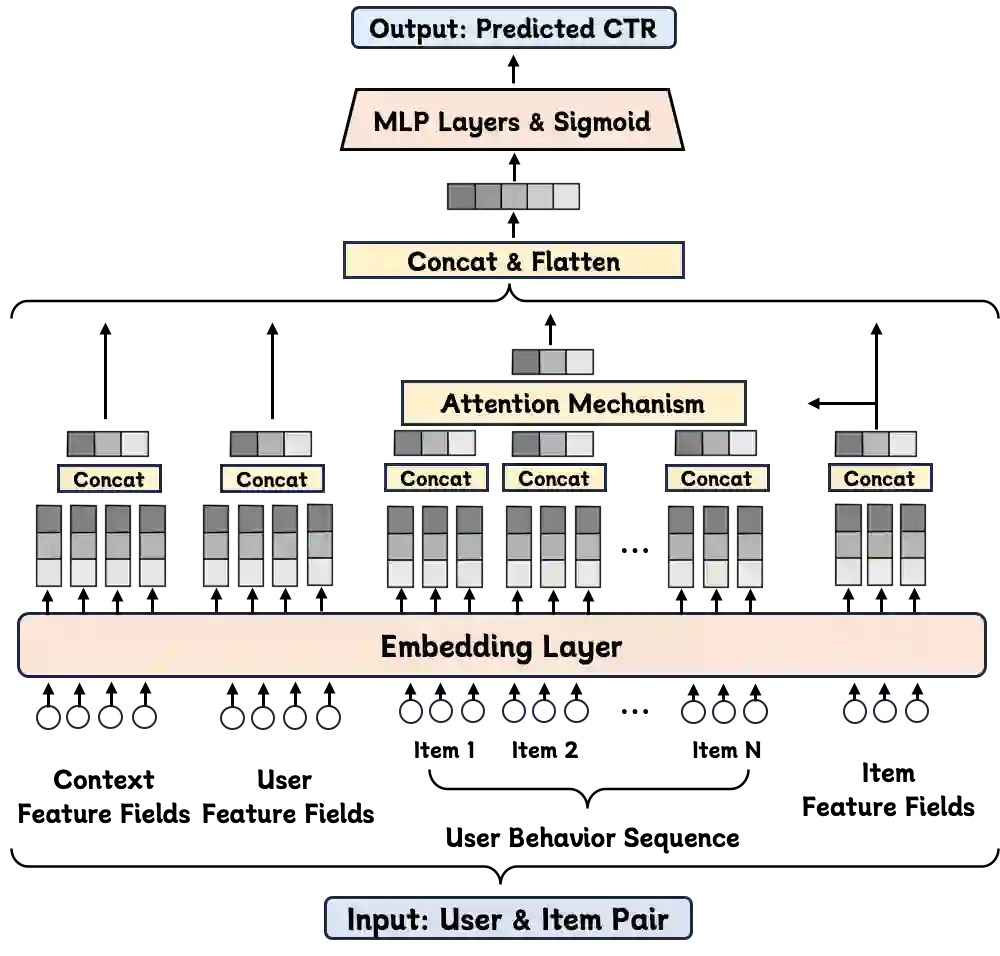
Compared to business-to-consumer (B2C) e-commerce systems, consumer-to-consumer (C2C) e-commerce platforms usually encounter the limited-stock problem, that is, a product can only be sold one time in a C2C system. This poses several unique challenges for click-through rate (CTR) prediction. Due to limited user interactions for each product (i.e. item), the corresponding item embedding in the CTR model may not easily converge. This makes the conventional sequence modeling based approaches cannot effectively utilize user history information since historical user behaviors contain a mixture of items with different volume of stocks. Particularly, the attention mechanism in a sequence model tends to assign higher score to products with more accumulated user interactions, making limited-stock products being ignored and contribute less to the final output. To this end, we propose the Meta-Split Network (MSNet) to split user history sequence regarding to the volume of stock for each product, and adopt differentiated modeling approaches for different sequences. As for the limited-stock products, a meta-learning approach is applied to address the problem of inconvergence, which is achieved by designing meta scaling and shifting networks with ID and side information. In addition, traditional approach can hardly update item embedding once the product is consumed. Thereby, we propose an auxiliary loss that makes the parameters updatable even when the product is no longer in distribution. To the best of our knowledge, this is the first solution addressing the recommendation of limited-stock product. Experimental results on the production dataset and online A/B testing demonstrate the effectiveness of our proposed method.
翻译:相比于企业对消费者(B2C)电商系统,消费者对消费者(C2C)电商平台通常面临限量库存问题,即同一商品在C2C系统中仅能销售一次。这给点击率(CTR)预测带来了若干独特挑战。由于每个商品(即物品)的用户交互有限,CTR模型中对应的物品嵌入难以收敛。这使得基于序列建模的传统方法无法有效利用用户历史信息,因为历史用户行为中混合了不同库存量的商品。特别地,序列模型中的注意力机制倾向于为累积用户交互更多的商品分配更高权重,导致限量库存商品被忽略且对最终输出的贡献降低。为此,我们提出元分割网络(MSNet),根据商品库存量对用户历史序列进行分割,并对不同序列采用差异化建模方法。对于限量库存商品,采用元学习方法解决嵌入不收敛问题——通过设计基于ID与侧信息的元缩放网络与元偏移网络实现。此外,传统方法在商品售罄后难以更新其物品嵌入。因此,我们提出一种辅助损失函数,使得即使商品脱离分布后参数仍可更新。据我们所知,这是首个解决限量库存商品推荐问题的方案。基于生产数据集与在线A/B测试的实验结果验证了所提方法的有效性。






相关内容





 微信扫码咨询专知VIP会员