

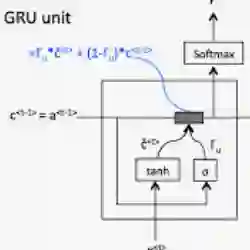
Existing research has shown the potential of classifying Alzheimers Disease (AD) from eye-tracking (ET) data with classifiers that rely on task-specific engineered features. In this paper, we investigate whether we can improve on existing results by using a Deep-Learning classifier trained end-to-end on raw ET data. This classifier (VTNet) uses a GRU and a CNN in parallel to leverage both visual (V) and temporal (T) representations of ET data and was previously used to detect user confusion while processing visual displays. A main challenge in applying VTNet to our target AD classification task is that the available ET data sequences are much longer than those used in the previous confusion detection task, pushing the limits of what is manageable by LSTM-based models. We discuss how we address this challenge and show that VTNet outperforms the state-of-the-art approaches in AD classification, providing encouraging evidence on the generality of this model to make predictions from ET data.
翻译:现有研究表明,通过依赖于特定任务手工设计特征的分类器,可从眼动追踪数据中对阿尔茨海默病进行分类。本文探究了能否通过端到端训练原始眼动数据的深度学习分类器来改进现有结果。该分类器(VTNet)并行使用门控循环单元和卷积神经网络,以同时利用眼动数据的视觉表征和时间表征,该模型此前曾用于检测用户处理视觉显示时的混淆状态。将VTNet应用于阿尔茨海默病分类任务的主要挑战在于:现有眼动数据序列远长于先前混淆检测任务所用的序列,这已达到基于长短期记忆网络模型的可处理极限。我们探讨了应对该挑战的方法,并证明VTNet在阿尔茨海默病分类中优于现有最优方法,为验证该模型从眼动数据预测的泛化性提供了令人振奋的证据。




相关内容



 微信扫码咨询专知VIP会员