

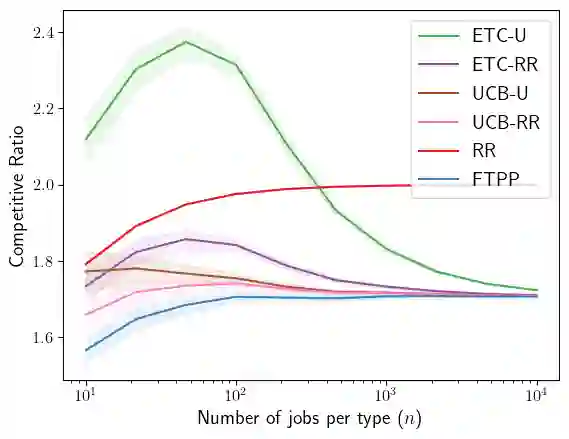
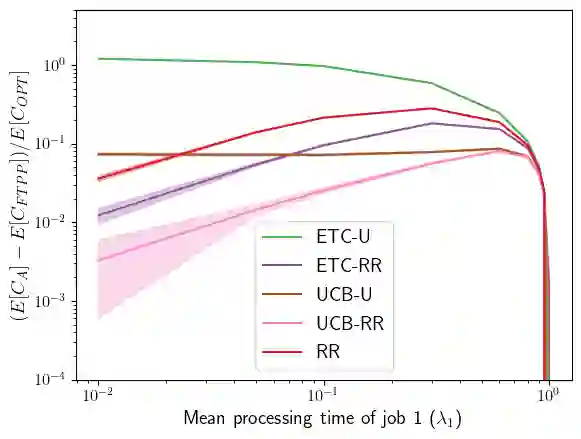
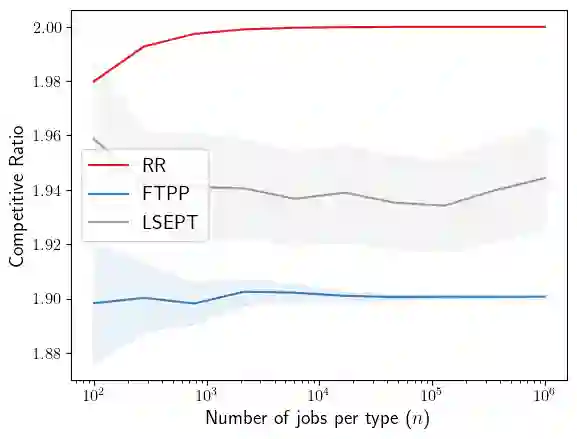
We study single-machine scheduling of jobs, each belonging to a job type that determines its duration distribution. We start by analyzing the scenario where the type characteristics are known and then move to two learning scenarios where the types are unknown: non-preemptive problems, where each started job must be completed before moving to another job; and preemptive problems, where job execution can be paused in the favor of moving to a different job. In both cases, we design algorithms that achieve sublinear excess cost, compared to the performance with known types, and prove lower bounds for the non-preemptive case. Notably, we demonstrate, both theoretically and through simulations, how preemptive algorithms can greatly outperform non-preemptive ones when the durations of different job types are far from one another, a phenomenon that does not occur when the type durations are known.
翻译:本文研究单机调度作业问题,每个作业隶属于一个决定其工期分布的工作类型。我们首先分析类型特征已知的场景,随后转向两种类型未知的学习场景:非抢占式问题(每个已启动的作业必须完成后才能切换至其他作业)与抢占式问题(作业执行可中断以优先处理其他作业)。针对这两种情形,我们设计的算法相比已知类型场景的性能实现了次线性超额成本,并证明了非抢占式问题的下界。值得注意的是,通过理论分析与仿真验证,我们发现当不同类型作业的工期差异显著时,抢占式算法的性能远优于非抢占式算法——这一现象在类型工期已知时并不会出现。





相关内容



 微信扫码咨询专知VIP会员