

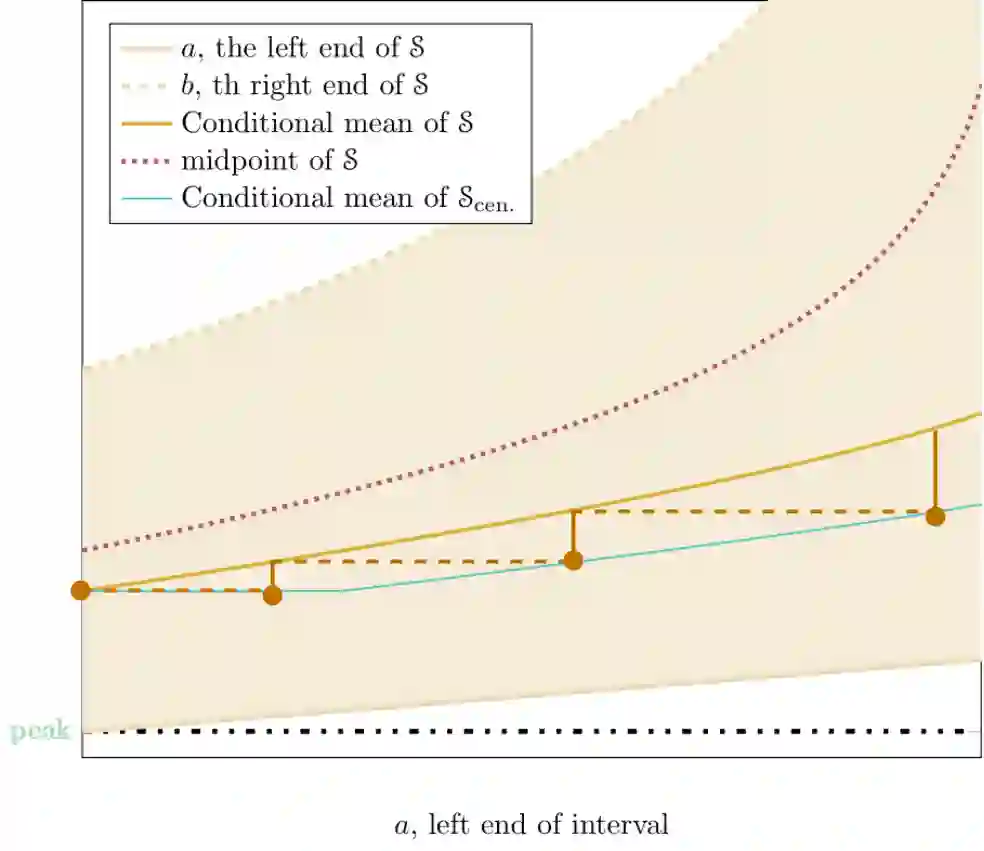
We study the probabilistic sampling of a random variable, in which the variable is sampled only if it falls outside a given set, which is called the silence set. This helps us to understand optimal event-based sampling for the special case of IID random processes, and also to understand the design of a sub-optimal scheme for other cases. We consider the design of this probabilistic sampling for a scalar, log-concave random variable, to minimize either the mean square estimation error, or the mean absolute estimation error. We show that the optimal silence interval: (i) is essentially unique, and (ii) is the limit of an iterative procedure of centering. Further we show through numerical experiments that super-level intervals seem to be remarkably near-optimal for mean square estimation. Finally we use the Gauss inequality for scalar unimodal densities, to show that probabilistic sampling gives a mean square distortion that is less than a third of the distortion incurred by periodic sampling, if the average sampling rate is between 0.3 and 0.9 samples per tick.
翻译:我们研究了一种随机变量的概率采样方法,其中变量仅当其落在给定集合(称为沉默集)之外时才被采样。这有助于理解独立同分布随机过程特殊情形下的最优事件驱动采样,以及理解其他情形下次优方案的设计。针对标量对数凹随机变量,我们考虑设计此类概率采样以最小化均方估计误差或平均绝对估计误差。研究表明:最优沉默区间 (i) 本质上唯一,且 (ii) 是中心化迭代过程的极限。进一步通过数值实验发现,超水平区间在均方估计中表现出显著的近似最优性。最后,利用标量单峰密度的高斯不等式证明:当平均采样率介于0.3至0.9样本/时间戳时,概率采样产生的均方失真小于周期采样失真的三分之一。




相关内容


 微信扫码咨询专知VIP会员