

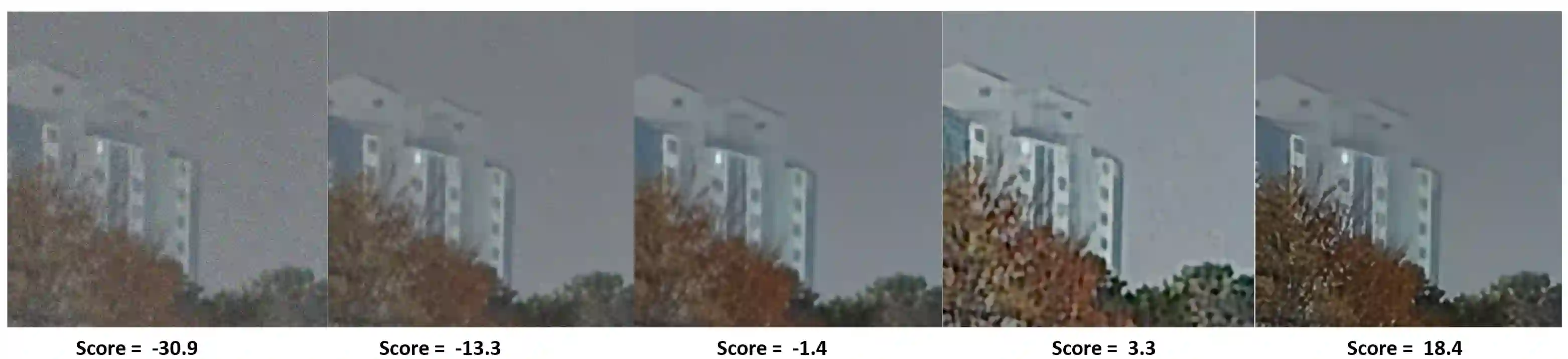
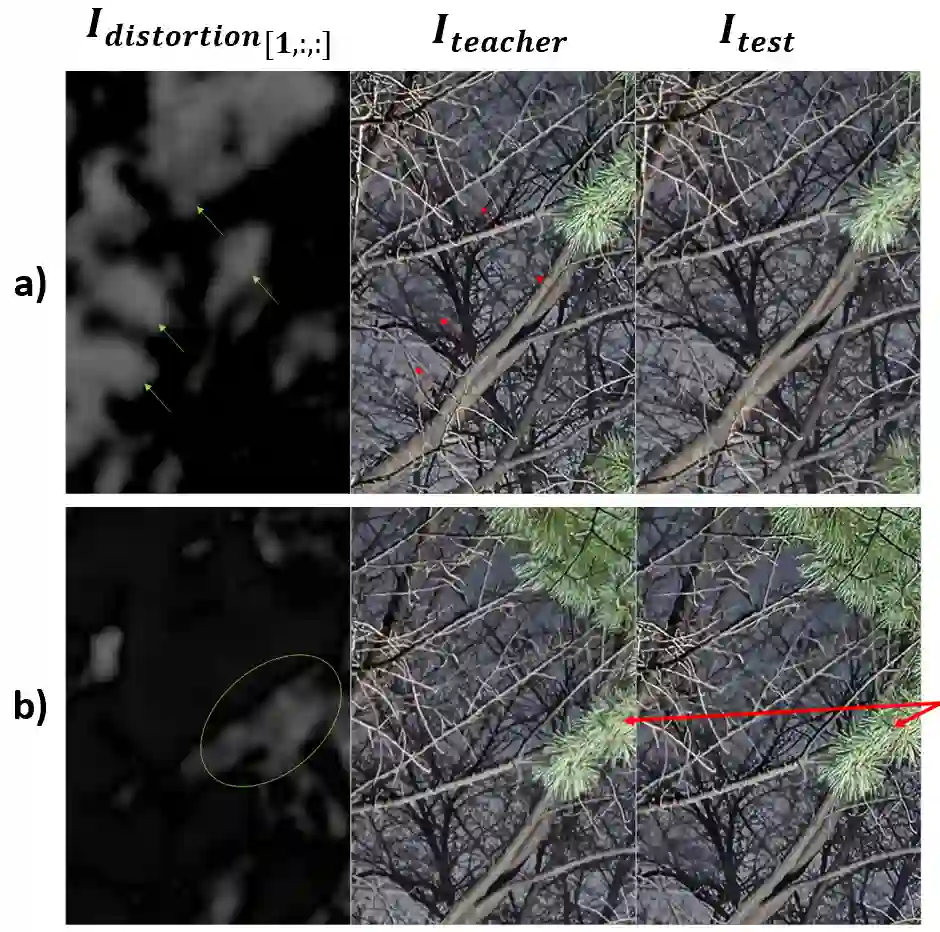
Traditional image quality assessment (IQA) methods rely on mean opinion scores (MOS), which are resource-intensive to collect and fail to provide interpretable, localized feedback on specific image distortions. We overcome these limitations by shifting from absolute quality prediction to a relational and directional assessment. Our approach utilizes a self-supervised synthetic distortion engine to generate training data, eliminating the need for manual annotation. A distortion prediction network is trained with an anti-symmetric objective to produce spatially-aware, disentangled maps that identify the type, intensity, and direction of distortions relative to a reference image. Subsequently, a scoring network is trained via contrastive learning on ordinally ranked image sets to predict a relational quality score. Our method provides a more granular and interpretable approach to IQA for the targeted optimization of image processing algorithms without requiring any human-labeled quality scores.
翻译:传统图像质量评估方法依赖平均意见分(MOS),其采集成本高昂且无法针对特定图像失真提供可解释的局部化反馈。我们通过将绝对质量预测转向关系型与方向性评估来克服这些限制。本方法采用自监督合成失真引擎生成训练数据,无需人工标注。失真预测网络以反对称目标函数进行训练,生成空间可感知的解耦映射图,从而识别相对于参考图像的失真类型、强度与方向。随后通过对比学习在序数排序图像集上训练评分网络,预测关系型质量分数。本方法为图像处理算法的定向优化提供了更精细且可解释的质量评估方案,且无需任何人工标注的质量分数。




相关内容
 微信扫码咨询专知VIP会员