

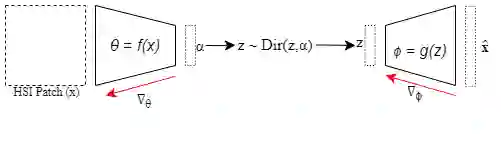
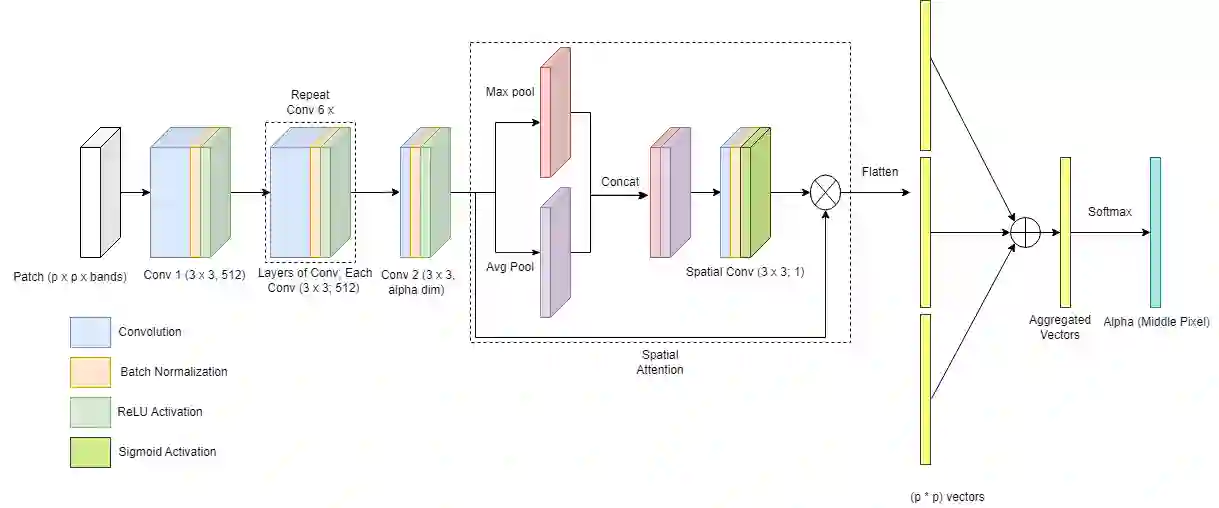
The Hyperspectral Unxming problem is to find the pure spectral signal of the underlying materials (endmembers) and their proportions (abundances). The proposed method builds upon the recently proposed method, Latent Dirichlet Variational Autoencoder (LDVAE). It assumes that abundances can be encoded as Dirichlet Distributions while mixed pixels and endmembers are represented by Multivariate Normal Distributions. However, LDVAE does not leverage spatial information present in an HSI; we propose an Isotropic CNN encoder with spatial attention to solve the hyperspectral unmixing problem. We evaluated our model on Samson, Hydice Urban, Cuprite, and OnTech-HSI-Syn-21 datasets. Our model also leverages the transfer learning paradigm for Cuprite Dataset, where we train the model on synthetic data and evaluate it on real-world data. We are able to observe the improvement in the results for the endmember extraction and abundance estimation by incorporating the spatial information. Code can be found at https://github.com/faisalqureshi/cnn-ldvae
翻译:高光谱解混问题旨在寻找底层物质的纯光谱信号(端元)及其比例(丰度)。所提出方法基于最新提出的潜狄利克雷变分自编码器(LDVAE)模型,该模型假设丰度可编码为狄利克雷分布,而混合像素与端元则由多元正态分布表示。然而,LDVAE未利用高光谱图像中的空间信息;为此,我们提出一种带有空间注意力的各向同性CNN编码器来解决高光谱解混问题。我们在Samson、Hydice Urban、Cuprite和OnTech-HSI-Syn-21数据集上评估了模型。针对Cuprite数据集,我们还利用了迁移学习范式,在合成数据上训练模型并在真实数据上进行评估。通过引入空间信息,我们在端元提取和丰度估计结果中观察到显著改进。代码详见https://github.com/faisalqureshi/cnn-ldvae




相关内容



 微信扫码咨询专知VIP会员