

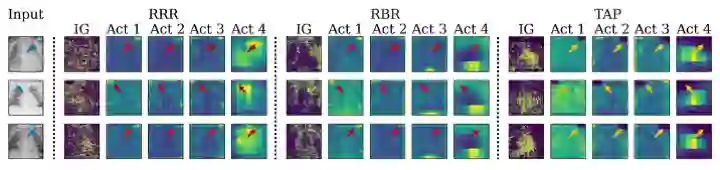
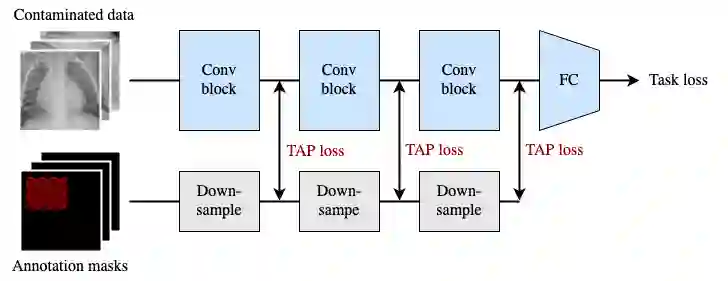
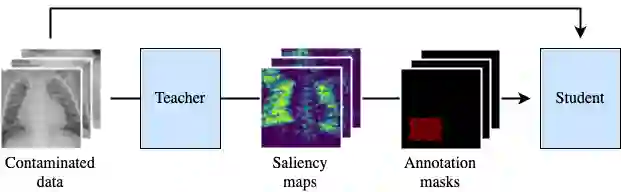
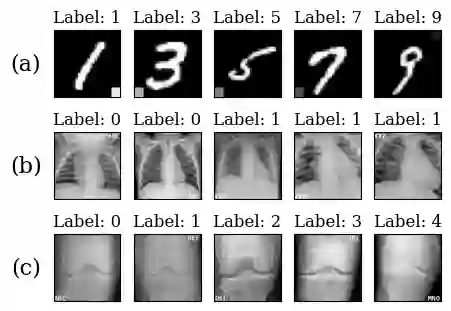
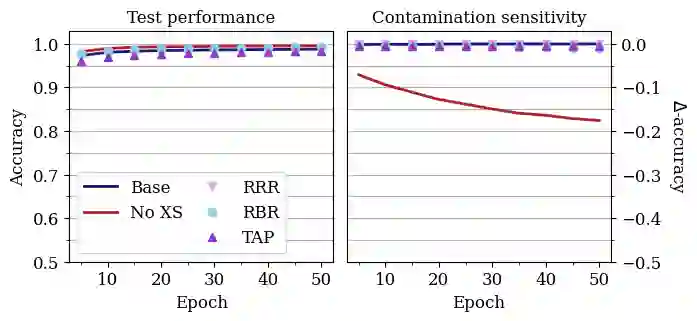
Neural networks (NNs) can learn to rely on spurious signals in the training data, leading to poor generalisation. Recent methods tackle this problem by training NNs with additional ground-truth annotations of such signals. These methods may, however, let spurious signals re-emerge in deep convolutional NNs (CNNs). We propose Targeted Activation Penalty (TAP), a new method tackling the same problem by penalising activations to control the re-emergence of spurious signals in deep CNNs, while also lowering training times and memory usage. In addition, ground-truth annotations can be expensive to obtain. We show that TAP still works well with annotations generated by pre-trained models as effective substitutes of ground-truth annotations. We demonstrate the power of TAP against two state-of-the-art baselines on the MNIST benchmark and on two clinical image datasets, using four different CNN architectures.
翻译:神经网络(NN)可能学习依赖训练数据中的虚假信号,从而导致泛化能力差。近期的方法通过使用这些信号的额外真实标注来训练神经网络以解决该问题,但这些方法可能使虚假信号在深度卷积神经网络(CNN)中重新出现。我们提出针对性激活惩罚(TAP),这是一种新方法,通过惩罚激活值来控制深度CNN中虚假信号的重新出现,同时降低训练时间和内存消耗。此外,真实标注的获取成本可能很高。我们证明,TAP在使用预训练模型生成的标注作为真实标注的有效替代时仍能良好工作。我们在MNIST基准测试和两个临床图像数据集上,使用四种不同的CNN架构,展示了TAP优于两个最先进基线的能力。




相关内容





 微信扫码咨询专知VIP会员