

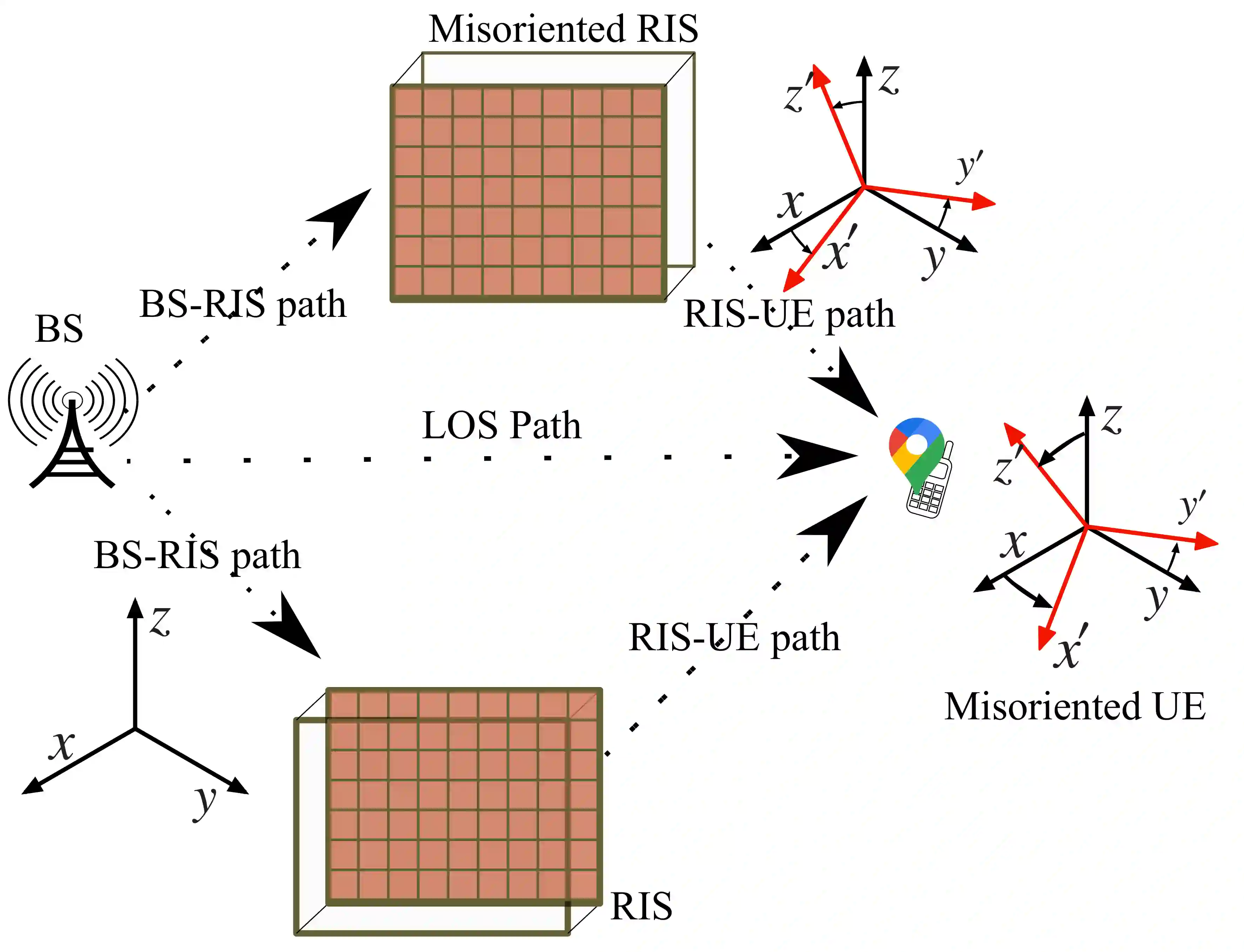
This paper presents a rigorous Bayesian analysis of the information in the signal (consisting of both the line-of-sight (LOS) path and reflections from multiple reconfigurable intelligent surfaces (RISs)) that originate from a single base station (BS) and is received by a user equipment (UE). For a comprehensive Bayesian analysis, both near and far field regimes are considered. The Bayesian analysis views both the location of the RISs and previous information about the UE as {\em a priori} information for UE localization. With outdated {\em a priori} information, the position and orientation offsets of the RISs become parameters that need to be estimated and fed back to the BS for correction. We first show that when the RIS elements have a half wavelength spacing, this RIS orientation offset is a factor in the pathloss of the RIS paths. Subsequently, we show through the Bayesian equivalent Fisher information matrix (EFIM) for the channel parameters that the RIS orientation offset cannot be corrected when there is an unknown phase offset in the received signal in the far-field regime. However, the corresponding EFIM for the channel parameters in the received signal observed in the near-field shows that this unknown phase offset does not hinder the estimation of the RIS orientation offset when the UE has more than one receive antenna. Furthermore, we use the EFIM for the UE location parameters to present bounds for UE localization in the presence of RIS uncertainty.
翻译:本文对单个基站(BS)发出的信号(包含视距(LOS)路径及多个可重构智能表面(RIS)的反射)中蕴含的信息进行了严格的贝叶斯分析,该信号由用户设备(UE)接收。为进行全面的贝叶斯分析,我们同时考虑了近场和远场两种场景。贝叶斯分析将RIS的位置信息及UE的先前信息视为UE定位的先验信息。当先验信息过时后,RIS的位置和方向偏移成为需要估计的参数,并需反馈至基站进行校正。我们首先证明,当RIS单元间距为半波长时,RIS方向偏移是影响RIS路径路径损耗的一个因子。随后,通过信道参数的贝叶斯等效费希尔信息矩阵(EFIM)表明,在远场场景下,若接收信号存在未知相位偏移,则无法校正RIS方向偏移。然而,近场观测到的接收信号中信道参数的对应EFIM显示,当UE具有多根接收天线时,该未知相位偏移不会阻碍RIS方向偏移的估计。此外,我们利用UE位置参数的EFIM,给出了存在RIS不确定性时UE定位的误差界。




相关内容




 微信扫码咨询专知VIP会员