

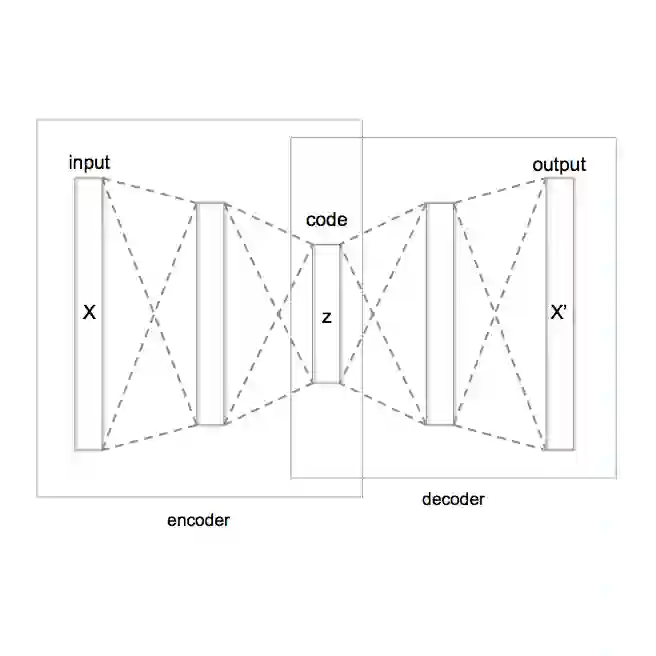
Quasiparticle interference (QPI) imaging is a powerful tool for probing electronic structures in quantum materials, but extracting the single-scatterer QPI pattern (i.e., the kernel) from a multi-scatterer image remains a fundamentally ill-posed inverse problem, because many different kernels can combine to produce almost the same observed image, and noise or overlaps further obscure the true signal. Existing solutions to this extraction problem rely on manually zooming into small local regions with isolated single-scatterers. This is infeasible for real cases where scattering conditions are too complex. In this work, we propose the first AI-based framework for QPI kernel extraction, which models the space of physically valid kernels and uses this knowledge to guide the inverse mapping. We introduce a two-step learning strategy that decouples kernel representation learning from observation-to-kernel inference. In the first step, we train a variational autoencoder to learn a compact latent space of scattering kernels. In the second step, we align the latent representation of QPI observations with those of the pre-learned kernels using a dedicated encoder. This design enables the model to infer kernels robustly under complex, entangled scattering conditions. We construct a diverse and physically realistic QPI dataset comprising 100 unique kernels and evaluate our method against a direct one-step baseline. Experimental results demonstrate that our approach achieves significantly higher extraction accuracy, improved generalization to unseen kernels. To further validate its effectiveness, we also apply the method to real QPI data from Ag and FeSe samples, where it reliably extracts meaningful kernels under complex scattering conditions.
翻译:准粒子干涉成像是一种探测量子材料电子结构的强大工具,但从多散射体图像中提取单散射体QPI模式(即核)仍然是一个本质上不适定的逆问题,因为许多不同的核可以组合产生几乎相同的观测图像,而噪声或重叠会进一步掩盖真实信号。现有解决该提取问题的方法依赖于手动放大到具有孤立单散射体的局部小区域。这在散射条件过于复杂的实际情况下是不可行的。本工作中,我们提出了首个基于人工智能的QPI核提取框架,该框架对物理有效核的空间进行建模,并利用此知识指导逆映射。我们引入了一种两步学习策略,将核表示学习与观测到核的推断解耦。第一步,我们训练一个变分自编码器来学习散射核的紧凑潜空间。第二步,我们使用专用编码器将QPI观测的潜表示与预学习核的潜表示对齐。该设计使模型能够在复杂、纠缠的散射条件下稳健地推断核。我们构建了一个包含100个独特核的多样化且物理真实的QPI数据集,并将我们的方法与直接的一步基线方法进行比较评估。实验结果表明,我们的方法实现了显著更高的提取精度,对未见核具有更好的泛化能力。为进一步验证其有效性,我们还将该方法应用于来自Ag和FeSe样品的真实QPI数据,在复杂散射条件下可靠地提取了有意义的核。




相关内容

 微信扫码咨询专知VIP会员