

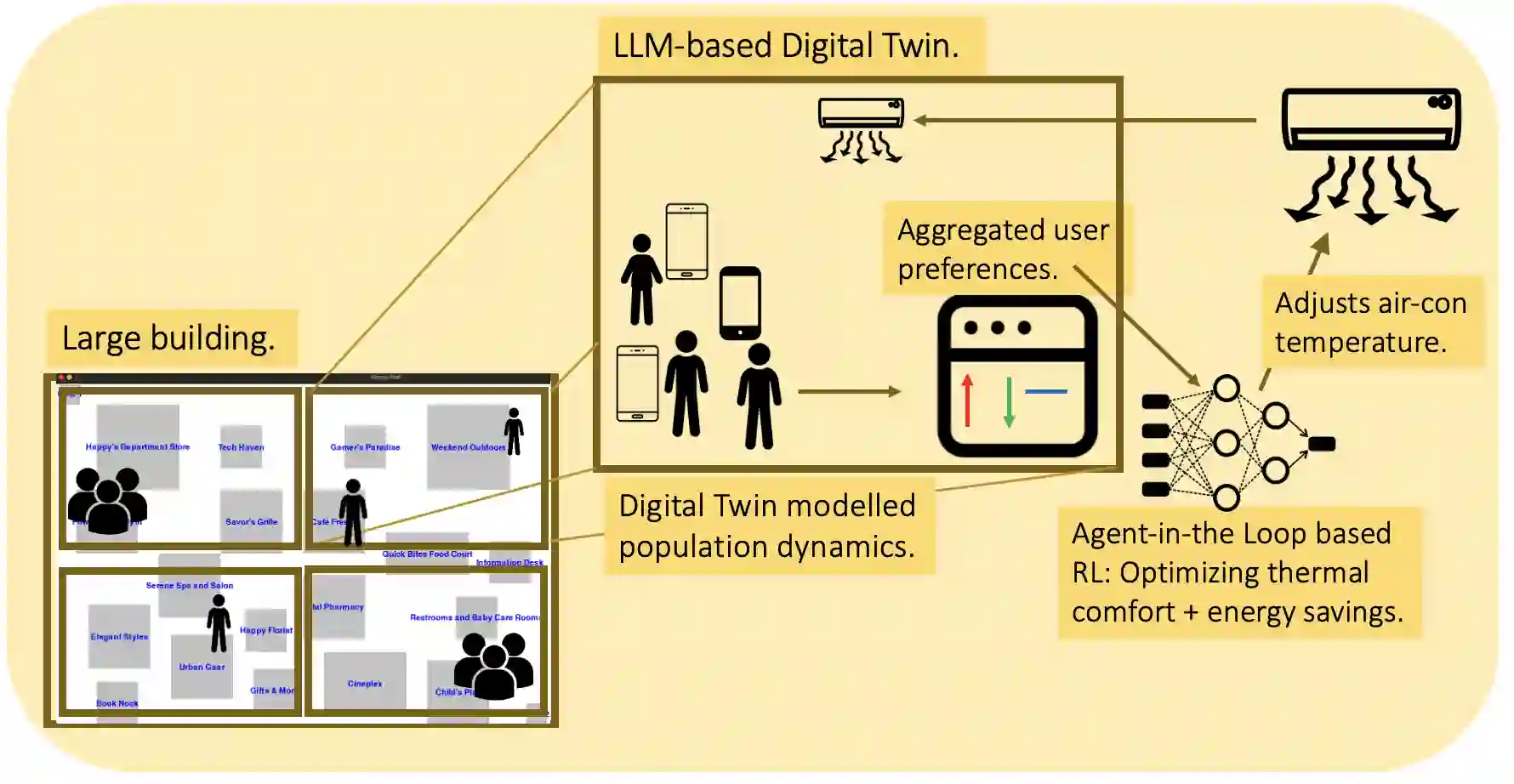
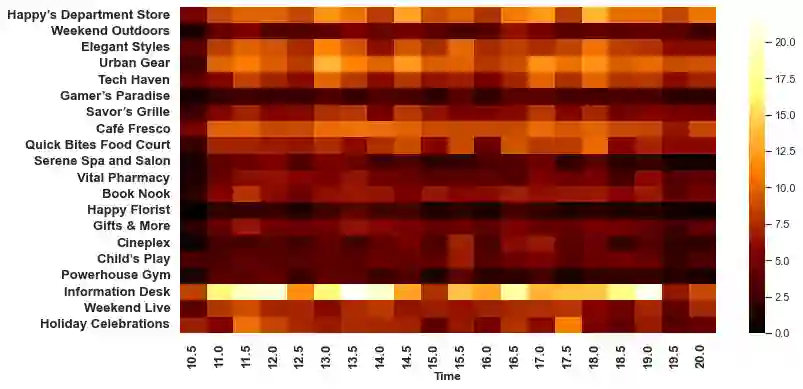
The increasing prevalence of Cyber-Physical Systems and the Internet of Things (CPS-IoT) applications and Foundation Models are enabling new applications that leverage real-time control of the environment. For example, real-time control of Heating, Ventilation and Air-Conditioning (HVAC) systems can reduce its usage when not needed for the comfort of human occupants, hence reducing energy consumption. Collecting real-time feedback on human preferences in such human-in-the-loop (HITL) systems, however, is difficult in practice. We propose the use of large language models (LLMs) to deal with the challenges of dynamic environments and difficult-to-obtain data in CPS optimization. In this paper, we present a case study that employs LLM agents to mimic the behaviors and thermal preferences of various population groups (e.g. young families, the elderly) in a shopping mall. The aggregated thermal preferences are integrated into an agent-in-the-loop based reinforcement learning algorithm AitL-RL, which employs the LLM as a dynamic simulation of the physical environment to learn how to balance between energy savings and occupant comfort. Our results show that LLMs are capable of simulating complex population movements within large open spaces. Besides, AitL-RL demonstrates superior performance compared to the popular existing policy of set point control, suggesting that adaptive and personalized decision-making is critical for efficient optimization in CPS-IoT applications. Through this case study, we demonstrate the potential of integrating advanced Foundation Models like LLMs into CPS-IoT to enhance system adaptability and efficiency. The project's code can be found on our GitHub repository.
翻译:随着信息物理系统与物联网(CPS-IoT)应用的日益普及以及基础模型的发展,人们得以构建利用环境实时控制的新型应用。例如,对供暖、通风与空调系统(HVAC)进行实时控制,可在无需保障人员舒适度时减少其运行能耗。然而,在这类人机协同(HITL)系统中,实时收集人类偏好反馈在实践中颇具挑战。我们提出利用大语言模型(LLMs)应对CPS优化中动态环境与数据获取困难的问题。本文通过案例研究,采用LLM智能体模拟购物中心中不同人群(如年轻家庭、老年人)的行为模式与热舒适偏好。将聚合后的热舒适偏好集成至基于智能体协同的强化学习算法AitL-RL中,该算法将LLM作为物理环境的动态仿真工具,学习如何在节能与人员舒适度之间取得平衡。研究结果表明,LLM能够有效模拟大型开放空间内复杂的人群移动模式。此外,与现有主流的设定点控制策略相比,AitL-RL展现出更优性能,表明自适应与个性化决策对CPS-IoT应用的高效优化至关重要。通过本案例研究,我们验证了将LLM等先进基础模型集成至CPS-IoT以增强系统适应性与效率的潜力。项目代码已发布至GitHub仓库。




相关内容



 微信扫码咨询专知VIP会员