

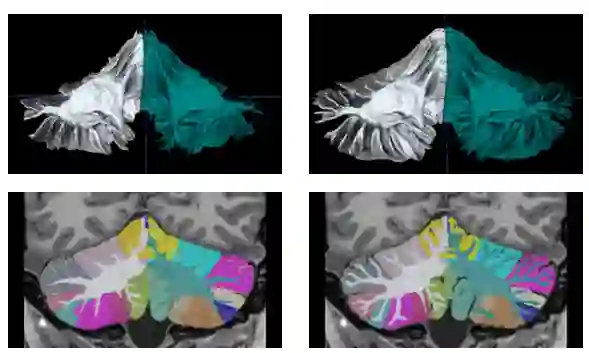
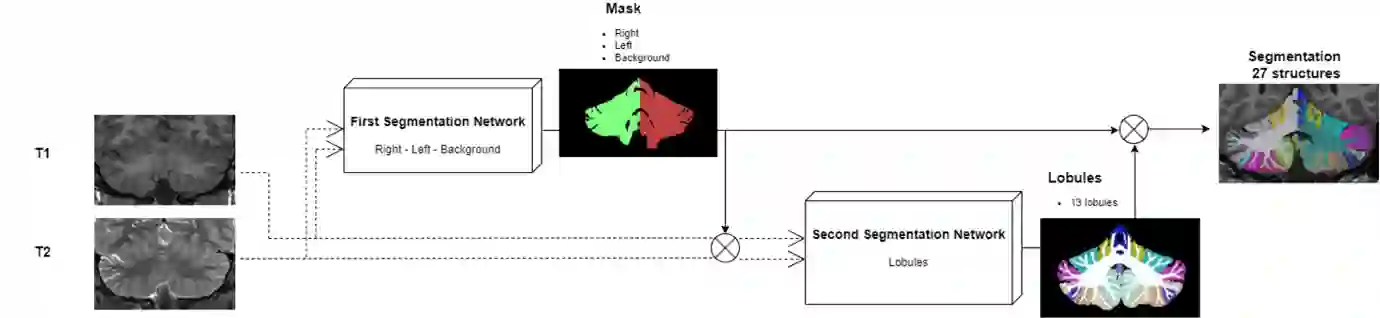
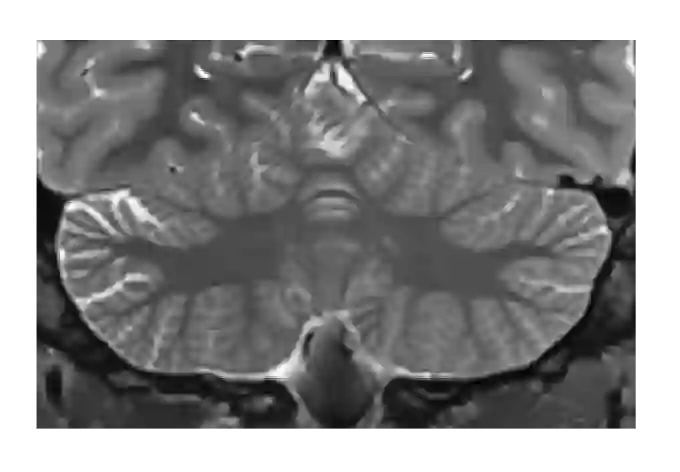
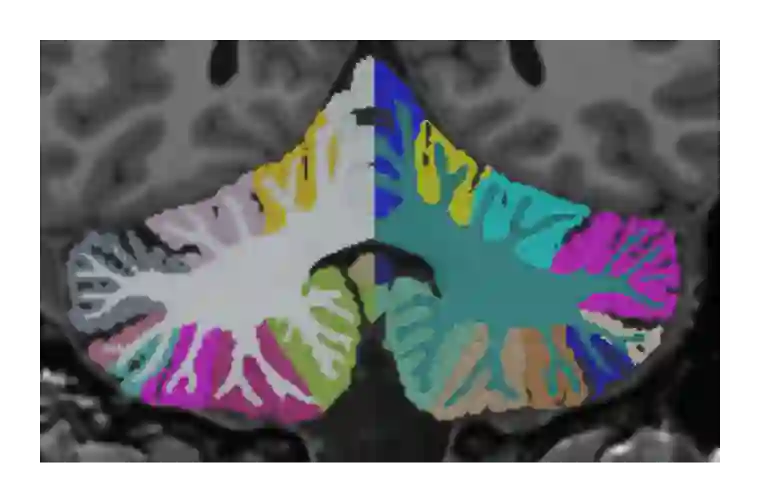
This paper introduces a novel multimodal and high-resolution human brain cerebellum lobule segmentation method. Unlike current tools that operate at standard resolution ($1 \text{ mm}^{3}$) or using mono-modal data, the proposed method improves cerebellum lobule segmentation through the use of a multimodal and ultra-high resolution ($0.125 \text{ mm}^{3}$) training dataset. To develop the method, first, a database of semi-automatically labelled cerebellum lobules was created to train the proposed method with ultra-high resolution T1 and T2 MR images. Then, an ensemble of deep networks has been designed and developed, allowing the proposed method to excel in the complex cerebellum lobule segmentation task, improving precision while being memory efficient. Notably, our approach deviates from the traditional U-Net model by exploring alternative architectures. We have also integrated deep learning with classical machine learning methods incorporating a priori knowledge from multi-atlas segmentation, which improved precision and robustness. Finally, a new online pipeline, named DeepCERES, has been developed to make available the proposed method to the scientific community requiring as input only a single T1 MR image at standard resolution.
翻译:本文提出了一种新颖的多模态高分辨率人脑小脑小叶分割方法。不同于当前使用标准分辨率($1 \text{ mm}^{3}$)或单模态数据的工具,该方法通过使用多模态超高分辨率($0.125 \text{ mm}^{3}$)训练数据集,提升了小脑小叶的分割性能。为开发该方法,首先构建了一个半自动标注的小脑小叶数据库,用于训练基于超高分辨率T1和T2 MR图像的模型。随后,设计并开发了一个深度网络集成模型,使所提方法在复杂的小脑小叶分割任务中表现出色,在提升精度的同时保持了内存效率。值得注意的是,本方法突破了传统U-Net模型的架构限制,探索了替代性网络结构。同时,我们将深度学习与经典机器学习方法相结合,通过引入多图谱分割的先验知识,进一步提高了精度和鲁棒性。最后,开发了一个名为DeepCERES的新型在线处理流程,仅需输入标准分辨率的单张T1 MR图像即可向科学界提供该方法。




相关内容


 微信扫码咨询专知VIP会员