

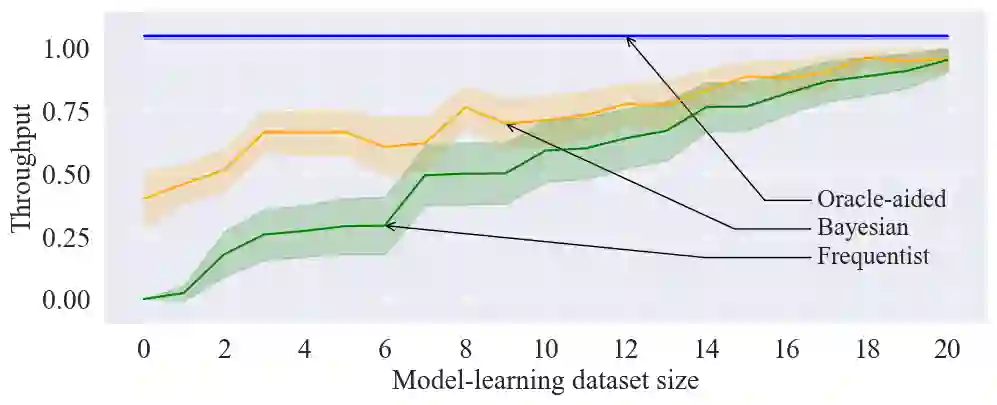
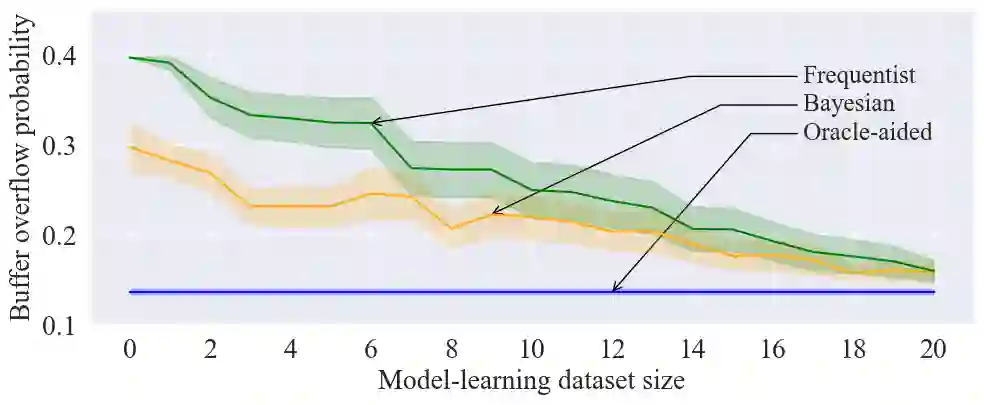
Commonly adopted in the manufacturing and aerospace sectors, digital twin (DT) platforms are increasingly seen as a promising paradigm to control and monitor software-based, "open", communication systems, which play the role of the physical twin (PT). In the general framework presented in this work, the DT builds a Bayesian model of the communication system, which is leveraged to enable core DT functionalities such as control via multi-agent reinforcement learning (MARL) and monitoring of the PT for anomaly detection. We specifically investigate the application of the proposed framework to a simple case-study system encompassing multiple sensing devices that report to a common receiver. The Bayesian model trained at the DT has the key advantage of capturing epistemic uncertainty regarding the communication system, e.g., regarding current traffic conditions, which arise from limited PT-to-DT data transfer. Experimental results validate the effectiveness of the proposed Bayesian framework as compared to standard frequentist model-based solutions.
翻译:数字孪生平台普遍应用于制造业和航空航天领域,正日益被视为控制和监测基于软件的"开放"通信系统(承担物理孪生角色)的理想范式。本文提出的通用框架中,数字孪生构建了通信系统的贝叶斯模型,该模型被用于实现数字孪生的核心功能,包括通过多智能体强化学习进行控制,以及对物理孪生进行异常检测监控。我们专门研究了所提框架在包含多个向公共接收器报告数据的传感设备的简单案例系统中的应用。在数字孪生上训练的贝叶斯模型具有关键优势,能够捕获关于通信系统的认知不确定性(例如当前流量状况),这些不确定性源于物理孪生到数字孪生的有限数据传输。实验结果验证了所提贝叶斯框架相比标准频率学派模型解决方案的有效性。







相关内容




 微信扫码咨询专知VIP会员