

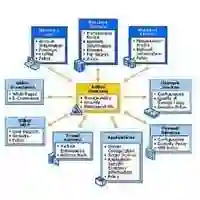
The concept of the federated Cloud-Edge-IoT continuum promises to alleviate many woes of current systems, improving resource use, energy efficiency, quality of service, and more. However, this continuum is still far from being realized in practice, with no comprehensive solutions for developing, deploying, and managing continuum-native applications. Breakthrough innovations and novel system architectures are needed to cope with the ever-increasing heterogeneity and the multi-stakeholder nature of computing resources. This work proposes a novel architecture for choreographing workloads in the continuum, attempting to address these challenges. The architecture that tackles this issue comprehensively, spanning from the workloads themselves, through networking and data exchange, up to the orchestration and choreography mechanisms. The concept emphasizes the use of varied AI techniques, enabling autonomous and intelligent management of resources and workloads. Open standards are also a key part of the proposition, making it possible to fully engage third parties in multi-stakeholder scenarios. Although the presented architecture is promising, much work is required to realize it in practice. To this end, the key directions for future research are outlined.
翻译:联邦云-边缘-物联网连续体的概念有望缓解当前系统的诸多弊端,改善资源利用、能源效率、服务质量等方面。然而,这一连续体在实践中仍远未实现,目前尚无开发、部署和管理连续体原生应用的综合解决方案。为应对计算资源日益增长的异构性和多利益相关方特性,需要突破性创新和新型系统架构。本文提出了一种在连续体中编排工作负载的新型架构,试图解决上述挑战。该架构全面应对这一问题,涵盖工作负载本身、网络与数据交换,乃至编排与编舞机制。该概念强调运用多样化的人工智能技术,实现资源和工作负载的自主智能管理。开放标准也是该方案的关键组成部分,使得在多利益相关方场景中能够充分引入第三方。尽管所提出的架构前景广阔,但真正实现它仍需大量工作。为此,本文概述了未来研究的关键方向。




相关内容




 微信扫码咨询专知VIP会员