

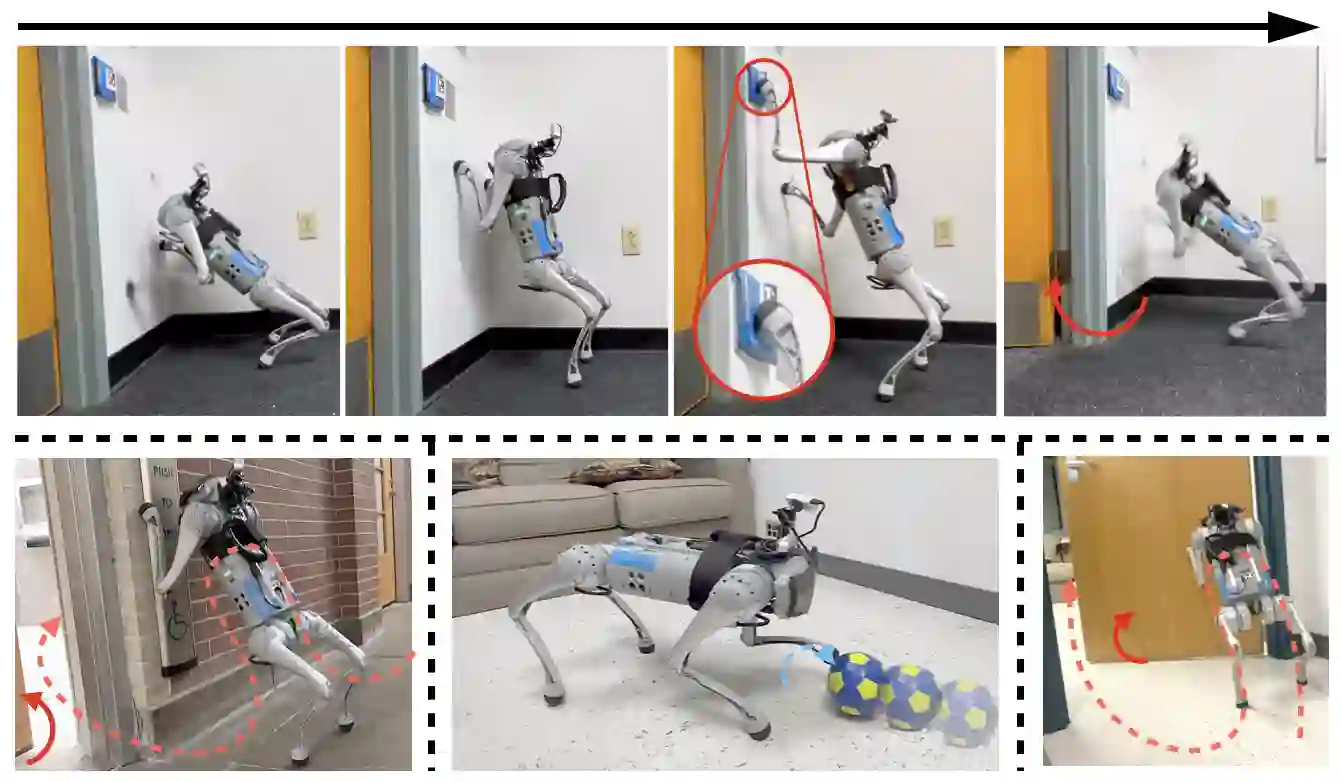
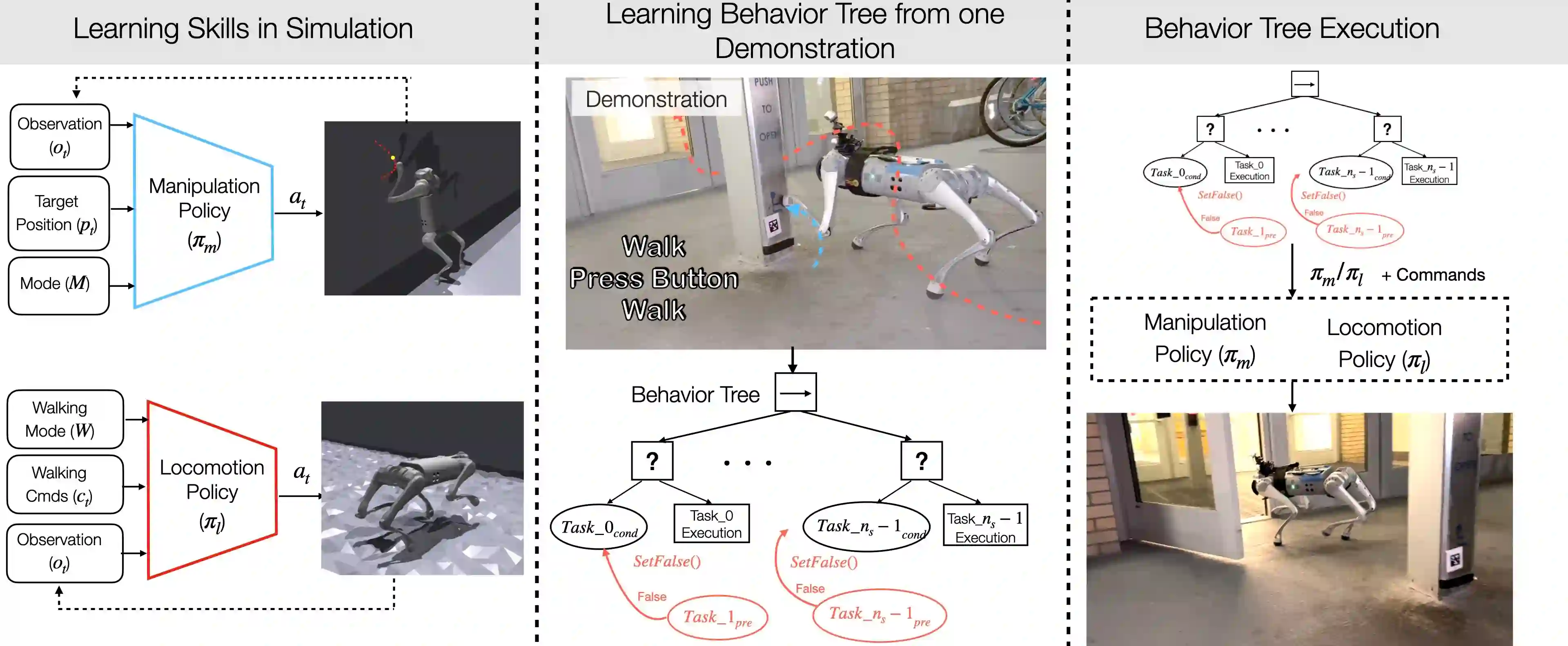
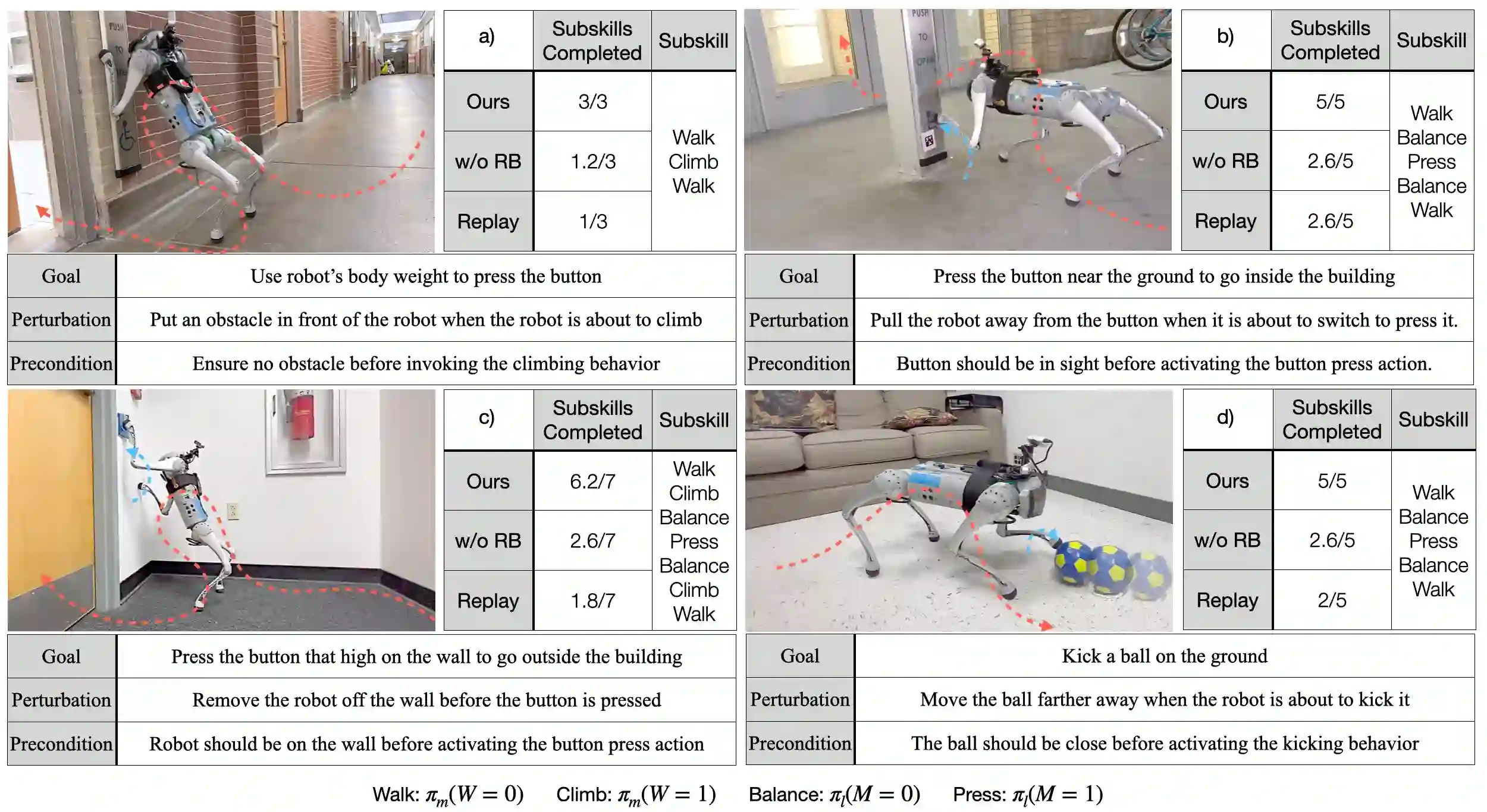
Locomotion has seen dramatic progress for walking or running across challenging terrains. However, robotic quadrupeds are still far behind their biological counterparts, such as dogs, which display a variety of agile skills and can use the legs beyond locomotion to perform several basic manipulation tasks like interacting with objects and climbing. In this paper, we take a step towards bridging this gap by training quadruped robots not only to walk but also to use the front legs to climb walls, press buttons, and perform object interaction in the real world. To handle this challenging optimization, we decouple the skill learning broadly into locomotion, which involves anything that involves movement whether via walking or climbing a wall, and manipulation, which involves using one leg to interact while balancing on the other three legs. These skills are trained in simulation using curriculum and transferred to the real world using our proposed sim2real variant that builds upon recent locomotion success. Finally, we combine these skills into a robust long-term plan by learning a behavior tree that encodes a high-level task hierarchy from one clean expert demonstration. We evaluate our method in both simulation and real-world showing successful executions of both short as well as long-range tasks and how robustness helps confront external perturbations. Videos at https://robot-skills.github.io
翻译:运动能力在穿越复杂地形的行走或奔跑方面取得了显著进展。然而,机器人四足动物仍远落后于其生物 counterparts,例如狗,后者展现出多种敏捷技能,并能利用腿部执行超越运动范围的基本操作任务,如物体交互和攀爬。本文通过训练四足机器人不仅能够行走,还能在现实世界中使用前腿攀爬墙壁、按压按钮以及执行物体交互,向缩小这一差距迈出一步。为应对这一具有挑战性的优化问题,我们将技能学习大致解耦为运动技能和操作技能:运动涉及任何与移动相关的行为(如行走或攀爬墙壁),操作则涉及利用一条腿进行交互,同时用其余三条腿保持平衡。这些技能在仿真环境中通过课程学习进行训练,并通过我们提出的基于近期运动成功案例的 sim2real 变体方法迁移至现实世界。最后,我们通过从一次干净专家演示中学习编码高层次任务层级的行为树,将这些技能整合为稳健的长周期规划。我们在仿真和现实世界中评估了该方法,展示了短程和长程任务的成功执行,以及鲁棒性如何帮助应对外部干扰。视频链接:https://robot-skills.github.io




相关内容




 微信扫码咨询专知VIP会员