

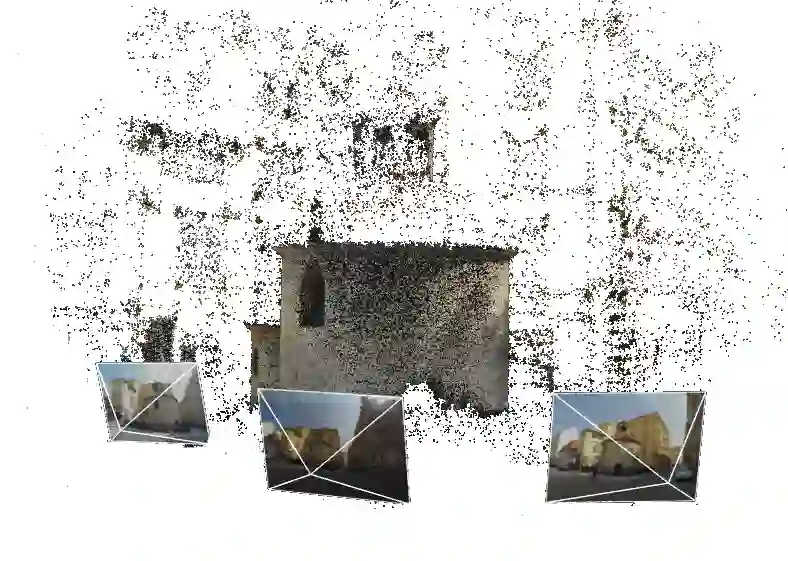
We study the challenging problem of estimating the relative pose of three calibrated cameras. We propose two novel solutions to the notoriously difficult configuration of four points in three views, known as the 4p3v problem. Our solutions are based on the simple idea of generating one additional virtual point correspondence in two views by using the information from the locations of the four input correspondences in the three views. For the first solver, we train a network to predict this point correspondence. The second solver uses a much simpler and more efficient strategy based on the mean points of three corresponding input points. The new solvers are efficient and easy to implement since they are based on the existing efficient minimal solvers, i.e., the well-known 5-point relative pose and the P3P solvers. The solvers achieve state-of-the-art results on real data. The idea of solving minimal problems using virtual correspondences is general and can be applied to other problems, e.g., the 5-point relative pose problem. In this way, minimal problems can be solved using simpler non-minimal solvers or even using sub-minimal samples inside RANSAC. In addition, we compare different variants of 4p3v solvers with the baseline solver for the minimal configuration consisting of three triplets of points and two points visible in two views. We discuss which configuration of points is potentially the most practical in real applications.
翻译:我们研究了三个标定相机相对位姿估计这一具有挑战性的问题。针对三视图四点配置(即著名的4p3v问题)这一公认的棘手场景,我们提出了两种新颖的求解方案。这两种方案基于一个简单的思路:通过利用三视图中四个输入对应点的位置信息,在两视图中生成一个额外的虚拟点对应。对于第一种求解器,我们训练了一个网络来预测该点对应关系。第二种求解器则采用基于三个输入对应点平均点的更简单高效的策略。新求解器基于现有的高效最小求解器(即著名的五点相对位姿求解器和P3P求解器),因此兼具高效性和易实现性。在真实数据上,这些求解器达到了当前最优水平。利用虚拟对应解决最小问题的思路具有普适性,可推广至其他问题(如五点相对位姿问题)。通过这种方式,最小问题得以使用更简单的非最小求解器甚至RANSAC框架内的次最小样本进行求解。此外,我们还将不同变体的4p3v求解器与基于三组三点对(含两视图可见的两点)的最小配置基准求解器进行了比较,并讨论了实际应用中最具实用潜力的点配置方案。




相关内容


 微信扫码咨询专知VIP会员