

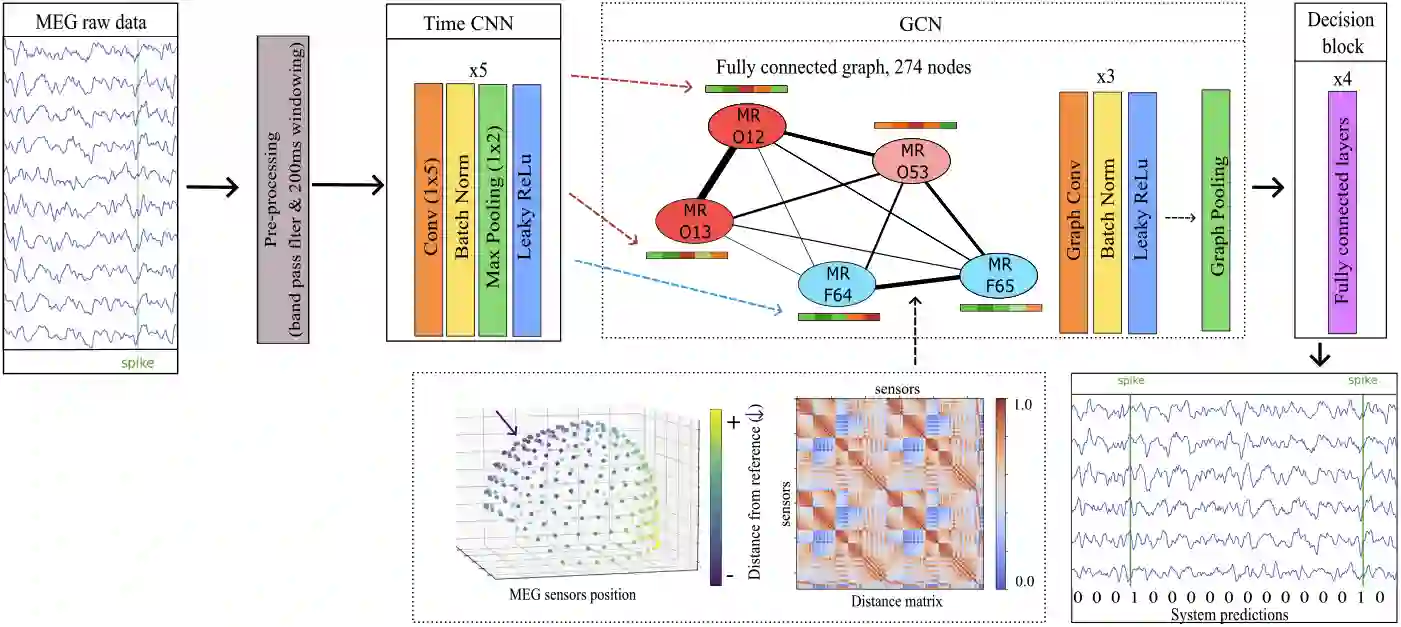
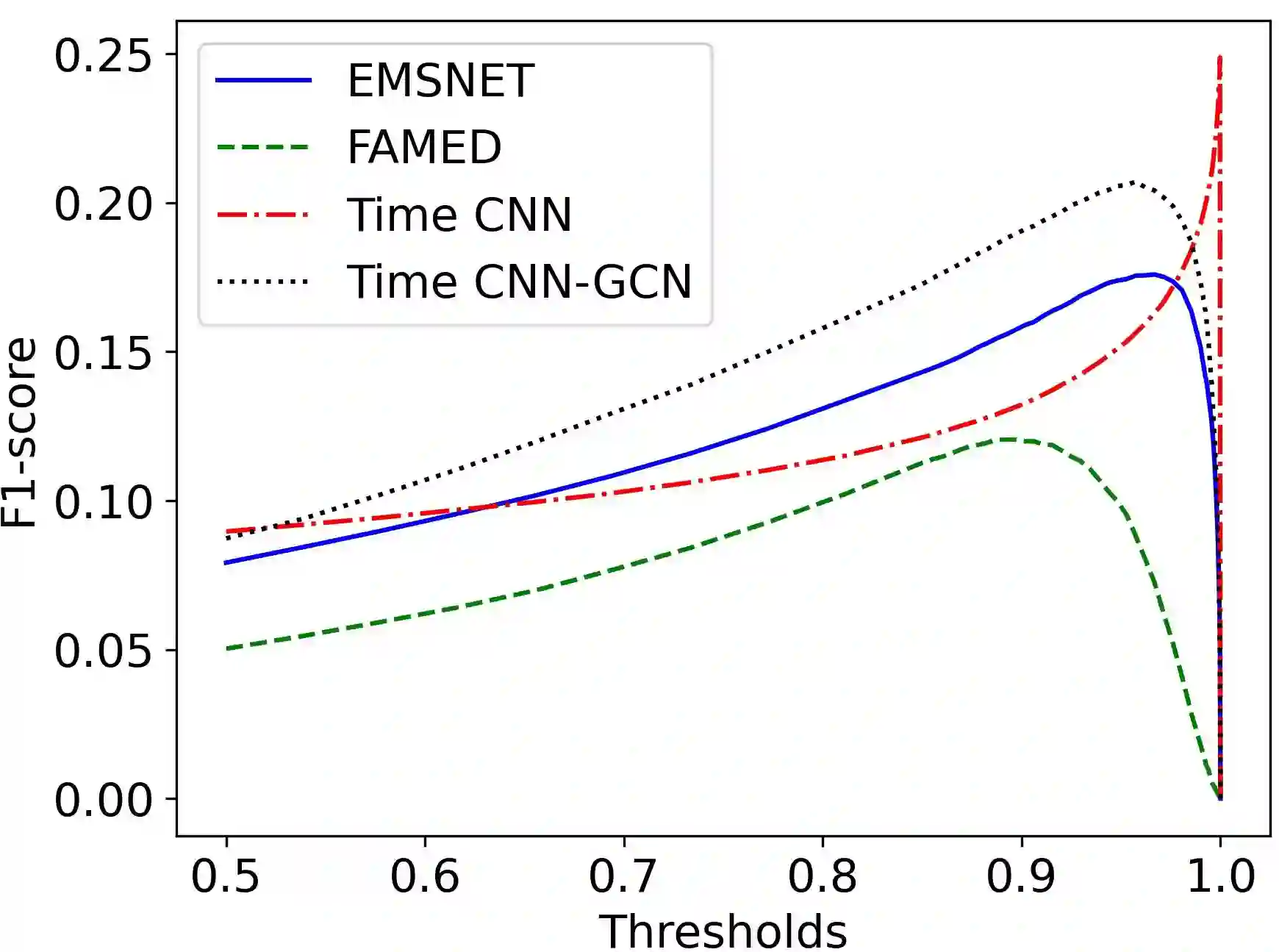
Magnetoencephalography (MEG) recordings of patients with epilepsy exhibit spikes, a typical biomarker of the pathology. Detecting those spikes allows accurate localization of brain regions triggering seizures. Spike detection is often performed manually. However, it is a burdensome and error prone task due to the complexity of MEG data. To address this problem, we propose a 1D temporal convolutional neural network (Time CNN) coupled with a graph convolutional network (GCN) to classify short time frames of MEG recording as containing a spike or not. Compared to other recent approaches, our models have fewer parameters to train and we propose to use a GCN to account for MEG sensors spatial relationships. Our models produce clinically relevant results and outperform deep learning-based state-of-the-art methods reaching a classification f1-score of 76.7% on a balanced dataset and of 25.5% on a realistic, highly imbalanced dataset, for the spike class.
翻译:脑磁图(MEG)记录中癫痫患者的信号呈现棘波,这是该病理的典型生物标志物。检测这些棘波可准确定位引发癫痫发作的脑区。棘波检测常由人工完成,但由于MEG数据的复杂性,这是一项繁琐且易出错的任务。为解决该问题,我们提出一种结合一维时间卷积神经网络(Time CNN)与图卷积网络(GCN)的方法,用于分类MEG记录的短时片段是否包含棘波。与近期其他方法相比,我们的模型参数量更少,并采用GCN建模MEG传感器空间关系。该模型取得了临床相关结果,在平衡数据集上棘波分类f1分数达76.7%,在现实高度不平衡数据集上达25.5%,优于基于深度学习的现有最优方法。




相关内容




 微信扫码咨询专知VIP会员