

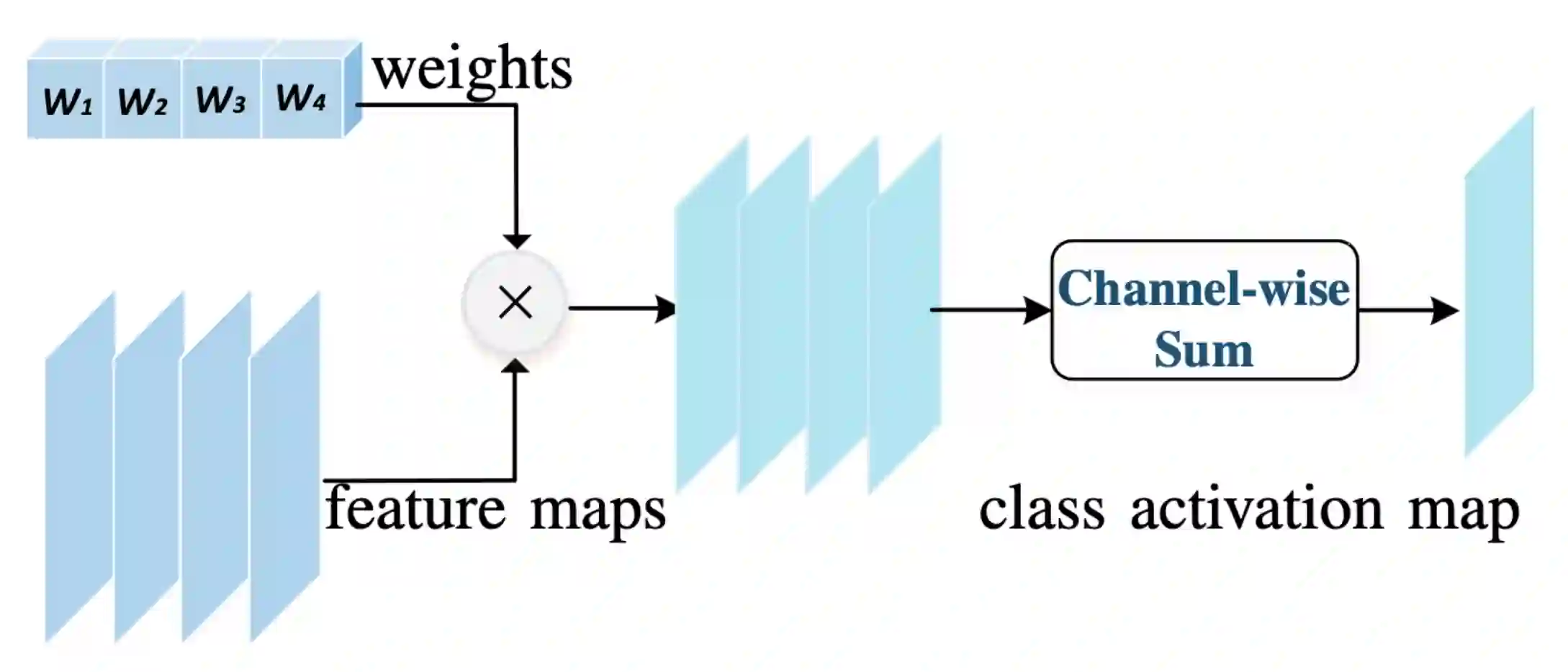
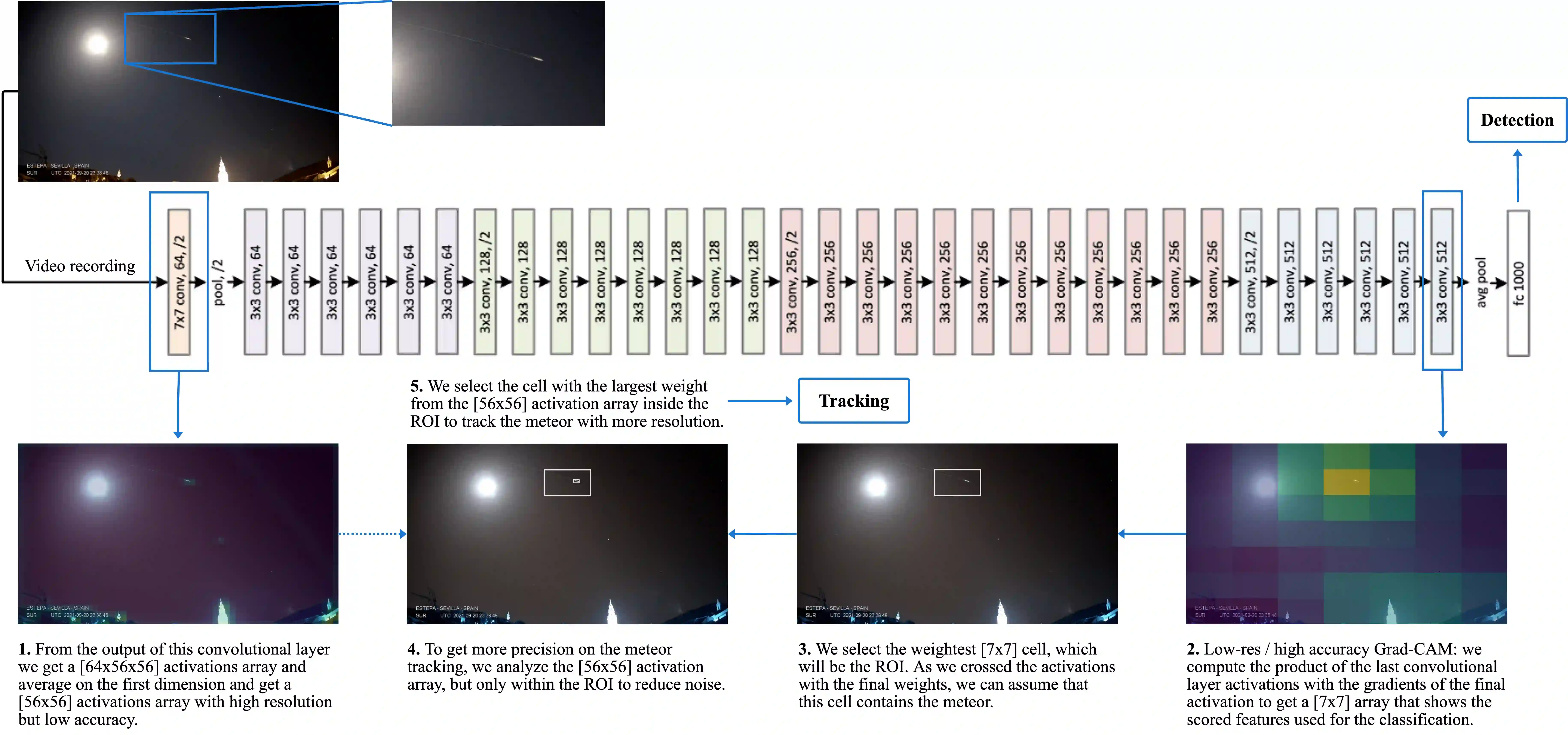
In recent decades, the use of optical detection systems for meteor studies has increased dramatically, resulting in huge amounts of data being analyzed. Automated meteor detection tools are essential for studying the continuous meteoroid incoming flux, recovering fresh meteorites, and achieving a better understanding of our Solar System. Concerning meteor detection, distinguishing false positives between meteor and non-meteor images has traditionally been performed by hand, which is significantly time-consuming. To address this issue, we developed a fully automated pipeline that uses Convolutional Neural Networks (CNNs) to classify candidate meteor detections. Our new method is able to detect meteors even in images that contain static elements such as clouds, the Moon, and buildings. To accurately locate the meteor within each frame, we employ the Gradient-weighted Class Activation Mapping (Grad-CAM) technique. This method facilitates the identification of the region of interest by multiplying the activations from the last convolutional layer with the average of the gradients across the feature map of that layer. By combining these findings with the activation map derived from the first convolutional layer, we effectively pinpoint the most probable pixel location of the meteor. We trained and evaluated our model on a large dataset collected by the Spanish Meteor Network (SPMN) and achieved a precision of 98\%. Our new methodology presented here has the potential to reduce the workload of meteor scientists and station operators and improve the accuracy of meteor tracking and classification.
翻译:近几十年来,用于流星研究的光学探测系统应用急剧增加,导致产生海量待分析数据。自动化流星探测工具对于研究持续的小天体流注入通量、回收新鲜陨石以及深化对太阳系的理解至关重要。在流星检测领域,传统上依靠人工分辨流星与非流星图像中的误报案例,这极其耗时。为解决这一问题,我们开发了全自动流水线,采用卷积神经网络对候选流星探测结果进行分类。即使图像中包含云层、月球和建筑物等静态元素,我们的新方法仍能有效检测流星。为精确定位每帧图像中的流星位置,我们采用了梯度加权类激活映射技术。该方法通过将最后一个卷积层的激活值与对应特征图梯度的平均值相乘,实现感兴趣区域的识别。结合第一卷积层的激活图,我们可精确锁定流星最可能的像素位置。我们使用西班牙流星网络收集的大规模数据集对模型进行训练与评估,实现了98%的精确率。本文提出的新方法有望减轻流星科学家与监测站操作员的工作负担,同时提升流星追踪与分类的准确度。






相关内容



 微信扫码咨询专知VIP会员