

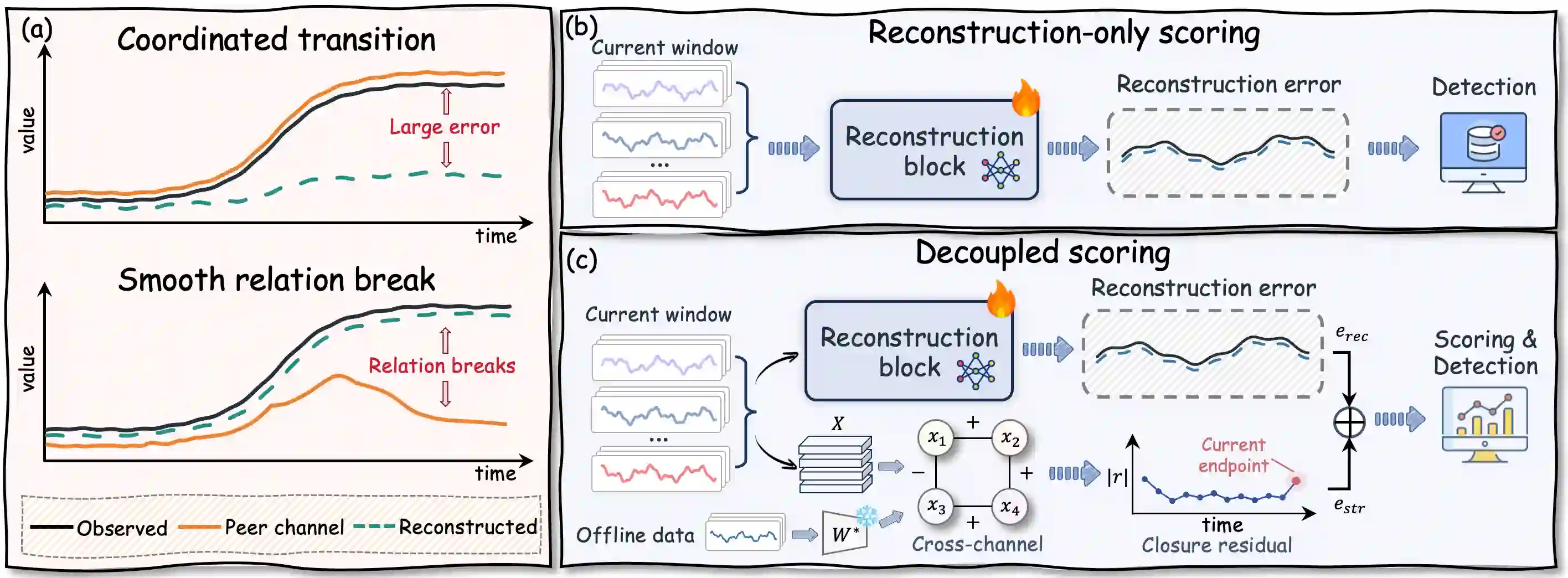
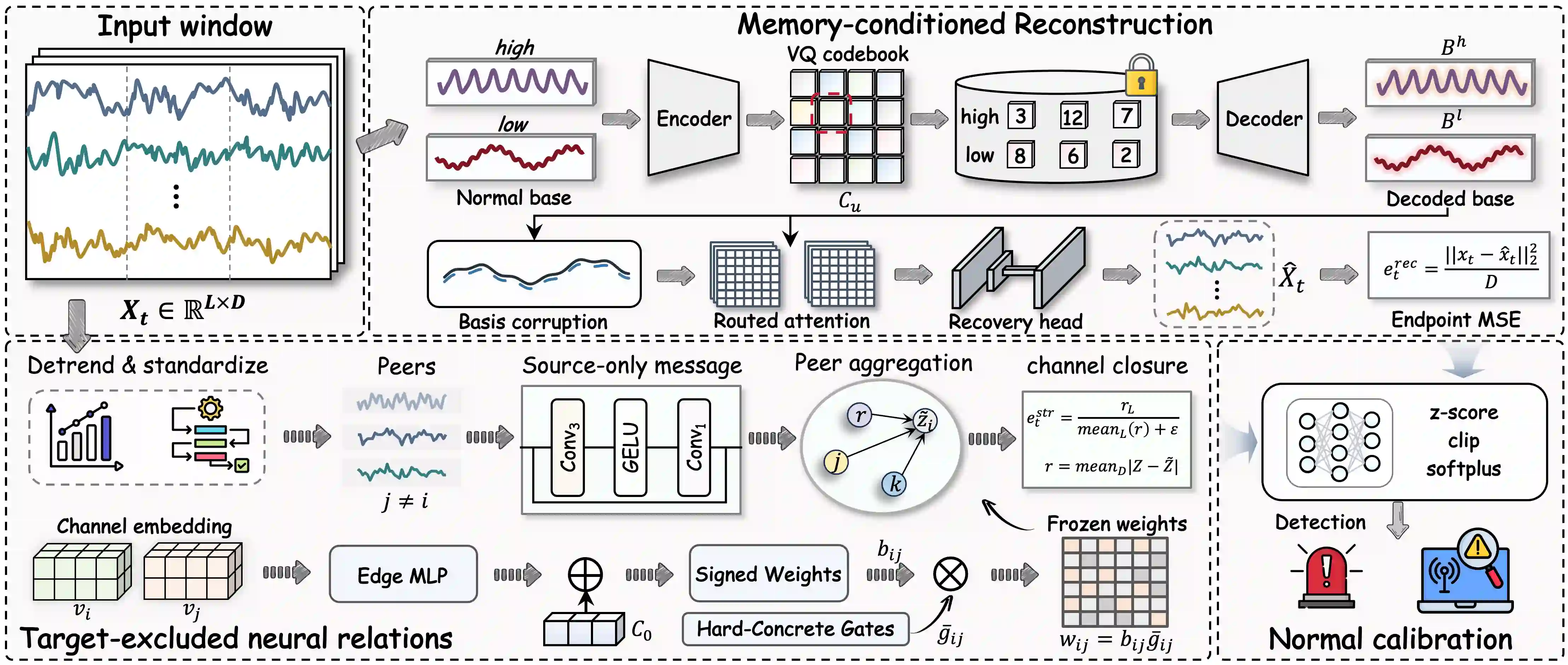
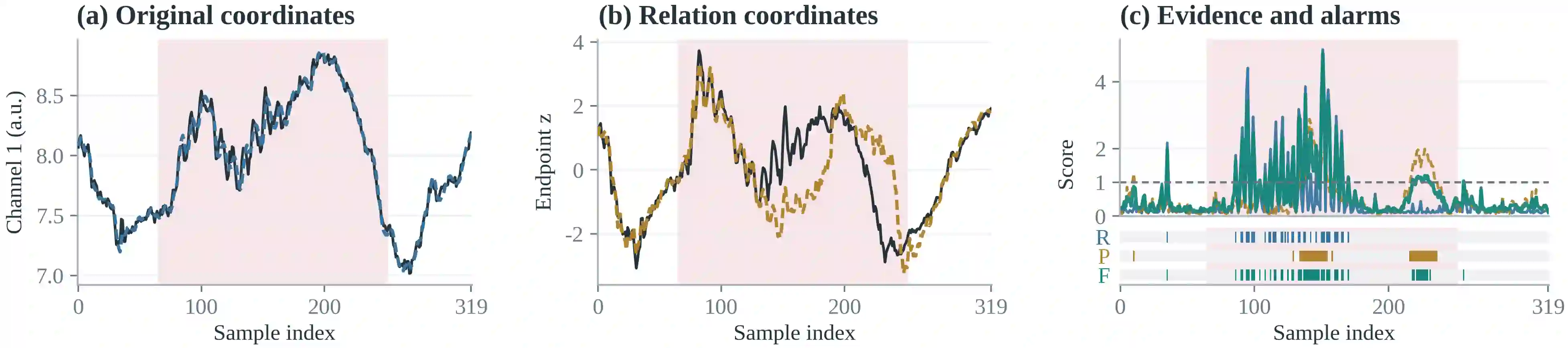
Multivariate time series produced by industrial installations and server clusters are under continuous monitoring, and anomaly detection is the first line of defense before a local fault escalates into a system-wide failure. In the absence of labels, the dominant paradigm trains a reconstruction model on normal data and scores the residual to reach a verdict. Recent work has steadily enriched the expressiveness of the recovery map through Transformers, diffusion models, and cross-scale associations. A residual, however, only certifies that an observation can be recovered; it does not certify that the variables still explain one another as they do under normal operation. A coordinated yet unfamiliar operating transition inflates the residual without breaking any relationship, whereas a sensor drifting away from its peers may leave the residual silent. Methods that fold inter-variable dependencies into the reconstruction objective inherit this ambiguity, because their relational evidence is ultimately supervised by the same recovery loss. We therefore propose CLOSURE, which evaluates recoverability and cross-channel consistency as two normal-data prediction tasks learned in separation. The recoverability task is solved by a diffusion reconstructor conditioned on a discrete memory of normal temporal bases. The consistency task is solved by a relation-closure operator that predicts every channel exclusively from the others, where the target's own trajectory is withheld and sparse signed gates decide which peers are actually used. The two scores are reconciled only through calibration on normal data. Extensive experiments show that CLOSURE consistently outperforms recent reconstruction-, frequency-, and topology-based detectors on public benchmark streams, confirming the value of examining consistency alongside recoverability.
翻译:暂无翻译


相关内容


 微信扫码咨询专知VIP会员