

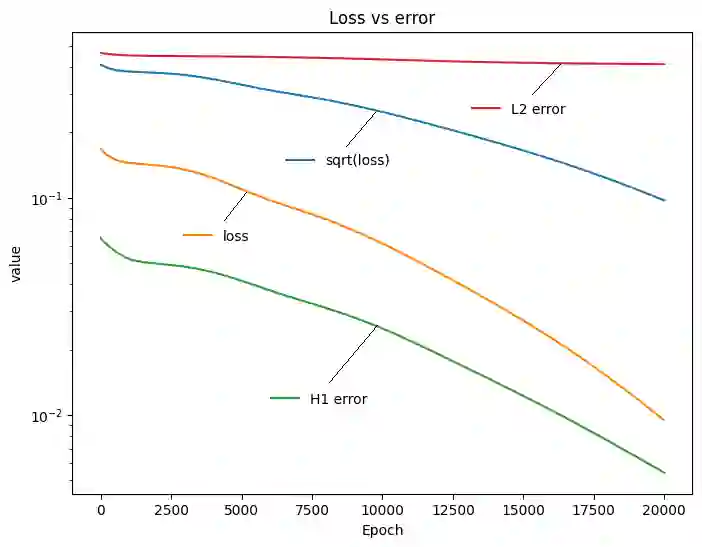
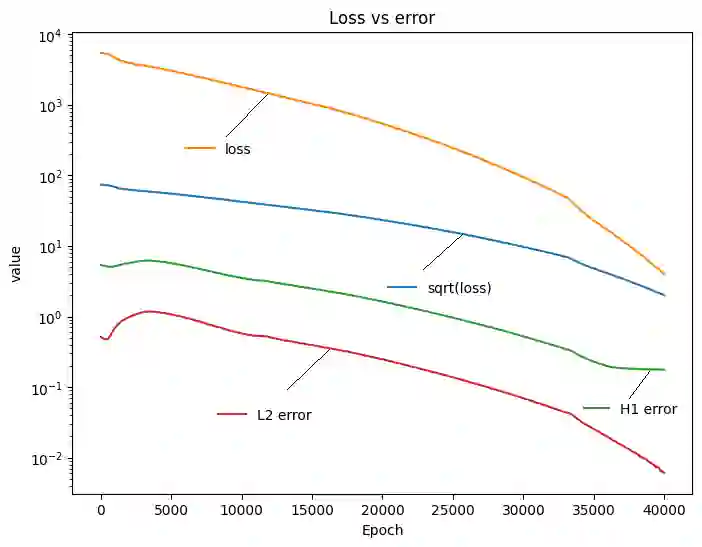
We introduce a Robust version of the Physics-Informed Neural Networks (RPINNs) to approximate the Partial Differential Equations (PDEs) solution. Standard Physics Informed Neural Networks (PINN) takes into account the governing physical laws described by PDE during the learning process. The network is trained on a data set that consists of randomly selected points in the physical domain and its boundary. PINNs have been successfully applied to solve various problems described by PDEs with boundary conditions. The loss function in traditional PINNs is based on the strong residuals of the PDEs. This loss function in PINNs is generally not robust with respect to the true error. The loss function in PINNs can be far from the true error, which makes the training process more difficult. In particular, we do not know if the training process has already converged to the solution with the required accuracy. This is especially true if we do not know the exact solution, so we cannot estimate the true error during the training. This paper introduces a different way of defining the loss function. It incorporates the residual and the inverse of the Gram matrix, computed using the energy norm. We test our RPINN algorithm on two Laplace problems and one advection-diffusion problem in two spatial dimensions. We conclude that RPINN is a robust method. The proposed loss coincides well with the true error of the solution, as measured in the energy norm. Thus, we know if our training process goes well, and we know when to stop the training to obtain the neural network approximation of the solution of the PDE with the true error of required accuracy.
翻译:我们提出了一种鲁棒版本的物理信息神经网络(RPINNs),用于近似偏微分方程(PDEs)的解。标准物理信息神经网络(PINN)在学习过程中考虑了PDE所描述的物理定律。该网络在由物理域内及其边界上随机选取点组成的数据集上进行训练。PINN已成功应用于求解各种具有边界条件的PDE问题。传统PINN的损失函数基于PDE的强残差。这种PINN中的损失函数通常对真实误差缺乏鲁棒性。PINN中的损失函数可能与真实误差相差甚远,这使得训练过程更加困难。特别地,我们无法判断训练过程是否已经收敛到满足所需精度的解。这在不知道精确解的情况下尤其突出,因为我们在训练过程中无法估计真实误差。本文介绍了一种定义损失函数的不同方法。它结合了残差和使用能量范数计算的Gram矩阵的逆矩阵。我们在两个二维空间中的拉普拉斯问题和一个对流扩散问题上测试了我们的RPINN算法。我们得出结论,RPINN是一种鲁棒方法。所提出的损失与解的真实误差在能量范数度量下高度吻合。因此,我们能够判断训练过程是否顺利,并知道何时停止训练,以获得满足所需真实误差精度的PDE解的神经网络近似。




相关内容





 微信扫码咨询专知VIP会员