

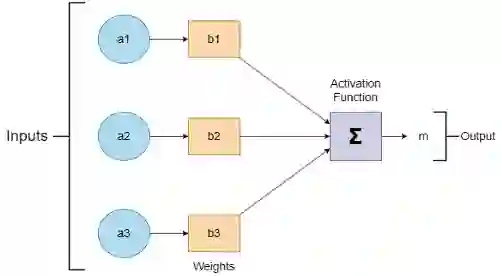
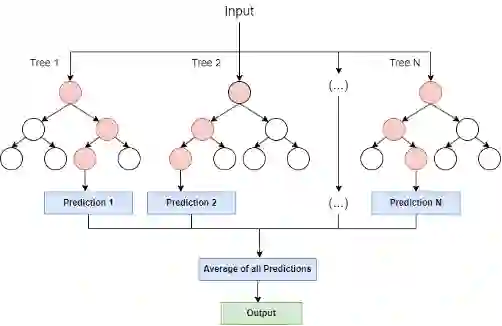
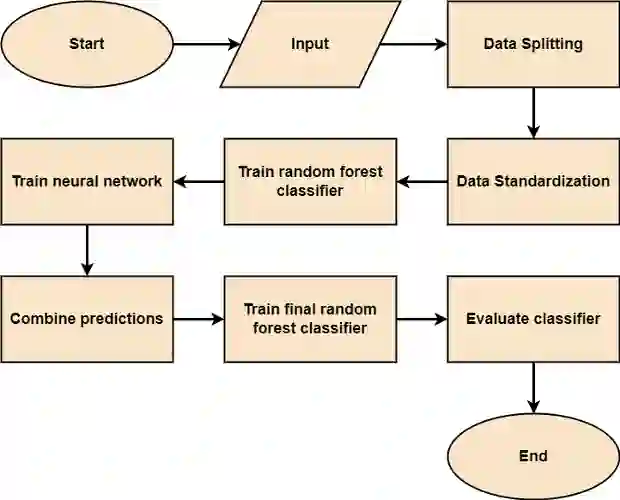
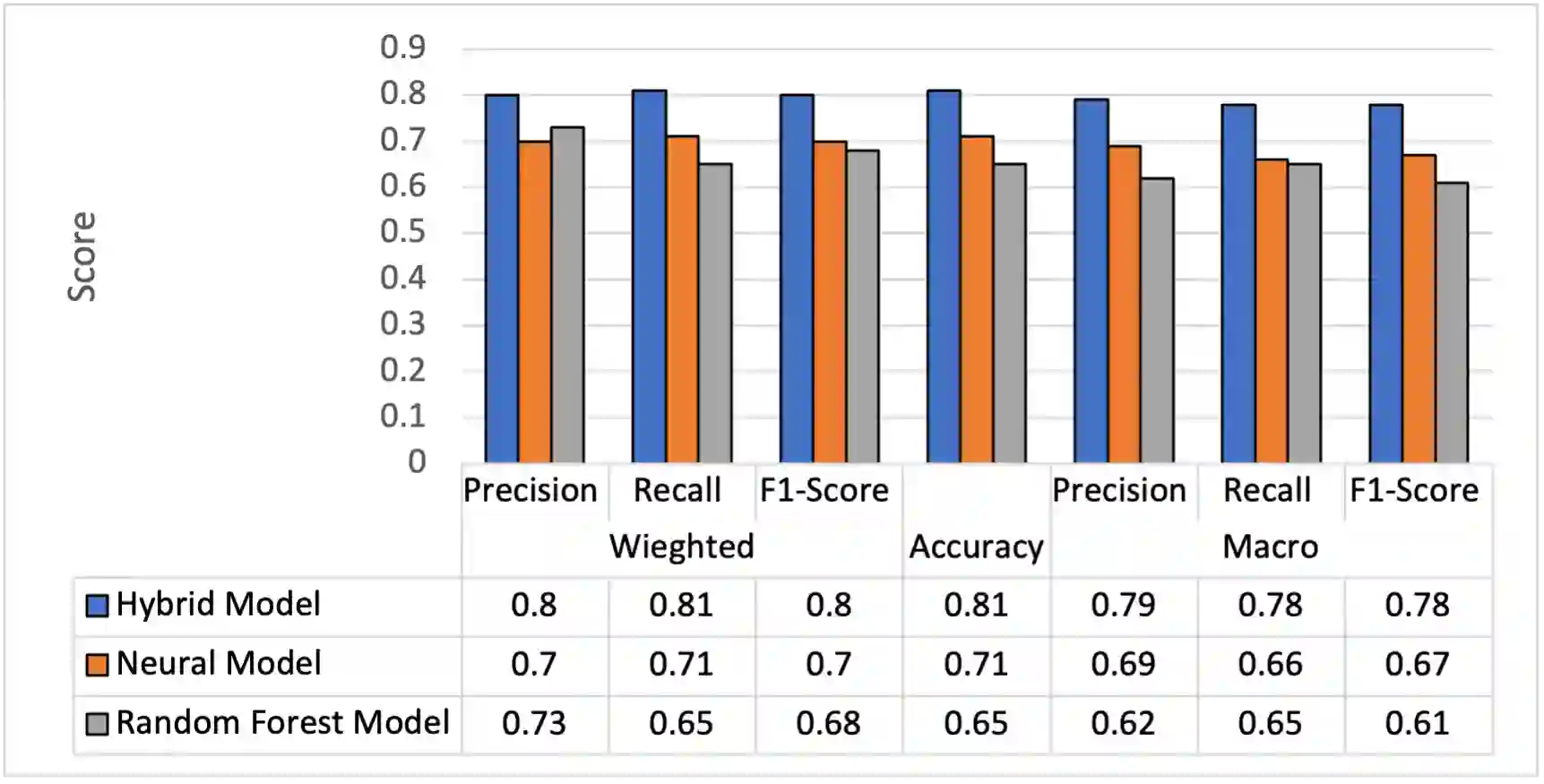
Regarding the rising number of people suffering from mental health illnesses in today's society, the importance of mental health cannot be overstated. Wearable sensors, which are increasingly widely available, provide a potential way to track and comprehend mental health issues. These gadgets not only monitor everyday activities but also continuously record vital signs like heart rate, perhaps providing information on a person's mental state. Recent research has used these sensors in conjunction with machine learning methods to identify patterns relating to different mental health conditions, highlighting the immense potential of this data beyond simple activity monitoring. In this research, we present a novel algorithm called the Hybrid Random forest - Neural network that has been tailored to evaluate sensor data from depressed patients. Our method has a noteworthy accuracy of 80\% when evaluated on a special dataset that included both unipolar and bipolar depressive patients as well as healthy controls. The findings highlight the algorithm's potential for reliably determining a person's depression condition using sensor data, making a substantial contribution to the area of mental health diagnostics.
翻译:针对当今社会精神疾病患者人数日益增多的现状,心理健康的重要性已不容忽视。可穿戴传感器因其日益普及的特性,为追踪和理解心理健康问题提供了潜在途径。这些设备不仅可监测日常活动,还能持续记录心率等生理指标,或可揭示个体的精神状态信息。近期研究已将这些传感器与机器学习方法相结合,用于识别与不同心理健康状况相关的模式,充分彰显了此类数据超越简单活动监测的巨大潜力。本研究提出一种新型算法——混合随机森林-神经网络模型,该算法专为评估抑郁症患者的传感器数据而设计。在包含单相抑郁、双相抑郁患者及健康对照组的特殊数据集上进行的评估显示,该方法的准确率达到80%。研究结果凸显了该算法基于传感器数据可靠判别个体抑郁状态的潜力,为心理健康诊断领域作出了重要贡献。




相关内容




 微信扫码咨询专知VIP会员