

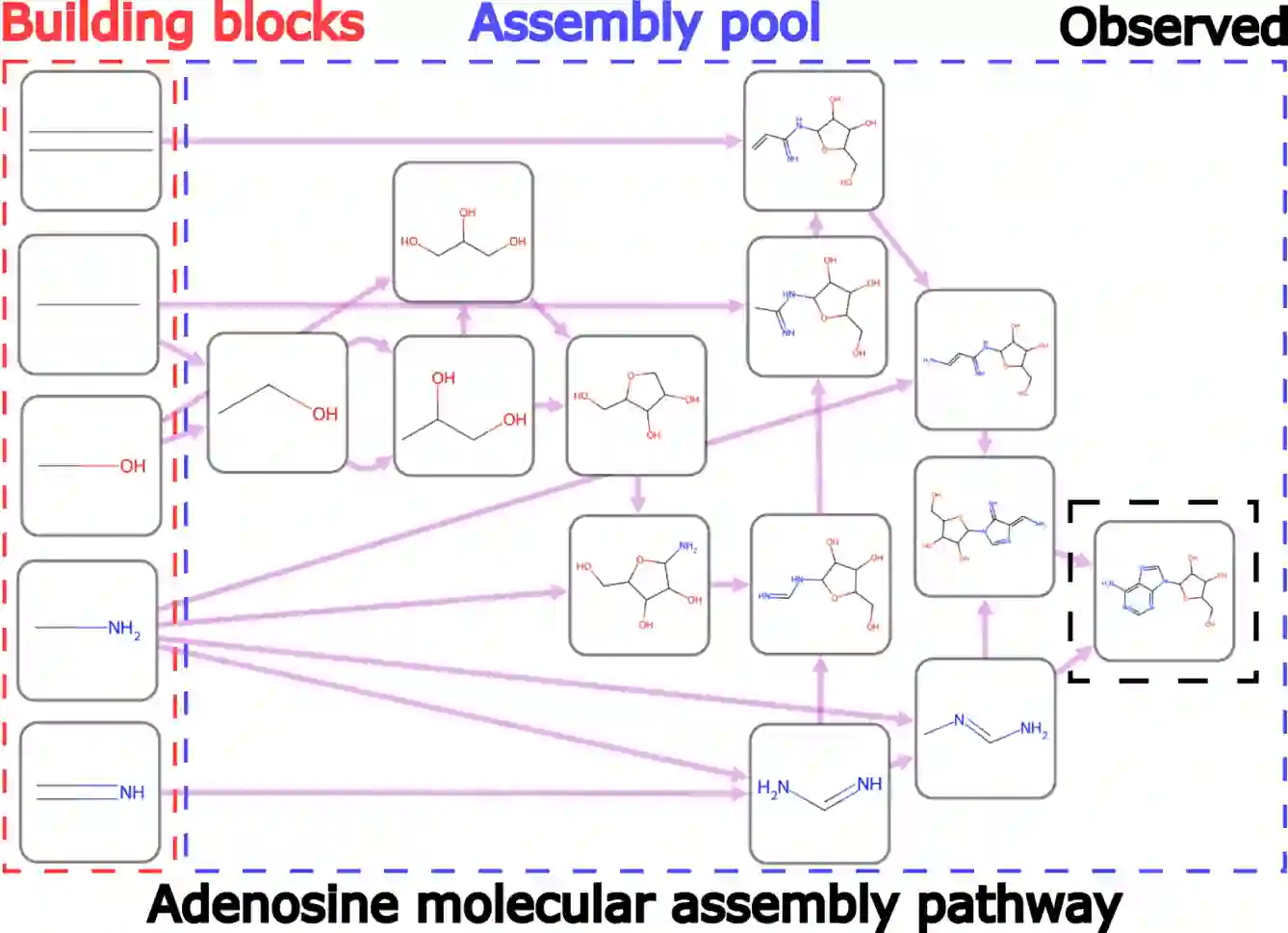
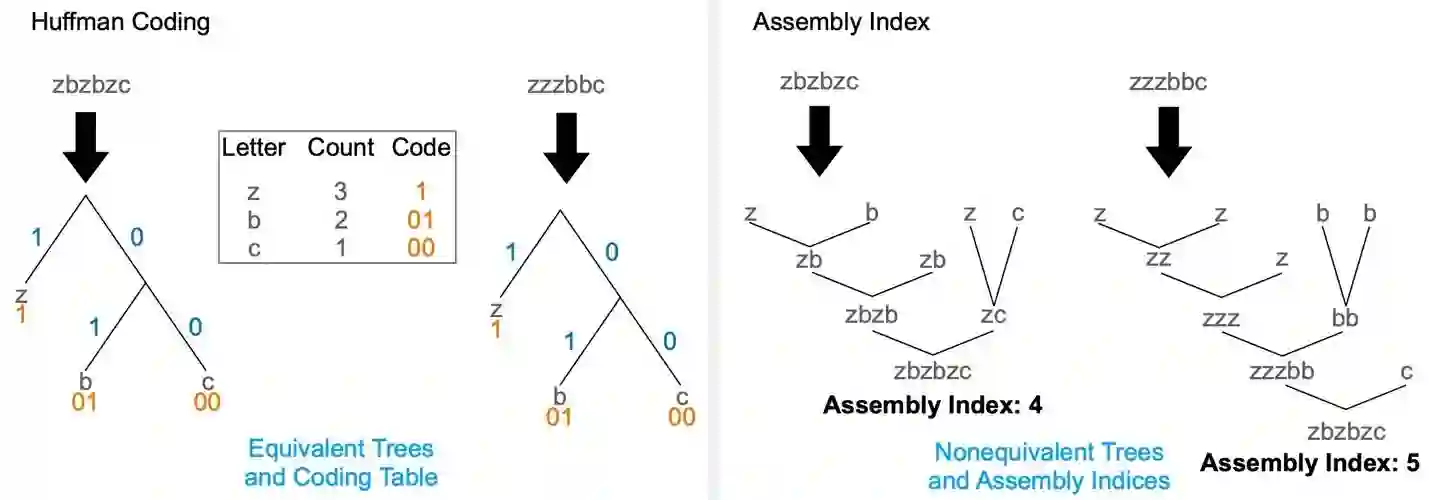
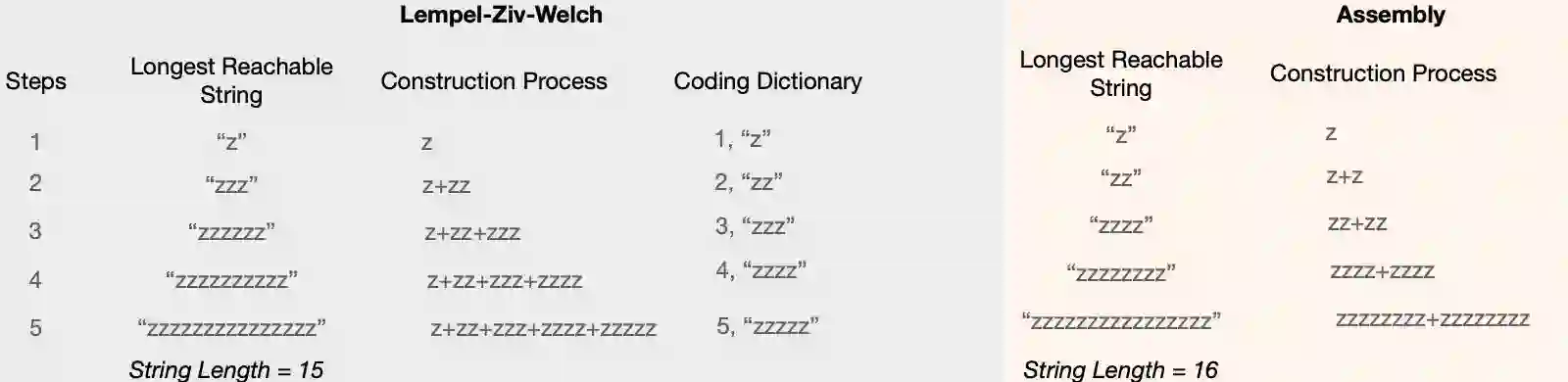
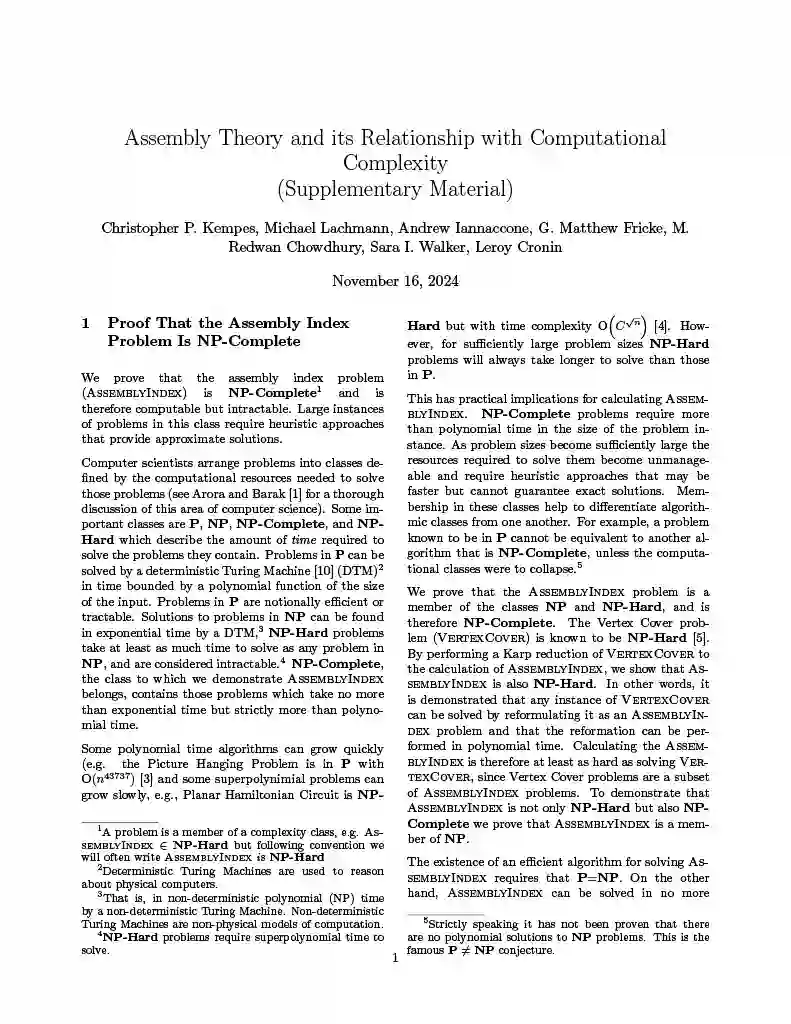
Assembly theory (AT) quantifies selection using the assembly equation and identifies complex objects that occur in abundance based on two measurements, assembly index and copy number, where the assembly index is the minimum number of joining operations necessary to construct an object from basic parts, and the copy number is how many instances of the given object(s) are observed. Together these define a quantity, called Assembly, which captures the amount of causation required to produce objects in abundance in an observed sample. This contrasts with the random generation of objects. Herein we describe how AT's focus on selection as the mechanism for generating complexity offers a distinct approach, and answers different questions, than computational complexity theory with its focus on minimum descriptions via compressibility. To explore formal differences between the two approaches, we show several simple and explicit mathematical examples demonstrating that the assembly index, itself only one piece of the theoretical framework of AT, is formally not equivalent to other commonly used complexity measures from computer science and information theory including Shannon entropy, Huffman encoding, and Lempel-Ziv-Welch compression. We also include proofs that assembly index is not in the same computational complexity class as these compression algorithms and discuss fundamental differences in the ontological basis of AT, and assembly index as a physical observable, which distinguish it from theoretical approaches to formalizing life that are unmoored from measurement.
翻译:装配理论(AT)通过装配方程对选择进行量化,并基于两个测量指标——装配指数与拷贝数——识别大量存在的复杂对象。其中,装配指数指从基础部件构建对象所需的最小连接操作数,拷贝数则指观测到给定对象的实例数量。二者共同定义了一个称为“装配量”的物理量,该量刻画了在观测样本中大量产生对象所需的因果作用强度。这与对象的随机生成形成鲜明对比。本文阐述了AT如何将选择作为复杂性的生成机制,提供了一种不同于计算复杂度理论的独特研究路径,并回答了后者无法涵盖的问题;计算复杂度理论主要关注通过可压缩性实现的最小描述。为探究两种方法的形式差异,我们通过数个简洁而明确的数学实例证明:装配指数(其本身仅是AT理论框架的一个组成部分)在形式上并不等价于计算机科学与信息论中常用的其他复杂度度量,包括香农熵、霍夫曼编码与Lempel-Ziv-Welch压缩算法。我们进一步给出严格证明,表明装配指数与上述压缩算法不属于同一计算复杂度类,并讨论了AT在本体论基础上的根本差异——装配指数作为物理可观测量,使其区别于那些脱离实际测量的生命形式化理论进路。





相关内容




 微信扫码咨询专知VIP会员