

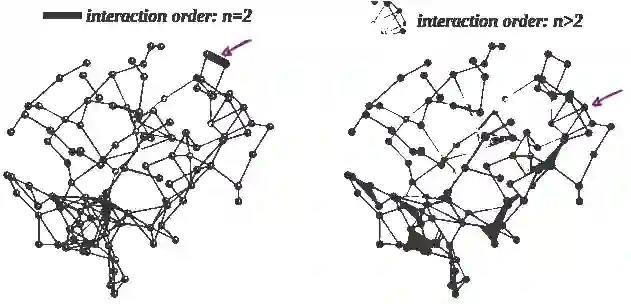
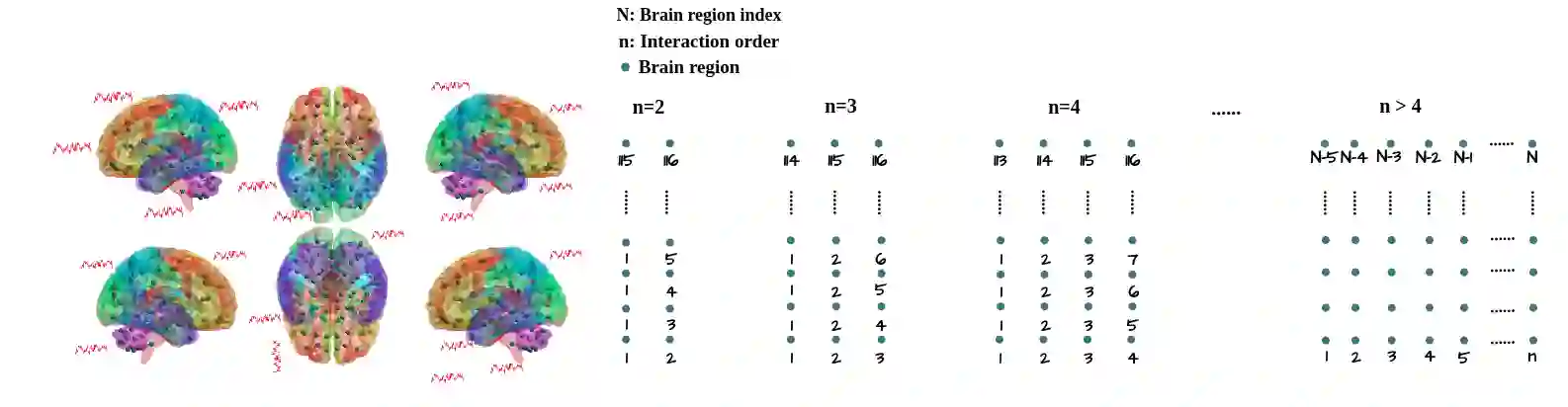
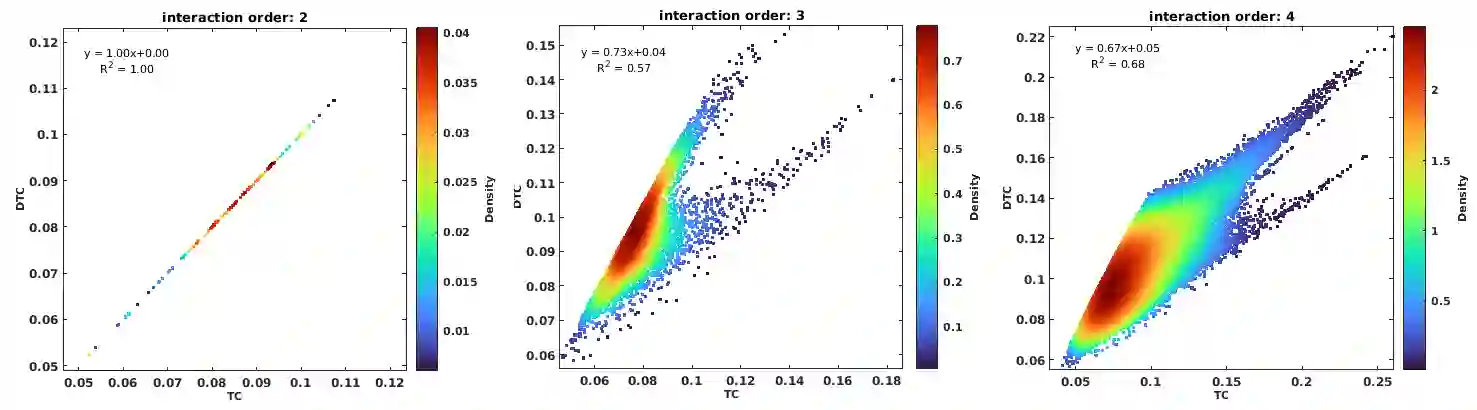
Pairwise metrics are often employed to estimate statistical dependencies between brain regions, however they do not capture higher-order information interactions. It is critical to explore higher-order interactions that go beyond paired brain areas in order to better understand information processing in the human brain. To address this problem, we applied multivariate mutual information, specifically, Total Correlation and Dual Total Correlation to reveal higher-order information in the brain. In this paper, we estimate these metrics using matrix-based R\'enyi's entropy, which offers a direct and easily interpretable approach that is not limited by direct assumptions about probability distribution functions of multivariate time series. We applied these metrics to resting-state fMRI data in order to examine higher-order interactions in the brain. Our results showed that the higher-order information interactions captured increase gradually as the interaction order increases. Furthermore, we observed a gradual increase in the correlation between the Total Correlation and Dual Total Correlation as the interaction order increased. In addition, the significance of Dual Total Correlation values compared to Total Correlation values also indicate that the human brain exhibits synergy dominance during the resting state.
翻译:成对度量指标常被用于估计大脑区域间的统计依赖性,但无法捕捉高阶信息交互。为更好地理解人脑中的信息处理过程,探索超越配对脑区的高阶交互至关重要。针对该问题,我们应用多元互信息——具体而言,采用总相关和双总相关来揭示大脑中的高阶信息。本文通过基于矩阵的Rényi熵估计这些度量指标,该方法提供了直接且易于解释的途径,不受多变量时间序列概率分布函数直接假设的限制。我们将这些指标应用于静息态fMRI数据,以检验大脑中的高阶交互。结果表明:捕获的高阶信息交互随交互阶数增加而逐渐增强。此外,观察到总相关与双总相关之间的相关性随交互阶数增加而逐渐增强。同时,相较于总相关值,双总相关值的显著性也表明人类大脑在静息状态下呈现协同优势。




相关内容



 微信扫码咨询专知VIP会员