

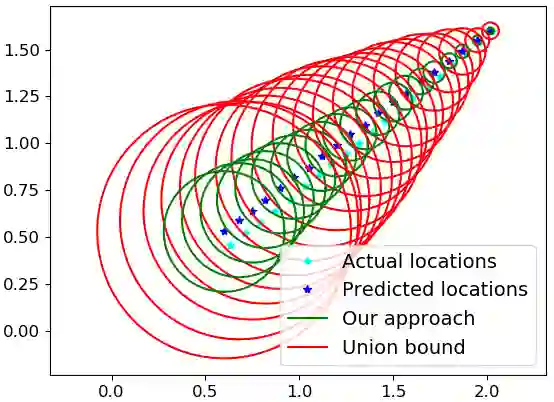
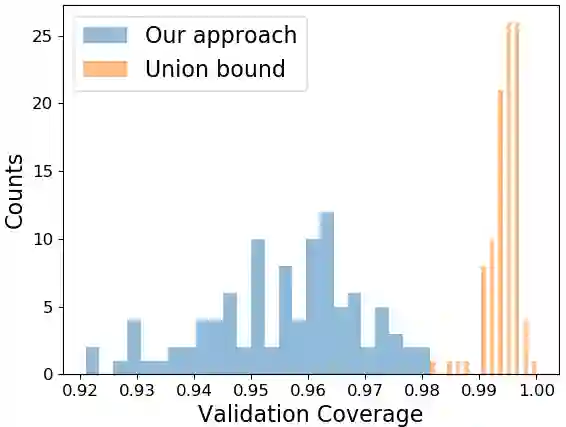
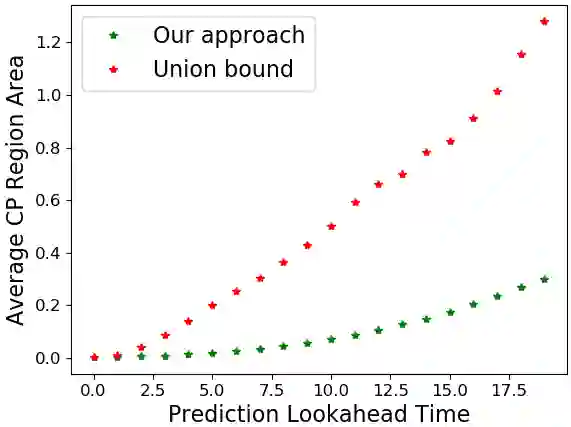
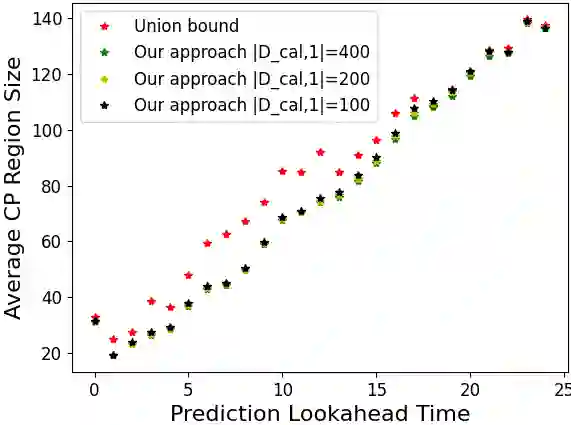
Conformal prediction is a statistical tool for producing prediction regions of machine learning models that are valid with high probability. However, applying conformal prediction to time series data leads to conservative prediction regions. In fact, to obtain prediction regions over $T$ time steps with confidence $1-\delta$, {previous works require that each individual prediction region is valid} with confidence $1-\delta/T$. We propose an optimization-based method for reducing this conservatism to enable long horizon planning and verification when using learning-enabled time series predictors. Instead of considering prediction errors individually at each time step, we consider a parameterized prediction error over multiple time steps. By optimizing the parameters over an additional dataset, we find prediction regions that are not conservative. We show that this problem can be cast as a mixed integer linear complementarity program (MILCP), which we then relax into a linear complementarity program (LCP). Additionally, we prove that the relaxed LP has the same optimal cost as the original MILCP. Finally, we demonstrate the efficacy of our method on case studies using pedestrian trajectory predictors and F16 fighter jet altitude predictors.
翻译:共形预测是一种统计工具,可为机器学习模型生成具有高置信度的预测区域。然而,将其应用于时间序列数据会导致预测区域过于保守。实际上,为获得在$T$个时间步长上置信度为$1-\delta$的预测区域,先前的工作要求每个独立预测区域在置信度$1-\delta/T$下有效。本文提出一种基于优化的方法以降低这种保守性,从而在使用学习型时间序列预测器时实现长时域规划与验证。不同于在每个时间步长单独考虑预测误差,我们引入跨多个时间步长的参数化预测误差。通过额外数据集优化参数,可得到非保守的预测区域。我们证明该问题可转化为混合整数线性互补规划(MILCP),进而松弛为线性互补规划(LCP)。此外,本文证明松弛后的线性规划与原始MILCP具有相同的最优解。最后,通过行人轨迹预测器与F16战斗机高度预测器的案例研究,验证了该方法的有效性。




相关内容



 微信扫码咨询专知VIP会员