

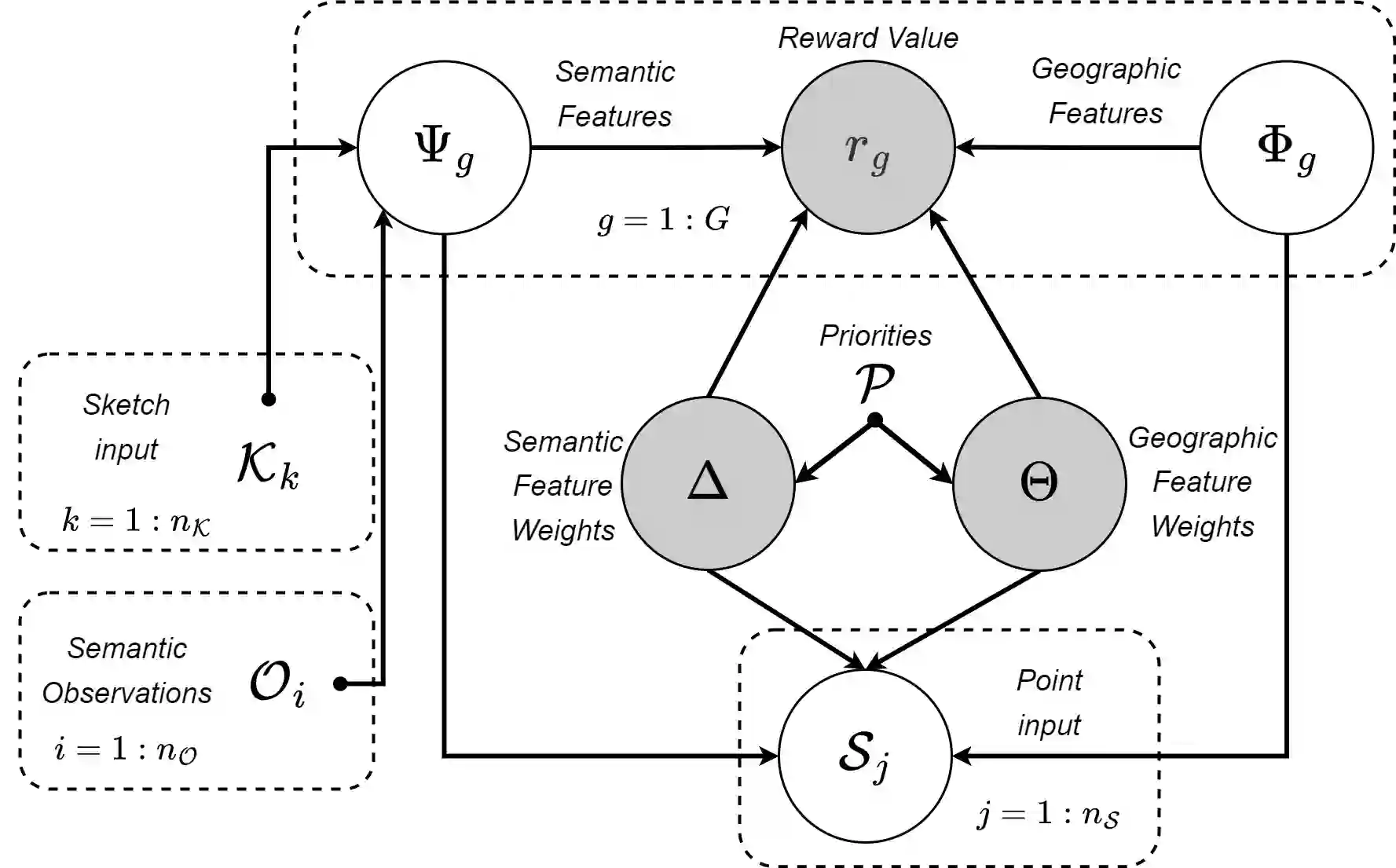
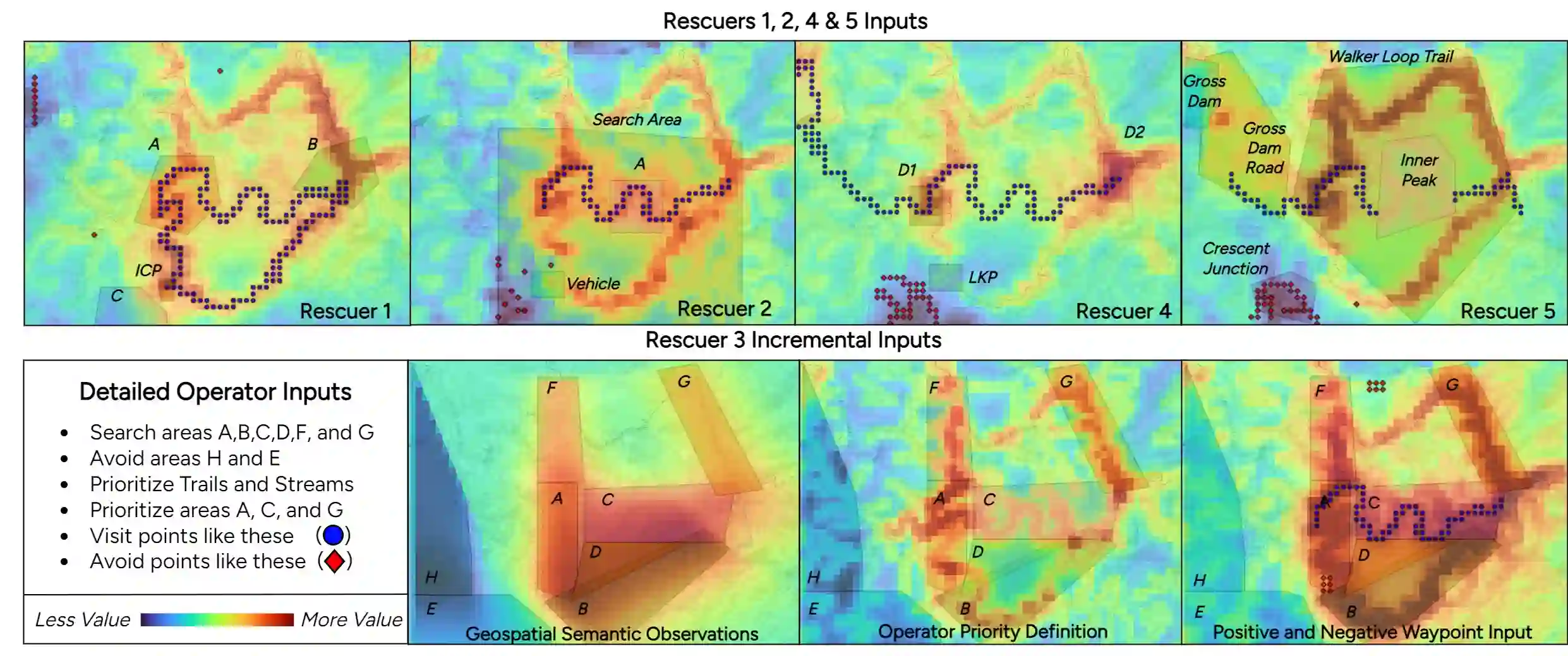
Deploying robots that operate in dynamic, uncertain environments, such as Uncrewed Aerial Systems in search \& rescue missions, require nearly continuous human supervision for vehicle guidance and operation. Without approaches that consider high level mission context, operational methods of autonomous flying necessitate cumbersome manual operation or inefficient exhaustive search patterns. To facilitate more effective use of autonomy, we present a human-centered autonomous system that infers geospatial mission context through dynamic features sets, which then guides a probabilistic target search planner. Operators provide a limited set of diverse inputs, including priority definition, spatial semantic observations over ad-hoc geographical areas, and reference waypoints, which are probabilistically fused with geographical database information and condensed into a discretized value map representing an operator's preferences over an operational area. An online, POMDP-based planner, optimized for target searching, is augmented with this value map to generate an operator-constrained vehicle waypoint guidance plan. We validate the system by gathering input from five first responders trained in search \& rescue and compare simulated system performance against current operational methods for autonomous missions. These results display effective task mental model alignment and more efficient guidance plans, resulting in faster rescue times.
翻译:在动态、不确定环境中运行的机器人(如搜索与救援任务中的无人航空系统)需要近乎连续的人工监督以进行飞行引导和操作。若未考虑高层任务背景,自主飞行的操作方法将导致繁琐的人工操作或低效的穷举搜索模式。为促进自主性的更有效应用,我们提出一种以人为中心的自主系统,该系统通过动态特征集推断地理空间任务背景,进而指导概率目标搜索规划器。操作员提供有限但多样化的输入,包括优先级定义、针对特定地理区域的语义空间观测以及参考航路点,这些输入与地理数据库信息进行概率融合,并浓缩为表示操作员对操作区域偏好的离散化价值图。一个基于部分可观测马尔可夫决策过程(POMDP)的在线规划器(针对目标搜索进行优化)通过该价值图增强,生成受操作员约束的飞行器航路点引导方案。我们通过来自五位受过搜索与救援培训的一线救援人员的输入验证该系统,并将模拟系统性能与当前自主任务操作方法进行比较。结果表明,该方法实现了更好的任务心智模型对齐和更高效的引导方案,从而缩短了救援时间。






相关内容





 微信扫码咨询专知VIP会员