

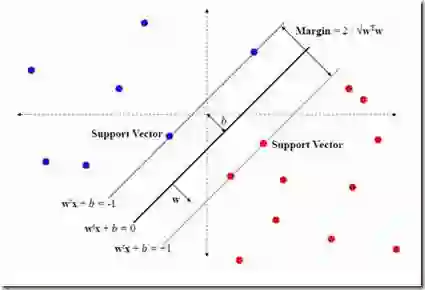
This work presents an approach for automating the discretization and approximation procedures in constructing digital representations of composites from Micro-CT images featuring intricate microstructures. The proposed method is guided by the Support Vector Machine (SVM) classification, offering an effective approach for discretizing microstructural images. An SVM soft margin training process is introduced as a classification of heterogeneous material points, and image segmentation is accomplished by identifying support vectors through a local regularized optimization problem. In addition, an Interface-Modified Reproducing Kernel Particle Method (IM-RKPM) is proposed for appropriate approximations of weak discontinuities across material interfaces. The proposed method modifies the smooth kernel functions with a regularized heavy-side function concerning the material interfaces to alleviate Gibb's oscillations. This IM-RKPM is formulated without introducing duplicated degrees of freedom associated with the interface nodes commonly needed in the conventional treatments of weak discontinuities in the meshfree methods. Moreover, IM-RKPM can be implemented with various domain integration techniques, such as Stabilized Conforming Nodal Integration (SCNI). The extension of the proposed method to 3-dimension is straightforward, and the effectiveness of the proposed method is validated through the image-based modeling of polymer-ceramic composite microstructures.
翻译:本文提出了一种自动化离散化和逼近过程的方法,用于从具有复杂微结构的微CT图像中构建复合材料的数字表征。该方法以支持向量机(SVM)分类为指导,提供了一种有效的微结构图像离散化方法。引入SVM软间隔训练过程作为异质材料点的分类手段,并通过局部正则化优化问题识别支持向量实现图像分割。此外,提出了一种界面修正的重现核粒子法(IM-RKPM),以恰当逼近材料界面上的弱不连续性。该方法通过引入与材料界面相关的正则化重阶函数来修正光滑核函数,从而抑制吉布斯振荡。IM-RKPM的公式化无需引入传统无网格方法中处理弱不连续性时所需的界面节点复制自由度。此外,IM-RKPM可与多种域积分技术(如稳定一致节点积分SCNI)结合实现。该方法向三维的扩展是直接的,并通过聚合物-陶瓷复合材料微结构的基于图像的建模验证了其有效性。




相关内容


 微信扫码咨询专知VIP会员