

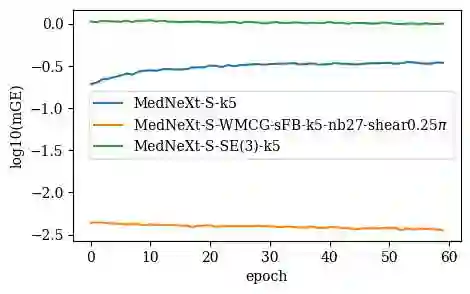
Filter-decomposition-based group equivariant convolutional neural networks show promising stability and data efficiency for 3D image feature extraction. However, the existing filter-decomposition-based 3D group equivariant neural networks rely on parameter-sharing designs and are mostly limited to rotation transform groups, where the chosen spherical harmonic filter bases consider only angular orthogonality. These limitations hamper its application to deep neural network architectures for medical image segmentation. To address these issues, this paper describes a non-parameter-sharing affine group equivariant neural network for 3D medical image segmentation based on an adaptive aggregation of Monte Carlo augmented spherical Fourier Bessel filter bases. The efficiency and flexibility of the adopted non-parameter strategy enable for the first time an efficient implementation of 3D affine group equivariant convolutional neural networks for volumetric data. The introduced spherical Bessel Fourier filter basis combines both angular and radial orthogonality for better feature extraction. The 3D image segmentation experiments on two abdominal image sets, BTCV and the NIH Pancreas datasets, show that the proposed methods excel the state-of-the-art 3D neural networks with high training stability and data efficiency. The code will be available at https://github.com/ZhaoWenzhao/WVMS.
翻译:基于滤波器分解的群等变卷积神经网络在三维图像特征提取中展现出良好的稳定性与数据效率。然而,现有基于滤波器分解的三维群等变神经网络依赖参数共享设计,且多局限于旋转变换群,其采用的球谐滤波器基仅考虑角度正交性。这些局限阻碍了其在医学图像分割的深层神经网络架构中的应用。为突破上述瓶颈,本文提出一种基于蒙特卡洛增强球面傅里叶-贝塞尔滤波器基自适应聚合的非参数共享仿射群等变神经网络,用于三维医学图像分割。所采用的非参数策略兼具高效性与灵活性,首次实现了面向体数据的3D仿射群等变卷积神经网络的高效构建。引入的球面贝塞尔傅里叶滤波器基融合了角度与径向正交性,可提升特征提取能力。在BTCV和NIH胰腺数据集两个腹部图像集上的三维图像分割实验表明,所提方法以显著优势超越现有最优三维神经网络,兼具高训练稳定性与数据效率。相关代码已开源至https://github.com/ZhaoWenzhao/WVMS。




相关内容





 微信扫码咨询专知VIP会员