

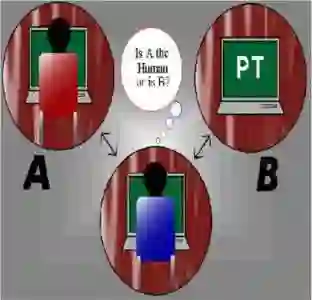
The rapid advancements in generative AI technologies, such as Stable Diffusion, DALL-E, and Midjourney, have significantly transformed the creation of synthetic visual content. While these models enable innovation across industries, they also pose serious challenges, including misinformation, disinformation, and biased content generation. The increasing realism of AI-generated images makes their detection a pressing concern for researchers, policymakers, and industry stakeholders. In this paper, we present the findings of the Defactify 4.0 workshop, which introduced the Counter Turing Test (CT2) for AI-Generated Image Detection. The competition consisted of two key tasks: (1) binary classification of images as either AI-generated or real and (2) identification of the specific generative model responsible for an AI-generated image. To facilitate this, we developed the MS COCOAI dataset, consisting of 50,000 synthetic images from multiple generative models alongside real-world images from the MS COCO dataset. Participants employed diverse detection strategies, including convolutional neural networks (CNNs), Vision Transformers (ViTs), frequency-based analysis, contrastive learning, and multimodal techniques. The results demonstrated that while AI-generated images can be detected with high accuracy (F1-score > 0.83), identifying the exact model used remains significantly more challenging (highest F1-score: 0.4986). These findings highlight the need for improved model fingerprinting, adversarial robustness, and real-time detection mechanisms.
翻译:生成式AI技术(如Stable Diffusion、DALL-E和Midjourney)的快速发展,显著改变了合成视觉内容的创作方式。尽管这些模型推动了各行各业的创新,但也带来了严重挑战,包括虚假信息、误导性内容以及有偏见的生成内容。AI生成图像日益逼真的特性,使其检测成为研究人员、政策制定者和行业利益相关者亟待解决的问题。本文介绍了Defactify 4.0研讨会的发现,该研讨会提出了用于AI生成图像检测的反图灵测试(CT2)。竞赛包含两项关键任务:(1)对图像进行AI生成或真实的二分类;(2)识别生成AI图像的具体生成模型。为此,我们构建了MS COCOAI数据集,包含来自多个生成模型的50,000张合成图像以及MS COCO数据集中的真实图像。参赛者采用了多种检测策略,包括卷积神经网络(CNN)、视觉变换器(ViT)、基于频率的分析、对比学习以及多模态技术。结果表明,虽然AI生成图像能够以高准确率(F1分数>0.83)被检测出,但识别具体生成模型仍更具挑战性(最高F1分数为0.4986)。这些发现凸显了改进模型指纹识别、对抗鲁棒性以及实时检测机制的迫切需求。




相关内容



 微信扫码咨询专知VIP会员