

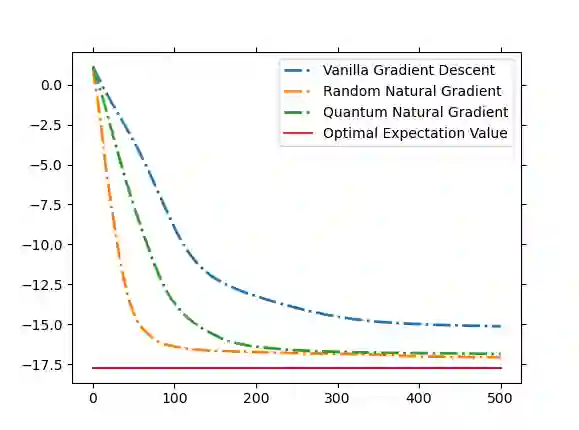
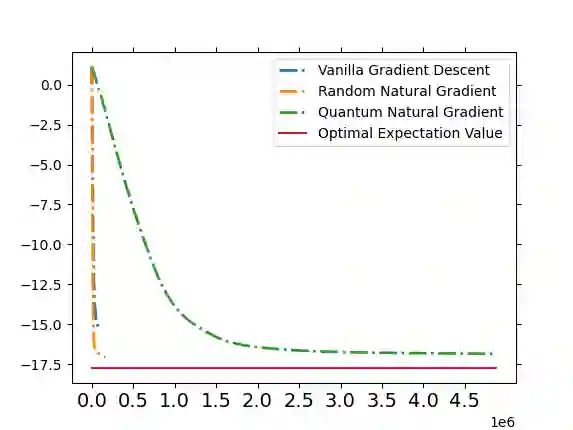
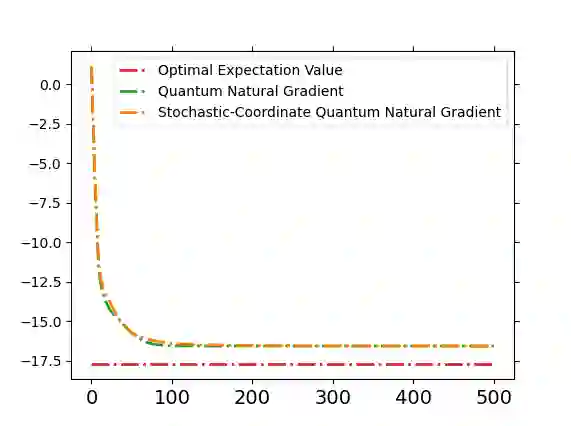
Hybrid quantum-classical algorithms appear to be the most promising approach for near-term quantum applications. An important bottleneck is the classical optimization loop, where the multiple local minima and the emergence of barren plateaux make these approaches less appealing. To improve the optimization the Quantum Natural Gradient (QNG) method [Quantum 4, 269 (2020)] was introduced - a method that uses information about the local geometry of the quantum state-space. While the QNG-based optimization is promising, in each step it requires more quantum resources, since to compute the QNG one requires $O(m^2)$ quantum state preparations, where $m$ is the number of parameters in the parameterized circuit. In this work we propose two methods that reduce the resources/state preparations required for QNG, while keeping the advantages and performance of the QNG-based optimization. Specifically, we first introduce the Random Natural Gradient (RNG) that uses random measurements and the classical Fisher information matrix (as opposed to the quantum Fisher information used in QNG). The essential quantum resources reduce to linear $O(m)$ and thus offer a quadratic "speed-up", while in our numerical simulations it matches QNG in terms of accuracy. We give some theoretical arguments for RNG and then benchmark the method with the QNG on both classical and quantum problems. Secondly, inspired by stochastic-coordinate methods, we propose a novel approximation to the QNG which we call Stochastic-Coordinate Quantum Natural Gradient that optimizes only a small (randomly sampled) fraction of the total parameters at each iteration. This method also performs equally well in our benchmarks, while it uses fewer resources than the QNG.
翻译:混合量子-经典算法被认为是近期量子应用最有前景的方法。其中关键瓶颈在于经典优化环路:多重局部极小值和贫瘠高原现象的出现降低了此类方法的吸引力。为改进优化效果,量子自然梯度(QNG)方法[Quantum 4, 269 (2020)]被提出——该方法利用量子态空间局部几何信息。尽管基于QNG的优化具有前景,但每一步都需要更多量子资源,因为计算QNG需要$O(m^2)$次量子态制备(其中$m$是参数化电路中的参数数量)。本文提出两种方法,在保持QNG优化优势与性能的同时,减少QNG所需的资源与态制备次数。具体而言:首先引入基于随机测量的随机自然梯度(RNG),其采用经典Fisher信息矩阵(区别于QNG使用的量子Fisher信息)。所需关键量子资源降至线性规模$O(m)$,实现二次"加速",且在数值模拟中其精度与QNG相当。我们为RNG给出部分理论依据,并在经典与量子问题上将其与QNG进行基准测试。其次,受随机坐标方法启发,我们提出QNG的新型近似方法——随机坐标量子自然梯度,每次迭代仅优化总参数中随机采样的小部分。该方法在基准测试中表现同样优异,且比QNG消耗更少资源。




相关内容




 微信扫码咨询专知VIP会员